
Apple advances iPhone 18 Pro with 2 nanometer chip and variable aperture camera system
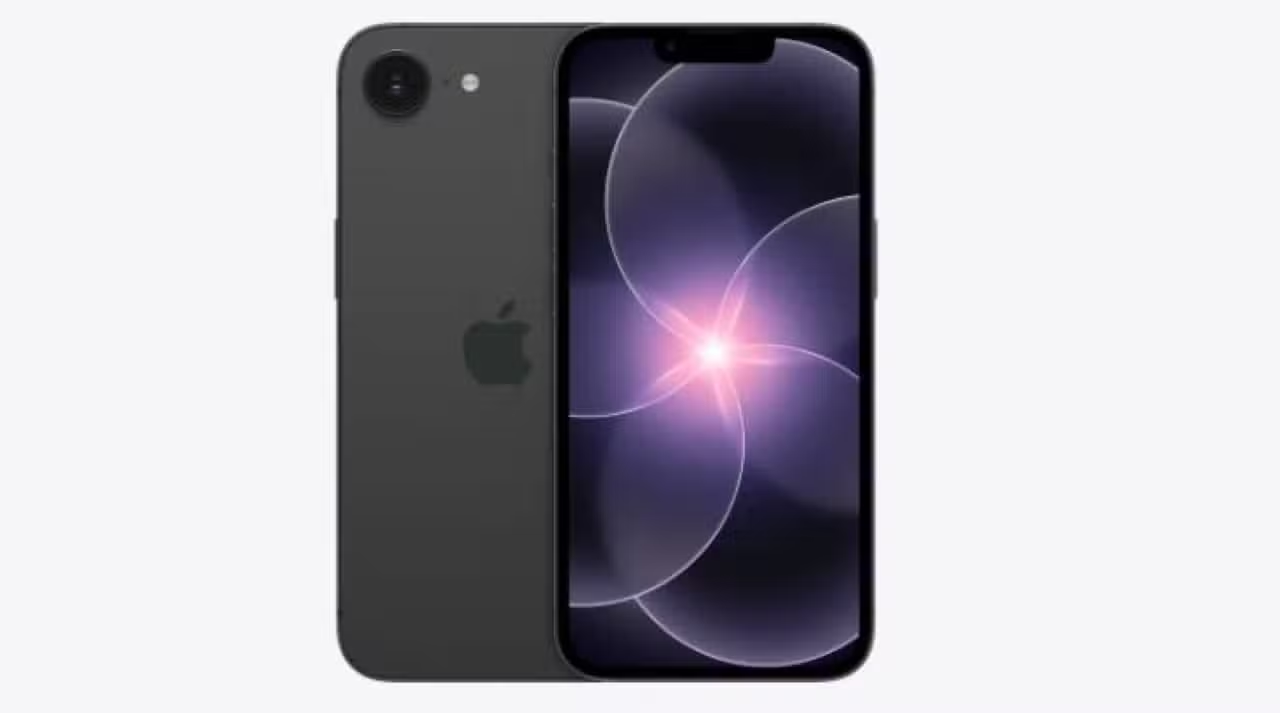
The Cupertino-based technology giant is preparing a significant overhaul for its flagship mobile device lineup, focusing on hardware advancements that promise to redefine the premium smartphone market. Informações recent behind-the-scenes insights into the Asian manufacturing industry reveal that the brand’s next generation of devices will bring profound innovations in image processing and capture.
The manufacturer’s internal schedule points to a global launch scheduled for September, following the company’s tradition for large announcements. The company’s engineers are concentrating their efforts on delivering a substantial technological leap, distancing the more expensive models from the conventional versions that will hit the market later.

Although the external visual identity must maintain the lines consolidated in recent generations, with straight edges and a metallic finish, the interior of the equipment will undergo one of the biggest evolutions of the last decade. The structural changes aim to accommodate new components that require greater energy efficiency and improved thermal dissipation.
Unprecedented architecture boosts performance and artificial intelligence
The main technical difference of the new devices lies in the implementation of the A20 Pro processor, a component developed with the unprecedented two-nanometer lithography. Manufacturing will be carried out by TSMC, a long-time partner of the brand, which has managed to stabilize mass production of this new transistor miniaturization technology.
The reduction in manufacturing scale allows a significantly greater number of transistors to be allocated in the same physical space on the chip. Testes laboratory preliminaries indicate that this architecture results in approximately fifteen percent faster processing, combined with thirty percent higher energy efficiency in direct comparison with the previous generation.
This gain in speed and battery savings has a specific purpose in the manufacturer’s planning. The new processor was designed to execute complex generative artificial intelligence functions directly on the user’s hardware, eliminating the need to constantly send data to cloud servers and ensuring greater privacy in daily operations.
Optical system incorporates professional equipment mechanics
The image capture department will receive a structural update long awaited by mobile photography professionals and enthusiasts. The forty-eight megapixel main sensor will be equipped with a variable aperture lens system, a mechanical feature widely used in traditional DSLR cameras but rare in smartphones due to physical space limitations.
This mechanism allows the user, or the camera management software itself, to physically adjust the size of the hole through which light enters the sensor. The mechanical change in aperture directly controls the depth of field, enabling the creation of a real and natural optical background blur, in addition to drastically optimizing light capture in excessively bright or very dark environments.
Telephoto advances and set durability tests
In addition to the redesign of the main sensor, the telephoto lens will undergo an internal redesign to maximize the sharpness of the optical zoom. The company’s optical engineering seeks to reduce distortions at the edges of images captured at long distances, using new arrangements of internal prisms.
Reports from supply chain analysts indicate that the manufacturer is in the final phase of mechanical stress tests. The objective is to ensure that the moving parts of the variable opening system withstand the wear and tear of daily use, including vibrations, accidental drops and sudden temperature variations.
The implementation of this mechanical technology places the new models in a position of considerable technical advantage compared to direct competitors in the high-end segment. Atualmente, most rival manufacturers still rely heavily on digital processing algorithms to simulate depth effects and compensate for lack of light.



The transition from purely digital processing to physical optical solutions represents a paradigm shift in the brand’s computational photography. The company’s software developers are already working on adapting the camera app to integrate precise manual controls that take advantage of the new mechanics.
Independence in connectivity and satellite network expansion
The production verticalization strategy gains a new chapter with the introduction of the C2 modem, a communication component developed entirely in the manufacturer’s own laboratories. The adoption of this proprietary part marks the end of the historical dependence on chips supplied by Qualcomm for connection to fifth generation networks. The new hardware promises to deliver superior signal stability in areas of high network congestion, in addition to drastically reducing power consumption during heavy mobile data traffic, such as high-resolution video streams or massive file downloads.
The modem’s in-house development also facilitates deeper integration with the company’s satellite communications system. The functionality, which until then was restricted to sending short messages in emergency situations, should receive a significant expansion of capabilities. The new hardware architecture will allow the establishment of more robust connections, paving the way for continuous communication services in remote regions, rural areas and maritime areas that do not have any type of traditional cell phone coverage.
Evolution of the front panel and hiding of biometric sensors
The user’s visual experience will undergo a notable refinement with the update of the interactive notch system on the screen, known for housing the facial recognition components and the selfie camera. The display engineering department managed to miniaturize and reposition part of the infrared sensors responsible for biometric mapping, placing them directly under the OLED glass panel. Essa structural change results in a substantially smaller and less intrusive physical cutout during media and game playback. The technical move is classified by industry experts as a fundamental transitional stage in the manufacturer’s long-term planning, which has as its ultimate objective the development of a completely clean front panel, without any type of visual interruption or apparent hole, integrating all cameras and sensors under the screen’s active pixel matrix.
Sales schedule adopts unprecedented market segmentation
Commercial planning for this generation presents a break with the company’s traditional calendar, adopting a fragmented launch strategy. Market information indicates that September’s main event will be dedicated exclusively to the presentation of high-performance models and a new device with a folding screen. The entry-level versions and conventional models of the line will have their launch postponed to the first quarter of the following year, a tactic designed to concentrate sales volume on devices with higher profit margins during the retail boom in the last quarter.
Renewed visual identity with new tones and metallic structure
The industrial design of the new devices will feature a reformulated color palette, abandoning the traditional sober tones in favor of more vibrant and exclusive options. The launch catalog should include the return of a high-saturation orange tone and the introduction of a deep dark red, colors that will undergo a special anodizing process to adhere to the metallic structure of the chassis.
The external frame will continue to be manufactured from aerospace-grade titanium alloys, a material that has been established in previous generations for offering an ideal relationship between mechanical resistance and lightness. The brushed finish of the metal will be maintained to avoid signs of use and fingerprints, ensuring the premium appearance characteristic of the line.
Dimensional adjustments to increase energy capacity
To accommodate the new mechanical camera module and ensure sufficient power for the advanced processor, the physical thickness of the devices will be slightly increased. The leaked industrial designs point to a profile of almost nine millimeters, extra space that will be fully used to house a battery cell with a capacity of more than five thousand milliampere-hours.
The increase in power reserve will compensate for the high brightness of the new display panel and the demands of the satellite communications network. The set will be protected by a new ceramic glass front formulation, designed to withstand severe impacts, while the internal storage options will follow the high capacity standard, starting from two hundred and fifty-six gigabytes up to one terabyte in the most complete versions.
Veja Tambem em News (EN)

Research reveals that parents are unaware of how their children use artificial intelligence

Samsung releases new system update with new features for Galaxy Watch 4 users

Digital retail reduces the value of the Galaxy S25 5G smartphone with bank bonuses and device exchange

Amazon’s wireless CarPlay adapter has a 50% discount and high approval ratings from drivers

Zach Cregger’s new Resident Evil ignores games and focuses on an unprecedented story with new characters

Rumor suggests that Nintendo is preparing a special edition of the Switch 2 with a remake of Ocarina of Time

Apple accelerates production of the iPhone 17e and develops new Air model with dual camera system

Epic Games platform releases twelve high-budget games at no permanent cost for PC users

PlayStation 5 Pro price drop accelerates digital retail sales and eliminates global stocks

New Galaxy Watch 9 firmware appears on server and confirms progress in software development

Apple’s commemorative project tests cell phone with 1.1 millimeter edge and curved screen for 2027
