
Physicist who discovered cesium-137 in Goiânia inspires Netflix series about the nuclear disaster
The rapid identification of an unknown substance in September 1987 changed the course of the largest radiological event recorded in an urban area in the world. The technical work carried out at the time allowed the immediate isolation of contaminated areas in the capital of Goiás and prevented even greater exposure of the local population.
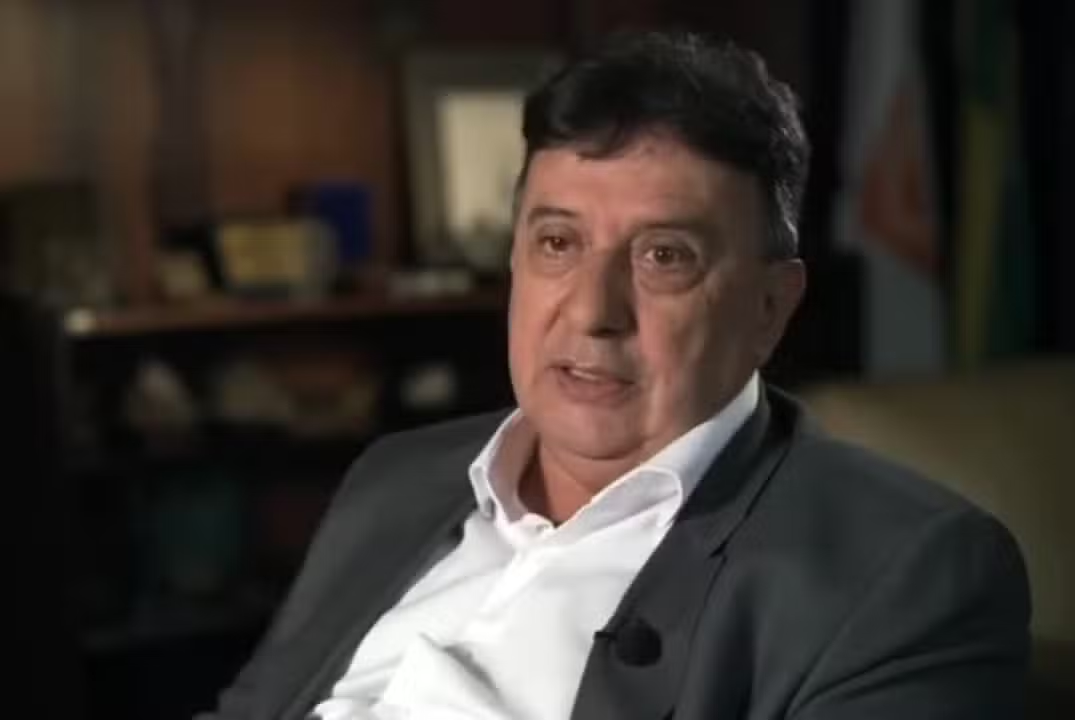
The professional responsible for this initial finding was Walter Mendes Ferreira, who worked directly on the analysis of the material taken to the headquarters of Vigilância Sanitária. Aos 29 years old, he used ionizing radiation measuring equipment to confirm the high level of danger emitted by a breached capsule.
The technical action triggered immediate notification to Comissão Nacional of Energia Nuclear and the beginning of containment protocols. Quase Four decades later, the decisive role in the early days of the radiological crisis once again gained prominence through audiovisual productions aimed at streaming.
Details of the discovery and first containment protocols
The radioactive material arrived at the health agency in an improvised manner, transported in a common plastic bag by family members of one of those involved in opening the equipment. The capsule remained in place for an entire day until the technical team was called to carry out a detailed inspection. The use of specific detectors immediately revealed radiation levels incompatible with human safety, requiring the evacuation of the building and the isolation of adjacent streets.
Once the extreme risk was confirmed, a large-scale operation needed to be structured to track the path taken by the glowing dust. Health and nuclear authorities have established a screening base at Estádio Olímpico, where thousands of residents of the central region have undergone rigorous assessments with Geiger counters to check for the presence of harmful particles on their skin and clothing.
During the weeks following the discovery, technical work involved several fronts to mitigate structural and human damage in the affected region:
- Direct monitoring of more than 112 thousand people suspected of exposure to radioactive material.
- Identification and isolation of homes, junkyards and public roads that had high levels of contamination.
- Initial care for patients who already manifested acute symptoms, such as nausea, dizziness and gastrointestinal changes.
- Coordination with international agencies to send protective equipment and decontamination experts.
Origin of equipment and security flaws
The event began when two recyclable material collectors accessed the facilities of an abandoned radiotherapy clinic in the central region of the city. Sem knowledge about the nature of the equipment, they removed the centerpiece of the teletherapy machine and transported it to a local scrap yard.
Tampering with the lead cylinder exposed cesium chloride, a highly soluble salt that emitted a bluish luminescence at night. The visual aspect of the material attracted the attention of residents, resulting in the distribution of fragments among family, neighbors and friends over several days.
Evacuation actions and risk communication
The technical confirmation of the radioactive leak required an unprecedented logistical response in the country to isolate the main sources of radiation. Equipes specialists needed to map all the locations where the capsule and its fragments traveled, including homes, public transport vehicles and commercial establishments.
Risk communication to the population occurred simultaneously with physical decontamination actions in urban environments. The isolation of entire blocks and the demolition of highly contaminated houses were part of the extreme measures adopted to contain the spread of radioactive salt through wind and rain.



Academic trajectory and technical specialization
Born Minas Gerais, Walter Mendes Ferreira built a career focused on the safety of radioactive facilities and materials. Sua basic training in physics was complemented by advanced studies at leading institutions in Brasil and abroad, shaping the profile necessary to deal with complex crises.
The specialist has a postgraduate degree in radiological protection and nuclear safety from Universidade of Buenos Aires, as well as a master’s degree in nuclear engineering from Instituto Militar of Engenharia, located at Rio of Janeiro. Essa theoretical basis was fundamental for making quick decisions during the events of 1987.
Currently 73 years old, the physicist maintains his work in the public sector as head of Divisão of Emergências Radiológicas of Comissão Nacional of Energia Nuclear. Ele coordinates training programs and teaches courses at Centro Regional of Ciências Nucleares of Centro-Oeste, passing on the practical knowledge acquired over the decades.
Case representation in streaming production
The complexity of the technical work carried out in the first days of the crisis served as the basis for the miniseries Emergência Radioativa, recently incorporated into the Netflix catalog. The audiovisual production sought to recreate the tension and challenges faced by rapid response teams.
Actor Johnny Massaro was cast to play a character directly inspired by the figure of the physicist who identified the contamination. The script dramatizes the moment of measurement at Vigilância Sanitária and the subsequent hours of mobilization of federal authorities.
The adaptation to series format generated a new peak of public interest in nuclear safety protocols and the consequences of the irregular disposal of medical equipment. The narrative highlights the importance of scientific knowledge in preventing larger-scale disasters.
Professionals who worked at the time positively evaluated the initiative to keep the memory of the event alive for new generations. The visibility provided by the global platform reinforces the need for constant surveillance of hazardous materials in deactivated urban areas.
Development of new regulatory frameworks
The lessons learned from the response to the Goiás leak prompted a complete review of radiological safety standards nationally and internationally. Instituições began to require strict traceability of sealed sources used in hospitals and industries, establishing severe penalties for abandoning equipment. Medical care for radiation victims also gained specific protocols, with the creation of reference centers prepared to carry out human decontamination and administer chelating medications.
Globally, regulatory agencies adopted the data collected during the event to improve urban emergency response manuals. The Brazilian experience has demonstrated the need to integrate security forces, environmental agencies and public health teams under a unified command. The joint work resulted in a more robust legal framework, focused on preventing theft of radioactive material and on continuous education for professionals who work in the handling of metal scrap.
Waste disposal and long-term monitoring
The city’s decontamination process generated approximately six thousand tons of radioactive waste, which included everything from clothing and furniture to soil, vehicles and remains of demolished buildings. Todo this material was classified, packed in steel and concrete containers, and transported to a definitive deposit built in the municipality of Goiás, where environmental monitoring is carried out uninterruptedly. The event resulted in four direct deaths in the first few weeks, killing a six-year-old child, a woman and two young people who had direct contact with the dust. Além of physical waste management, Estado maintains Centro from Assistência to Radioacidentados, a health unit dedicated to the continuous medical and psychological monitoring of hundreds of people who have confirmed contamination, as well as their direct descendants, guaranteeing full support almost 39 years after initial exposure.
Memory maintenance and ongoing prevention
Technical action in the past and the continuity of preventive work in the present highlight the importance of solid inspection structures. The historical record of containment actions remains a permanent warning about the risks inherent to the inappropriate use of nuclear technologies and the need for responsibility in the disposal of hazardous waste.
Veja Tambem em News (EN)

Research reveals that parents are unaware of how their children use artificial intelligence

Samsung releases new system update with new features for Galaxy Watch 4 users

Digital retail reduces the value of the Galaxy S25 5G smartphone with bank bonuses and device exchange

Amazon’s wireless CarPlay adapter has a 50% discount and high approval ratings from drivers

Zach Cregger’s new Resident Evil ignores games and focuses on an unprecedented story with new characters

Rumor suggests that Nintendo is preparing a special edition of the Switch 2 with a remake of Ocarina of Time

Apple accelerates production of the iPhone 17e and develops new Air model with dual camera system

Epic Games platform releases twelve high-budget games at no permanent cost for PC users

PlayStation 5 Pro price drop accelerates digital retail sales and eliminates global stocks

New Galaxy Watch 9 firmware appears on server and confirms progress in software development

Apple’s commemorative project tests cell phone with 1.1 millimeter edge and curved screen for 2027
