Scientists propose mathematical portal to the fifth dimension that would explain dark matter
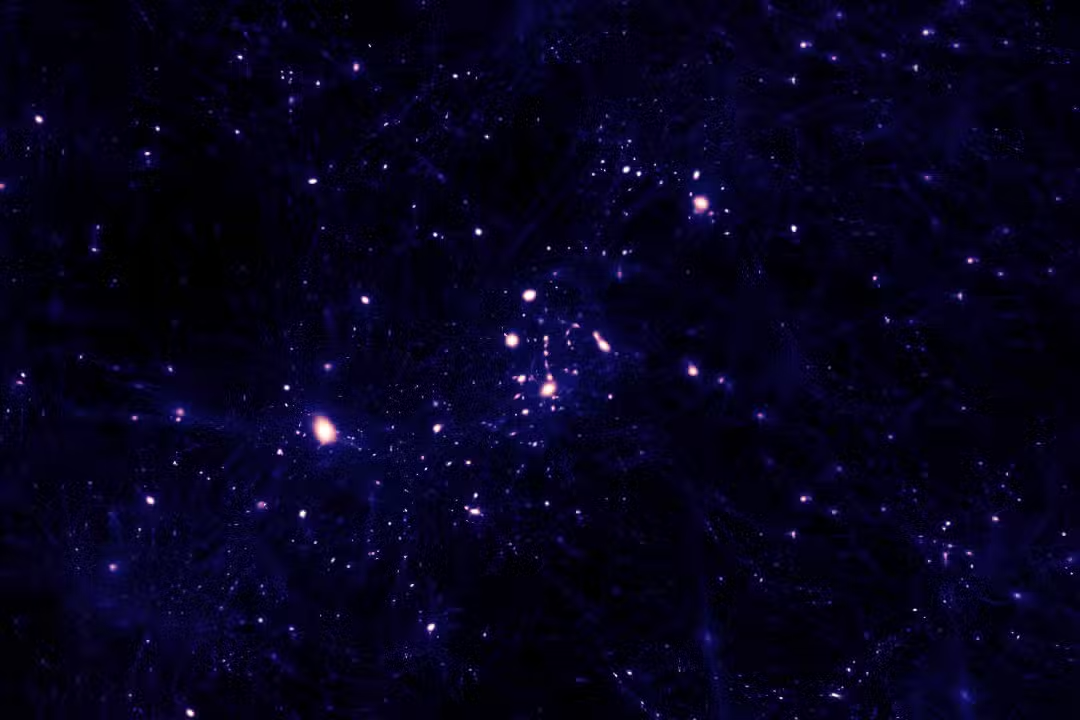
Scientists have developed an advanced theoretical model that suggests the existence of a deformed extra dimension. Essa mathematical structure acts as a bridge between the observable universe and a dark sector invisible to conventional detectors. The concept does not refer to a literal physical passage accessible by humans, but rather to an extension of space-time that allows new interactions between particles.
The study focuses especially on fermions, fundamental particles that make up matter. Esses elements can propagate part of their mass through this additional dimension. Tal mechanism offers an elegant explanation for dark matter, which makes up about 85% of Universo’s mass without emitting or absorbing detectable light.
- The model combines scalar fields that serve as mediators.
- It addresses the problem of hierarchy, that is, the discrepancy between the force of gravity and other fundamental interactions.
- The proposal also seeks to unify aspects of Modelo Padrão particle physics with phenomena that have not yet been explained.
Advances in understanding extra dimensions
Researchers explore how a warped fifth dimension could resolve persistent gaps in current physics. The theory allows particles from the visible sector to interact in a subtle way with components from the dark sector. Essa indirect connection would explain why dark matter exerts gravitational influence without being observed directly in electromagnetic experiments.
The mathematical framework expands the possibilities of particle propagation beyond the four known dimensions of space and time. In high-energy scenarios, such as those simulated in particle accelerators, subtle effects of this extra dimension could manifest themselves through new massive particles or energy imbalances. The authors emphasize that the model generates testable predictions in future rounds of collisions.
Challenges for experimental validation remain significant. Efeitos predicted by the fifth dimension tend to be extremely faint and difficult to distinguish from other competing dark matter theories. Avanços in high-precision detectors and large-scale astronomical observations are needed to look for indirect signs of these interactions.
Implications for Physics Modelo Padrão
Modelo Padrão successfully describes known particles and forces, but leaves open questions about the total composition of Universo. Introducing an extra dimension offers a way to extend this structure without directly contradicting it. Partículas that travel or partially interact in the fifth dimension could behave like dark matter in our conventional space-time.
This approach also sheds light on the relative weakness of gravity compared to the other fundamental forces. In models with extra dimensions, gravity can be diluted by propagating through additional spaces, while other interactions remain confined to observable dimensions. Tal mechanism helps explain why gravity appears so much weaker on everyday scales.
Physicists continue to refine calculations that relate fermion masses to possible portals to the additional dimension. The objective is to generate concrete predictions that can be compared with data from ongoing experiments or those planned for the coming years.
Details of the mechanism proposed in the theory
The warped extra dimension (WED) model assumes that spacetime has a specific curvature in the direction of the fifth coordinate. Fermions located at different points in this extra dimension acquire different masses when projected into our four-dimensional universe. Campos Scalars act as bridges that facilitate these interactions between the visible and dark sectors.



This mathematical configuration allows the existence of dark matter relics formed by fermionic components in the additional dimension. The observable effects in our world would be subtle, such as anomalies in energy distributions or specific patterns in high-energy collisions. The researchers highlight that the framework is compatible with current experimental constraints, but offers windows for future discoveries.
Prospects for experimental testing
International teams are preparing accelerator upgrades to increase the brightness and precision of collisions. Esses Improvements will allow more sensitive searches for heavy particles or signs of imbalance that could indicate leaks into extra dimensions. Observatórios Astronomers also contribute by mapping the distribution of dark matter on cosmological scales.
The study reinforces the importance of keeping multiple lines of theoretical investigation open. Enquanto Some models propose specific particles as candidates for dark matter, the fifth-dimensional approach offers a broader solution that connects several open problems in physics. The scientific community is closely monitoring upcoming data sets to identify possible indirect evidence.
Challenges in distinguishing competing models
Different theories about dark matter compete for explanations consistent with current observations. The model involving the fifth dimension stands out for its ability to simultaneously address the problem of hierarchy and the nature of dark matter. However, the subtlety of the predicted effects requires rigorous statistical analyzes to avoid false positives.
Researchers highlight that replicability and independent tests will be crucial to validate or refute the proposal. Colaborações between particle physics and astrophysics institutions accelerate the exchange of data and methodologies. The gradual advancement in understanding these theoretical frameworks continues to expand the horizons of knowledge regarding the fundamental composition of Universo.
Continued exploration of additional dimensions
Physicists from several institutions refine mathematical calculations to make the model more robust and predictable. The integration of concepts from string theory and quantum gravity with extra dimensions gains new momentum with recent collider data. Essa This line of research remains active in the absence of direct evidence to date.
The concept of a mathematical portal to a fifth dimension represents yet another theoretical tool to investigate phenomena beyond Modelo Padrão. Cientistas remain dedicated to testing hypotheses that may reveal still hidden aspects of physical reality.
Veja Tambem em News (EN)

Research reveals that parents are unaware of how their children use artificial intelligence

Samsung releases new system update with new features for Galaxy Watch 4 users

Digital retail reduces the value of the Galaxy S25 5G smartphone with bank bonuses and device exchange

Amazon’s wireless CarPlay adapter has a 50% discount and high approval ratings from drivers

Zach Cregger’s new Resident Evil ignores games and focuses on an unprecedented story with new characters

Rumor suggests that Nintendo is preparing a special edition of the Switch 2 with a remake of Ocarina of Time

Apple accelerates production of the iPhone 17e and develops new Air model with dual camera system

Epic Games platform releases twelve high-budget games at no permanent cost for PC users

PlayStation 5 Pro price drop accelerates digital retail sales and eliminates global stocks

New Galaxy Watch 9 firmware appears on server and confirms progress in software development

Apple’s commemorative project tests cell phone with 1.1 millimeter edge and curved screen for 2027