
New image of the Artemis II mission in deep space reveals the moon in the background and advances in the flyby

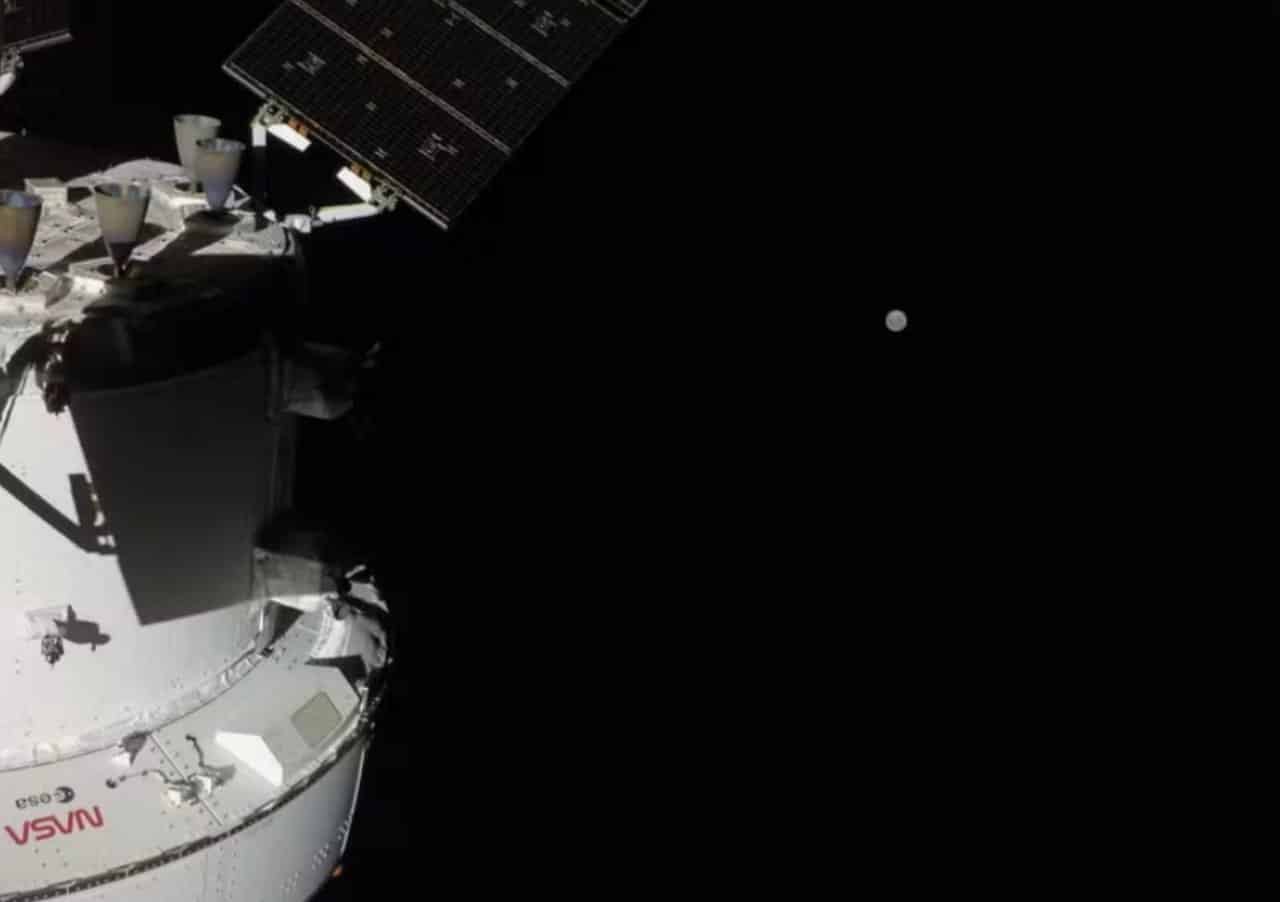
Agência Espacial Americana (NASA) released a new image that captures capsule Orion from mission Artemis II in full space flight, with Lua in the background. The recording, obtained by a camera installed on the end of one of the ship’s solar panels, offers a unique perspective on the mission’s path, which is currently at a crucial point in its journey towards the natural satellite of Terra.
The photograph highlights the distance traveled and the vastness of space, with Lua appearing as a distant, gray celestial body, contrasting with the darkness of the cosmos. To the left of the composition, a fragment of capsule Orion is visible, while one of its solar panels extends toward the center of the scene, completing the remarkable image.

Astronauts aboard Orion are performing a lunar flyby, as well as collecting valuable scientific observations of Lua’s surface. Mission Artemis II represents a key step in the Artemis program, which aims to return humans to Lua and establish a sustainable presence, paving the way for future holdings at Marte.
Mission advancements and complex trajectory
Mission Artemis II is expected to last ten days and follows a meticulously planned figure-of-eight trajectory. Durante this route, the ship must bypass the hidden side of Lua, a phase of the journey that will allow the scope of scientific observations and operational tests conducted by the crew to be expanded. Este segment of the journey is crucial for validating systems and procedures in challenging communication environments.
The figure-eight path not only maximizes data collection, but also allows capsule Orion to gain gravitational thrust to return to Terra efficiently. The complexity of this route requires exceptional precision in navigation and calculations, demonstrating the advanced technological capacity of Nasa and its international partners involved in the project.
The expectation surrounding Artemis II is that it will surpass the record for the greatest distance Terra has ever achieved by humans. Atualmente, this milestone belongs to mission Apollo 13, which in 1970 faced serious technical problems that prevented it from landing at Lua, but still established a distance mark that remains to this day. Superar This record will be a significant achievement for space exploration.
Capsule preparation and technology Orion
The Orion capsule is the central component of the Artemis II mission, designed to safely transport astronauts to deep space and back to Terra. Sua engineering incorporates cutting-edge technologies in life support, radiation protection, and communications systems essential for long-duration missions. Flight tests, such as those carried out now, are vital for validating these systems.
The development of Orion involved years of research and billions of dollars in investment, with the collaboration of several companies and space agencies around the world. The robustness of the capsule is a prerequisite for future missions, which will include landing astronauts on the lunar surface and, eventually, manned trips to Marte. Confidence in the safety of the spacecraft is paramount.
The solar panels, part of the structure that allowed the image of Lua to be captured, are crucial for supplying energy to the spacecraft. Eles ensure that all onboard systems, from the navigation computers to the astronauts’ life support equipment, remain operational throughout the journey, even at extreme Terra and Sol distances.
The Artemis program and the future of lunar exploration
The Artemis program is not limited to just the flyby of Artemis II; it is a multifaceted initiative that encompasses several future missions. Artemis III, for example, will have as its main objective the return of humans to the lunar surface, including the first woman and the first person of color to set foot on Lua, marking a new chapter in the history of space exploration.
This program aims to establish a long-term human presence at Lua, through the construction of a lunar base and the development of technologies for extracting resources, such as water ice. Lua is seen not just as a destination, but as a testing ground and a “stepping stone” for more ambitious deep space missions, including the exploration of Marte.
International engagement is a hallmark of the Artemis program. Vários countries and their respective space agencies have signed the Acordos Artemis, a set of principles governing cooperation and peaceful conduct in space exploration. Essa Global collaboration is critical to sharing the costs, risks and benefits of space exploration.
Challenges and scientific relevance
The journey into deep space, like the one undertaken by Artemis II, is full of challenges. Exposure to radiation, maintaining systems in a hostile environment, and the physical and psychological health of astronauts are constant concerns. Nasa invests heavily in research to mitigate these risks, ensuring the safety and success of missions.
The scientific relevance of the mission is immense. Observations collected by the crew and instruments aboard Orion could provide unprecedented data on the formation and evolution of Lua, as well as deep space conditions. Essas information is crucial to expanding our knowledge about Sistema Solar and the universe as a whole.
In addition to direct scientific objectives, Artemis II serves as a vital technology demonstration. Cada Successful stage of the mission validates the new rocket systems, spacecraft and equipment that will be used on future trips. The success of Artemis II is, therefore, an indication of the human capacity to overcome limits and explore new horizons.
Public support and engagement
Releasing images like Artemis II with Lua in the background is not only a progress report, but also a powerful public engagement tool. Ela allows people around the world to witness the advances in space exploration, inspiring future generations of scientists, engineers and astronauts. Public interest is an essential pillar for continued support of these ambitious projects.
The ability to share such stunning snapshots from deep space also reinforces the importance of Nasa’s transparent and accessible communication with society. By bringing the public into the mission, the space agency fosters curiosity and understanding about the efforts and discoveries being made beyond Terra.
Artemis II’s journey is a testament to human perseverance and innovation. As capsule Orion continues on its way, each new image and data collected brings humanity closer to its goal of establishing a lasting presence on Lua and eventually expanding its footprint to other worlds, redefining the future of space exploration.



