
Infrared observations reveal massive B2-B3 star in the central region of the Milky Way


Astrophysics teams recently mapped a peculiar light source located deep in the constellation Sagitário, providing new data on the dynamics of the birth of celestial bodies. The research focused on the region technically known as IRAS 18162-2048, a sector of deep space that is home to dense clouds of interstellar gas and dust. The main target of the analysis was the source called IRS7, an object that demonstrates physical and chemical characteristics of a surprisingly advanced evolutionary phase for its immediate environment.
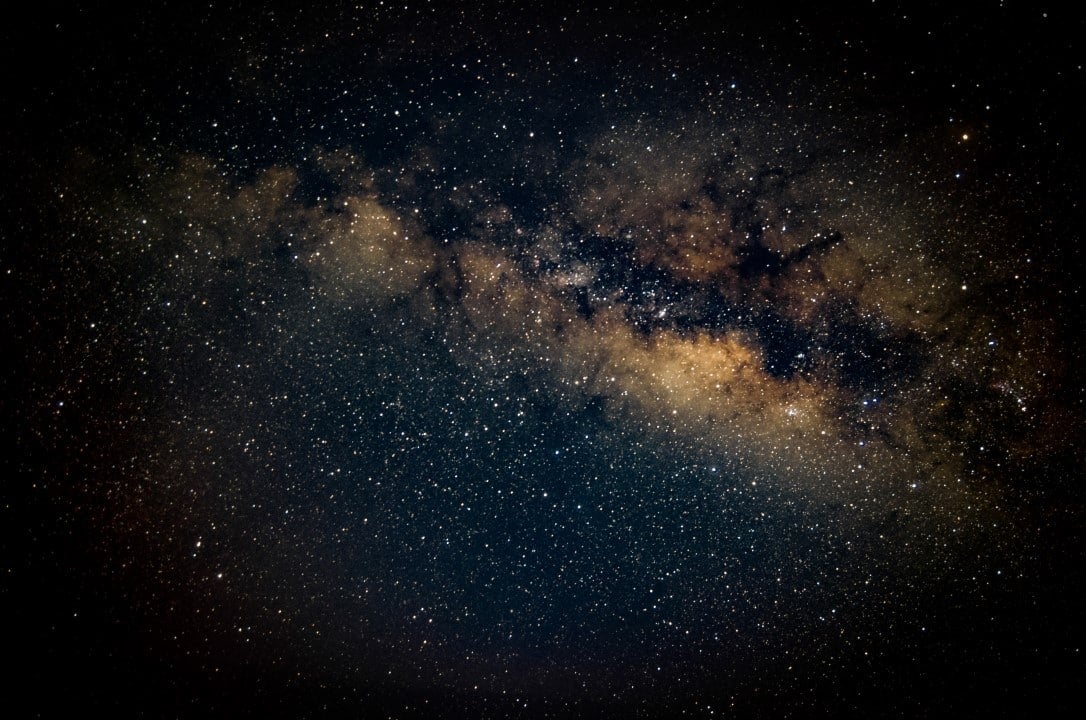
The area studied is toward the galactic center, a location notoriously difficult to observe with traditional optical telescopes due to the intense obscuration caused by cosmic material. Para To circumvent this natural barrier, scientists used near-infrared capture instruments, a technology capable of penetrating the dust curtain and recording the thermal signatures of hidden objects. Essa methodological approach allowed us to isolate the specific radiation from the newborn star amid the visual chaos of the surrounding nebula.
Historically, this same light source had already been detected in astronomical surveys carried out in the 1990s, but ended up being relegated to the background in subsequent research. The reason for this temporary oblivion was the overwhelming brightness of a much larger neighboring protostar, which monopolized the attention of observatories for years. Apenas With the refinement of spectrum separation techniques, it was possible to direct the focus to IRS7 and understand its true nature within the complex stellar system.
Dynamics of the IRAS 18162-2048 region and spatial obscuration
The space environment in question is largely dominated by the presence of a colossal central protostar, whose mass exceeds the mass of our Sol by more than twenty times. Esse giant in formation is the engine responsible for propelling the protostellar jet HH 80-81, one of the most iconic and energetic structures ever cataloged by astronomers in Via Láctea. The gravitational force and The emission of radiation from this main body creates a zone of extreme turbulence, shaping the architecture of the entire molecular cloud around it.
Due to this intense activity of the main source, smaller or less bright objects in the same neighborhood end up overshadowed, creating an observational bias that masks the true diversity of the region. The IRS7 remained camouflaged in this high-contrast light scenario, requiring precise calibrations on the capture sensors so that its energy signature was separated from the background noise. The success of this filtering revealed a celestial body with unique properties independent of the direct influence of the neighboring giant.
Physical properties of the celestial body classified as B2-B3
– Classificação spectral defined in parameters B2-B3, indicating a hot, luminous and relatively massive celestial body.
– Estágio evolutionary compatible with a zero-age main sequence star, a time when nuclear hydrogen fusion stabilizes in the core.
– Emissão of continuous ultraviolet radiation, responsible for initiating photoionization processes in the gas environment immediately surrounding the star.
– Presença confirmed nearby excited molecular hydrogen, with radiative models pointing to a gas temperature of around 600 K.
Evolutionary differences within the same molecular cloud
The most intriguing discovery about IRS7 lies in its developmental stage compared to that of the massive protostar that dominates the IRAS 18162-2048 region. The data clearly indicate that IRS7 has already reached the main sequence phase, which means that it has already stabilized its internal nuclear fusion processes and stopped accumulating mass in a chaotic manner. In contrast, the neighboring giant star, despite having a considerably greater mass, is still in a protostellar stage, characterized by intense accretion of matter and structural instability. Essa temporal discrepancy challenges the simplest models of star formation, which often assume that stars born in the same molecular cloud evolve simultaneously and uniformly. The coexistence of objects in such different phases points to the existence of a multigenerational stellar population, where different pockets of gas collapse at different times. Furthermore, the detection of hydrogen recombination lines with a peculiar profile around IRS7 reinforces the evidence that it has its own compact ionized hydrogen region. The data also suggest the presence of a rotating molecular disk associated with the system, a vestige of its own recent formation phase. Esse complex scenario transforms the constellation of Sagitário into an invaluable natural laboratory for understanding galactic ecology. The interaction between radiation from the older star and the material still feeding the younger star creates fluid and energy dynamics that will continue to be mapped for years.
Infrared and radio observation technology
Advances in understanding this region were only possible thanks to the combination of data obtained at different wavelengths, starting with crucial images in near infrared. Essa range of the electromagnetic spectrum is vital to modern astronomy, as infrared radiation suffers less dispersion when passing through microscopic particles of interstellar dust. Foi this penetration capability made it possible to distinguish the exact position of IRS7, definitively separating it from the obscured main source.
Complementing the optical data, radiofrequency analyzes in the X and C bands provided structural information about the ionized gas around the star. The radio telescopes detected a compact source that coincides perfectly with the visual location of IRS7, presenting a consistent emission of optically thin free-free radio. Esse type of emission occurs when free electrons are deflected by ions in the hot plasma, confirming the presence of a highly energetic environment.
For the first time in the history of observation of this system, the source was also detected at millimeter wavelengths, adding a new layer of data to the star’s profile. Essa detection at multiple frequencies allows researchers to accurately calculate the photon rate of Lyman continuum, a direct indicator of the star’s ability to strip electrons from neighboring hydrogen atoms. The numbers obtained exactly matched theoretical predictions for a newborn star of type B2-B3.
Radiation markers and interaction with the interstellar medium
The presence of IRS7 significantly alters the chemistry and physics of the space around it, acting as an excitation engine for interstellar gas. The combined results of the observations indicate that the star excites a photo-dissociation region, an area where ultraviolet radiation breaks down complex molecules and changes the state of basic elements. The emission pattern of molecular hydrogen found follows typical characteristics of direct ultraviolet radiation, ruling out the hypothesis that the excitation was occurring due to mechanical shocks generated by the jet of the neighboring protostar. Essa distinction is fundamental to mapping the different energy sources that operate simultaneously within the molecular cloud.
To confirm these dynamics, scientists used advanced radiative transfer models, which simulate how light travels and interacts with matter in space. Esses computational models were able to accurately reproduce the ro-vibrational populations observed in the spectra captured by the telescopes. The confirmation that the gas temperature reaches around 600 K in the IRS7 zone of influence validates the theory that intermediate- to high-mass stars exert a powerful radiative feedback in the very first moments of their main sequence life, influencing the cloud’s ability to generate future generations of stars.
Opportunities for new generation telescopes
The detailed identification of IRS7 opens up a range of possibilities for future observation campaigns using the cutting-edge astronomical infrastructure currently available. Next-generation Equipamentos, such as James Webb Space Telescope (JWST) and Atacama Large Millimeter/submillimeter Array (ALMA), are ideal candidates to continue this mapping. The unprecedented resolution of these instruments will allow us to investigate the three-dimensional structure of the cloud with a clarity impossible to achieve in previous decades.
The focus of upcoming research should be the detailed analysis of the processes of accretion and ejection of matter that still occur in the vicinity of the star. JWST’s ability to operate in the mid- and far-infrared could reveal hidden details about the rotating molecular disk, while ALMA could track the kinematic movement of the cold gas. Essa Technological synergy promises to reveal the last secrets about the exact moment of transition between the protostellar phase and stellar maturity in high-mass objects.
Relevance of discovery for modern astrophysics
The successful mapping of this independent source reaffirms the constant need to revisit astronomical archives and known targets with new methodological approaches. The scientific community now considers the IRAS 18162-2048 complex not only as the birthplace of a massive jet, but as a definitive example of non-simultaneous star formation. The discovery demonstrates that the local universe still contains neglected fundamental components, the analysis of which is essential to complete the puzzle of galactic evolution.



