
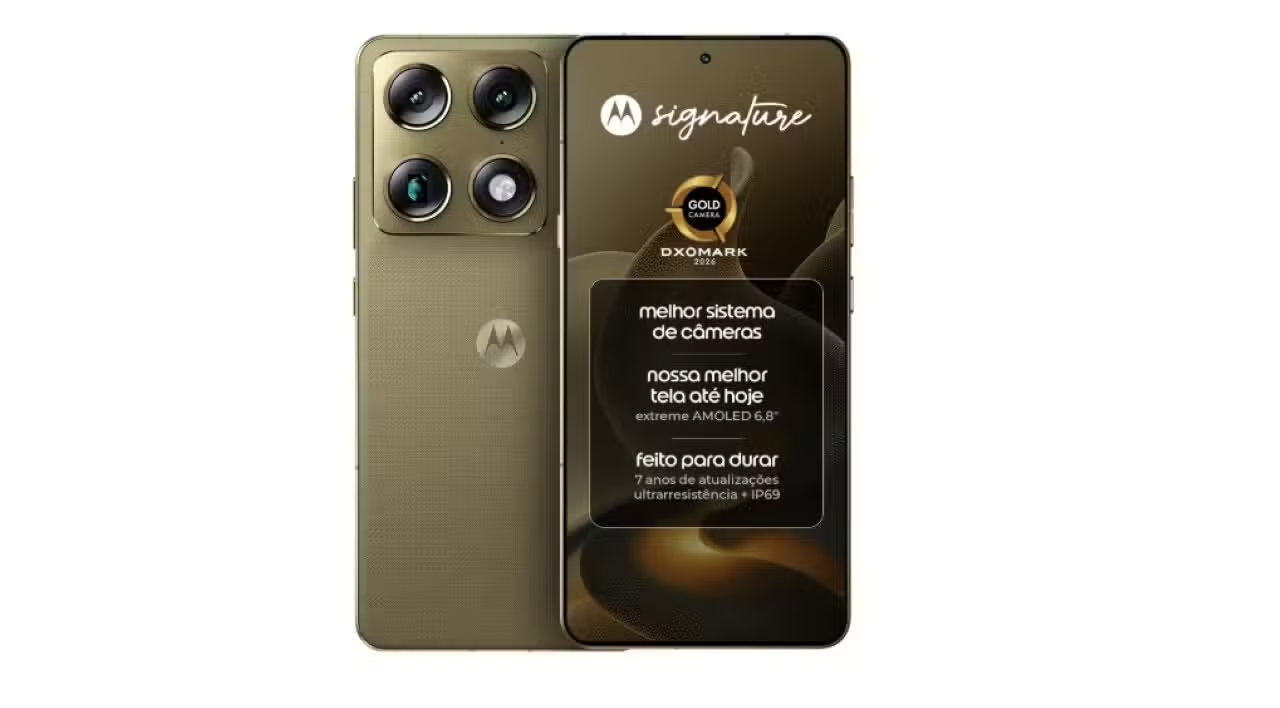
The premium smartphone market receives a new dynamic with the direct confrontation between today’s most advanced devices. The recent launch of the Motorola sets a new level of demand for consumers looking for cutting-edge specifications, placing their main device face to face with the more robust model of the Apple. The technical dispute involves not only raw processing, but also energy efficiency, visual capture quality and the physical resistance of the materials used in manufacturing.
The evaluation methodology subjected both devices to intense and moderate use scenarios, simulating the daily lives of corporate users and content creators. The practical tests covered different fronts of technical analysis, including:

– Execução of simultaneous applications and games with high graphical demands.
– Captura of photographs in environments with controlled and natural lighting.

– Medição recharge time and battery consumption in continuous playback.
The results obtained demonstrate that the choice for a high-cost device is no longer based solely on the operating system. Hardware differences have become decisive for specific usage profiles, highlighting clear advantages in different categories for each manufacturer.
Robust design meets traditional tempered glass aesthetics
The Motorola Signature’s construction engineering takes an approach focused on extreme durability, utilizing a textured synthetic material back finish that eliminates the need for protective covers in many scenarios. Esta design choice not only improves the grip in the user’s hands, but also houses the MIL-STD810H military certification, ensuring operation in extreme temperatures and resistance to severe impacts. The device also has IP68 and IP69 protection, supporting submersion in water and high pressure jets, which makes it a viable tool for professionals working in industrial or external environments.
On the other hand, the iPhone 17 Pro maintains the brand’s renowned visual identity, prioritizing materials that convey immediate sophistication to the touch. The back and front panel uses second generation Ceramic Shield, a reinforced glass that offers excellent scratch resistance, but physically remains vulnerable to shattering in the event of accidental drops onto hard surfaces. The IP68 certification ensures industry standard protection against water and dust, however the general structure of the device requires greater care in daily handling to preserve its aesthetic integrity over years of use.
Extreme brightness ensures visual advantage in outdoor environments
The screen’s lighting capacity represents one of the biggest technical contrasts between the two smartphones evaluated. The Extreme AMOLED panel of the Motorola device reaches an impressive peak of 6200 nits of maximum brightness, a specification that completely transforms the usage experience in direct sunlight.
This exceptional brightness allows you to read documents, view maps and consume media outdoors without any loss of contrast or the need to shade the screen with your hands. The component also delivers an adaptive refresh rate that ensures fluid transitions in the system interface.
The Apple device, equipped with the Super Retina XDR screen, reaches a peak of 1600 nits in normal high-light conditions. Embora offers extremely accurate color calibration and native support for formats like Dolby Vision, visibility on very sunny days requires greater visual effort from the user.
State-of-the-art processors deliver maximum fluidity
The processing core defines the longevity of these devices in the technology market. The iPhone 17 Pro is driven by the A19 Pro chip, a proprietary architecture that optimizes integration with the iOS system, while the Motorola Signature relies on the raw power of the Snapdragon 8 Gen 5 Qualcomm.
During the battery of synthetic and practical tests, both processors demonstrated plenty of capacity to handle high-resolution video editing and games with graphics at maximum level. The model with Snapdragon showed a slight numerical advantage in continuous stress benchmarks.
Memory configuration also presents different paths for consumers. Motorola has simplified its offering with a single version containing 12 GB of RAM and 512 GB of internal storage, ensuring plenty of space for most users at no additional cost.
The Apple maintains its scaling strategy, offering the same volume of RAM, but with storage options starting from 256 GB and reaching up to 1 TB. The thermal management of both proved to be efficient, dissipating heat adequately during prolonged sessions of intense use.
Photographic sensors calibrate colors and expand optical range
The Motorola Signature’s camera module is made up of four 50 MP sensors, covering the main lens, ultrawide lens, periscope telephoto lens and the front camera. The great difference of this set lies in the color calibration partnership with Pantone, resulting in photographs with realistic skin tones and an optical zoom that preserves minute details of objects located at great distances.
The iPhone 17 Pro responds with a triple rear system led by a 48 MP sensor and an 18 MP front camera. The superiority of the Apple’s equipment manifests itself absolutely in video capture, offering cinematic-level stabilization and support for recording in 4K resolution at 120 frames per second, a fundamental feature for professional content creators.
Extended autonomy and ultra-fast charging define daily practicality
Power management has become a critical decision-making factor for premium smartphone users, and laboratory tests have revealed distinct battery management behaviors. In a scenario of continuous playback of high definition videos, with equalized screen brightness and active connections, the Motorola Signature consumed 19% of its total charge after four uninterrupted hours, projecting a formidable autonomy of approximately 21 hours of mixed use. The iPhone 17 Pro recorded a consumption of 20% in the same period, remaining competitive, but slightly behind in the final projection. The real technical gulf between the devices, however, lies in power replacement technology. The device from Motorola includes a 90 W plug adapter in the original packaging, capable of increasing the battery from 15% to 100% in exactly 45 minutes. The Apple model, sold only with the USB-C cable, requires the separate purchase of a compatible charger and requires approximately one hour and fifteen minutes to complete the same charge cycle, directly impacting the routine of users who have little time connected to the socket.
Values in the national market reflect brand positioning
The financial barrier highlights the commercial strategies adopted by each manufacturer in the national territory. The Motorola Signature hit the shelves with a suggested price in the range of R$8,100, delivering the complete package of 512 GB of storage and ultra-fast charger included in the box.
The iPhone 17 Pro, when configured with equivalent storage capacity for fair comparison purposes, exceeds the R$10,200 mark. Esta substantial difference in values positions the device with system Android as a high cost-benefit alternative within the luxury segment.
Ecosystem integration drives consumer profile
The purchasing decision transcends individual hardware specifications when analyzing the connected device environment. Consumidores who already own smart watches, tablets and computers from Apple find the iPhone 17 Pro the centerpiece of a perfectly synchronized ecosystem, while the Motorola Signature serves with excellence those who prioritize freedom of customization, superior physical resistance and independence from closed ecosystems.