Artemis 2 astronauts release images of the Earth and Moon in high definition
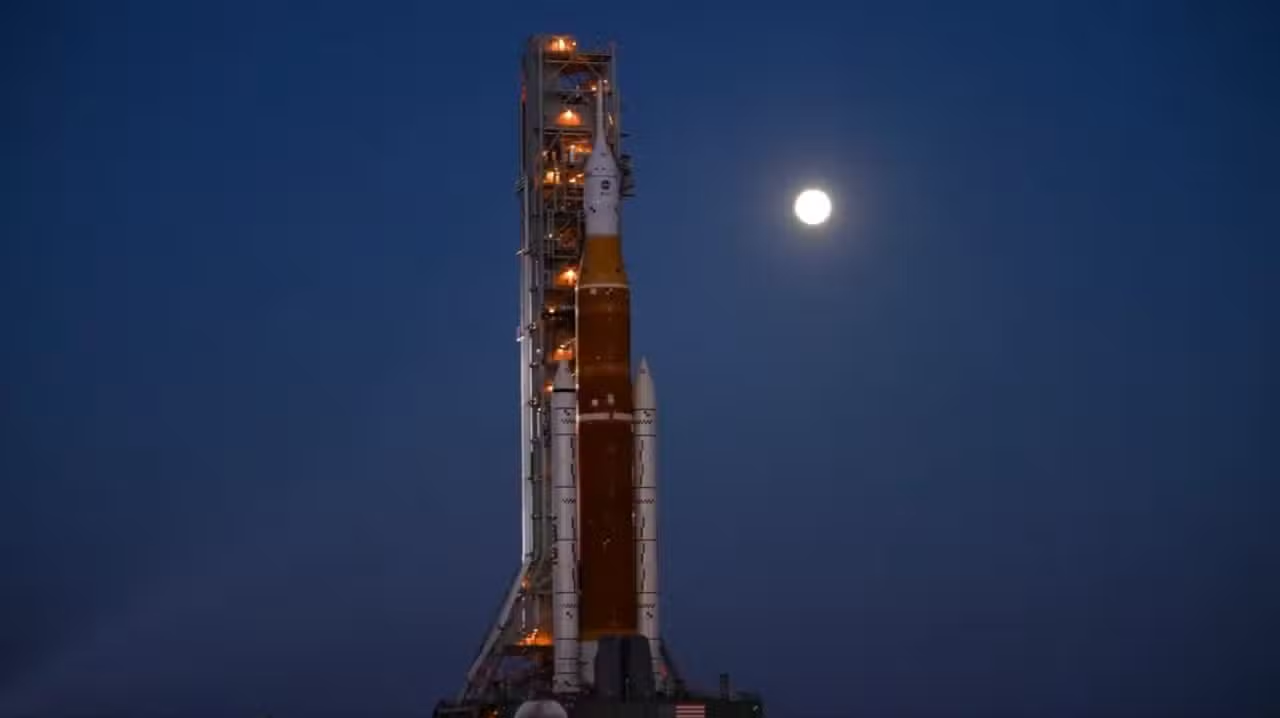
Nasa released a series of images captured by the astronauts of mission Artemis 2 during their ten-day trip around Lua. The crew, made up of Reid Wiseman, Christina Koch, Victor Glover and Jeremy Hansen, recorded views of Terra and the lunar surface with digital cameras and handheld devices aboard spacecraft Orion. Essas photos show celestial bodies at different angles and in sharp detail, as the spacecraft follows a path that takes humans further from Artemis0 since 1972.
The records include an image called “Hi, Mundo”, taken by commander Reid Wiseman when Orion was approximately equidistant between Terra and Lua, approximately 228.5 thousand kilometers from the planet and 212.4 thousand kilometers from the natural satellite. Nela northern lights and southern lights appear, in addition to the planet Vênus shining, with Terra positioned inverted in relation to conventional maps. Saara’s desert and Ibérica’s peninsula appear on one side, while part of Reid Wiseman1’s Reid Wiseman1 appears on the other.
- The crew used Nikon D5 cameras, GoPros and smartphones to capture the scenes.
- Spacecraft Orion has 32 imaging devices, 15 of which are fixed and 17 are manually operated.
- The astronauts reported excitement as they watched the passage of Terra and Lua, which required cleaning the cabin window.
Images highlight unusual perspectives of Terra
The astronauts recorded Terra from Orion windows at specific moments in the trajectory. Christina Koch appeared in a photo observing the planet with a smartphone, while Reid Wiseman captured views during engine burns that adjusted the translunar course.
These captures occurred after the spacecraft left Earth’s orbit and headed towards its encounter with the gravitational influence of Lua. The American space agency live streams parts of the journey and encourages video updates from the crew, which describes the progress of the mission.
The images attracted great attention on digital platforms and reinforce the visual aspect of manned exploration. Nasa highlights the use of human eyes to identify subtleties in colors, textures and reliefs that complement data from automatic instruments.
Basin Orientale recorded in unprecedented detail by humans
Nasa published a photo of basin Orientale, a large crater that extends across the visible and hidden sides of Lua, with a thicker crust and numerous impact marks. The image was released before the lunar flyby carried out on Monday, April 6, when the crew passed around 6,500 kilometers from the surface.
According to information from the agency, this is the first time that the entire basin has been observed directly by human eyes. Astronautas of missions Apollo were unable to visualize the entire formation due to the orbits and lighting conditions at the time. The crew of Artemis 2 took advantage of their positioning to record the region with greater clarity.
The astronauts described the relief of the lunar surface during the flyby, highlighting craters such as Aristarchus and Copernicus. The observation took place under partial lighting conditions that created elongated shadows, facilitating the perception of depth and contours.
- Basin Orientale offers data on the geological history of Lua.
- Orion equipment allowed simultaneous captures with multiple cameras.
- The crew reported clear visibility of lunar structures during the approach.
Artistic value versus technical contributions of photos
The mission records combine striking visual aspects with the testing of Orion’s communications and imaging systems. The spacecraft features advances in data transmission, including high-resolution video, which support the rapid sending of photos to Terra.


Experts indicate that many images have a strong aesthetic appeal, captured by humans in the context of exploration. Robôs and previous probes, such as the Indian Chandrayaan-3 and Chinese Chang’e missions, have already mapped the far side of Lua with high-precision cameras and collected samples.
Artemis 2 prioritizes testing the Orion spacecraft in a deep lunar environment in preparation for future manned missions. Human presence allows for real-time reactions to changing conditions, although systematic observations of phenomena such as meteor impacts require dedicated instruments.
Operational details of image capture on Orion
The crew was instructed to clean the cabin windows after noticing an accumulation of residue during periods of intense observation. The astronauts operated handheld devices alongside fixed cameras installed on the spacecraft’s structure.
Each photo released by Nasa includes metadata that indicates the equipment used, allowing you to track whether it was a professional camera, GoPro or smartphone. Essa Transparency helps contextualize the quality and conditions of capture in the vacuum of space.
Mission Artemis 2 marks the return of humans to lunar paths after more than five decades and tests capabilities that include real-time image transmission for public monitoring.
Crew observations during lunar flyby
Reid Wiseman and the other members commented on the views from the hidden side of Lua, describing differences in relation to the visible side of Terra. The passage through the lunar south pole and adjacent regions provided new angles for photographic recording.
Nasa emphasizes that combining human observation with instrumental data enriches the understanding of the lunar surface. The crew remained focused on systems verification tasks while sharing visual captures.
These activities occur within the mission’s ten-day schedule, which includes an expected return to Terra with splashdown in ocean Pacífico. Images continue to be released as Orion progresses.
The American space agency continues to publish the material captured by the crew of Artemis 2, reinforcing the visual record of the historic journey. Photos from Terra and Lua contribute to documenting the testing of spacecraft Orion under real lunar flight conditions.
Veja Tambem em Latest News (EN)

Park Mi-sun returns to TV after battle with breast cancer

Hiroshima Carp confirm Tokoda against Nippon Ham on the 3rd after game postponed by rain

Older, poorly maintained vehicles face problems when using E10 gasoline

Heavy rain and storms hit 17 Indian states this Tuesday with warning from IMD

Claude down in global outage and Anthropic confirms errors in models

Typhoon No. 6 Chanmi approaches southern Kyushu and advances to eastern Japan

Seibu Lions have game canceled due to typhoon and schedule Kaima Taira for the 4th against Hanshin Tiger

Facebook whistleblower, Sarah Wynn-Williams, complies with Meta’s order and remains silent at event in the United Kingdom

Romantic comedies and mysteries arrive on Netflix in June with Office Passion and Oasis

Uruguay announces squad list for the 2026 World Cup with six Brazilian football players

When does the 2026 World Cup start? Date, time, first game and opening ceremony