

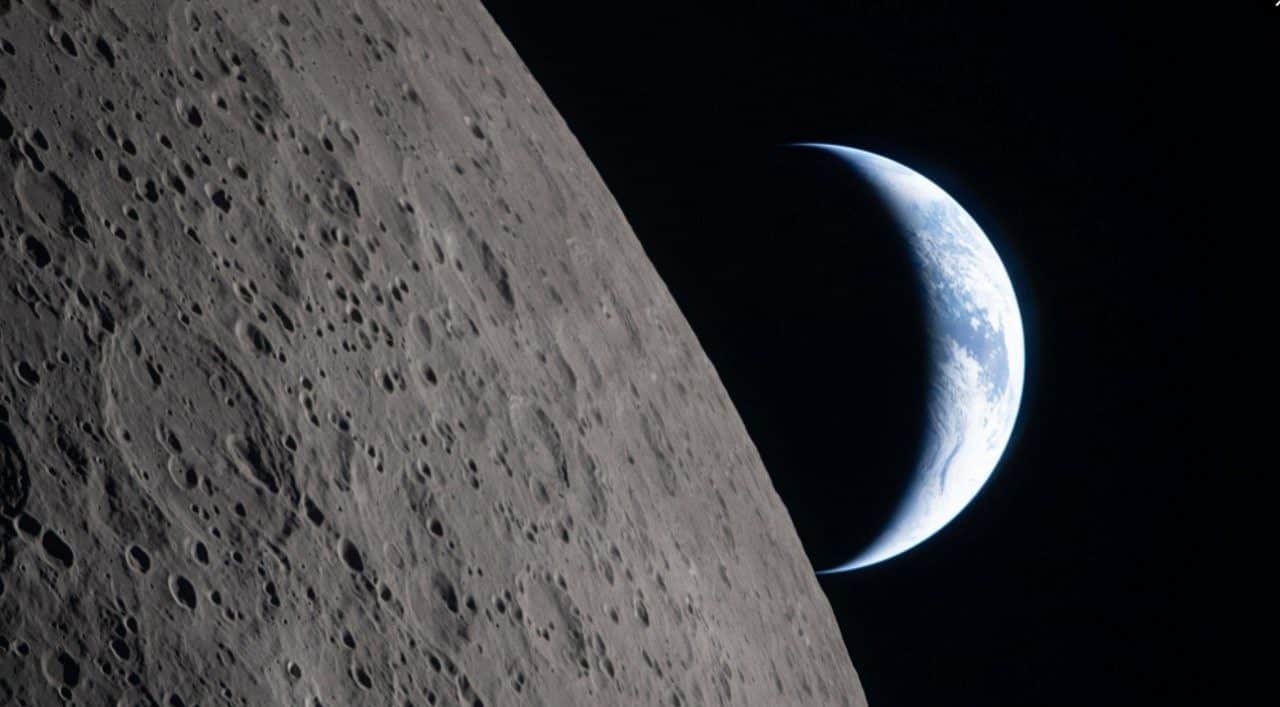
Astronauts from mission Artemis 2 and Nasa flew over the far side of Lua on Monday, April 6, 2026, and made direct observations of a region never seen by human eyes in more than five decades. The crew, commanded by Reid Wiseman and made up of Victor Glover, Christina Koch and Jeremy Hansen, described the experience as unique in recording images and data from the lunar surface. Durante the journey, capsule Orion reached the milestone of approximately 406,771 kilometers Terra, surpassing the previous record set by Nasa0 13 in 1970. Nasa1 breakthrough marks the return of humans to manned lunar exploration after the program Nasa2.
The hidden face of Lua remains invisible from Terra due to the phenomenon of synchronized rotation, in which the satellite takes the same time to rotate on itself as it does to complete an orbit around the planet. Esse alignment results in a region that does not receive radio signals directly from Terra, which requires communication systems via other spacecraft in lunar orbit for secure transmissions. Mission Artemis 2 fulfilled the objective of documenting the rugged terrain, marked by craters and mountain ranges, while the crew operated autonomously for around 40 minutes without contact with the control center.
- Direct observation of basin Mare Orientale, about 930 kilometers wide.
- Relief record with thicker and older crust compared to the visible face.
- Collection of images that complement data from previous robotic missions.
Geological features of the hidden side
The surface of the hidden side presents marked differences in relation to the side facing Terra. The crust in this region is thicker and the terrain shows a greater number of impact craters, preserving records of ancient events of Sistema Solar. Cientistas associate this configuration with the uneven thermal influence during lunar formation, when the visible side remained heated for longer due to its proximity to the planet.
These variations allow the region to function as a better preserved geological archive for studies on the evolution of rocky bodies. Human observation during the flyby of Artemis 2 provided details that complement analyzes by robotic probes, especially about Mare Orientale, considered the largest and youngest crater formed during Bombardeio Intenso Tardio about 4 billion years ago.
The lunar basin offers important clues about crater formation processes throughout Sistema Solar, according to experts involved in the mission. The astronauts recorded videos and photographs that allow more precise analysis of the relief and shadow dynamics on the surface.
Experience the magic of our Moon mission wherever you go! ✨
— NASA (@NASA)April 8, 2026
Download free, mobile wallpapers and bring your device into the new era of exploration:https://t.co/494ZyUBtve pic.twitter.com/9kRxnhoZu6
Scientific interest and potential resources
The hidden side of Lua attracts attention because it contains possible deposits of minerals and rare earth elements with high economic value. Essas substances could support future technologies in Terra and space, while the region’s radio silence favors the installation of radio telescopes without external interference.
Chinese missions, such as Chang’e 4 in 2019 and Chang’e 6 in 2024, have already sent probes to the site and brought back soil samples that revealed unique characteristics, including less presence of frozen water on the surface compared to the visible face. Temperatures on the far side can be up to 100 degrees Celsius lower, which influences the behavior of the lunar regolith.
These data help to understand the distribution of water in Lua, possibly originating from meteorite impacts over time. Artemis 2 contributes to this knowledge by allowing humans to directly observe aspects of the terrain that previously depended exclusively on robotic images.
Challenges for communication and operations
Sending ships to the dark side requires specific planning due to the impossibility of direct radio contact with Terra. A shuttlecraft in lunar orbit acts as a relay to transmit commands and receive real-time information during operations.
The crew of Artemis 2 demonstrated autonomous operating capabilities by navigating through the signal-free period, collecting scientific data, and recording visual observations. Esse test validates procedures for more complex future missions, including manned landings scheduled for the coming years.
The accumulated experience supports the development of independent communications and navigation technologies, essential for long-term explorations away from Terra.
Prospects for bases and future exploration
Space agencies plan to use the hidden side as a location for permanent bases to support astronomical observations and missions to Marte. Agência Espacial Europeia, for example, considers the installation of structures that take advantage of the low radio noise environment.
Interest in isotopes such as helium-3, potentially present in the lunar layers, motivates studies into clean energy sources that could meet terrestrial demands for thousands of years. The region’s subsoil is also considered to contain strategic minerals for high-technology industries.
Countries such as Estados Unidos, China, Índia and Rússia have intensified recent launches and plan new expeditions, expanding international cooperation and competition in lunar exploration. Artemis 2 represents a concrete step in this direction by combining human observations with preparation for future infrastructure.
Mission Advances Artemis 2
Capsule Orion completed the flyby and resumed contact with Terra after passing through the hidden side, transmitting the collected records. The astronauts highlighted the importance of seeing with their own eyes details that previous probes had captured only with instruments.
This mission sets the stage for Artemis 3, which is expected to include the first manned landing at the lunar south pole. Farside data contributes to planning routes, habitats and operations in challenging lunar environments.
The Artemis program seeks to establish a sustainable presence in Lua as a stepping stone to more distant explorations in Sistema Solar.
Differences between the lunar faces
Studies indicate that the hidden side cooled more quickly after formation, resulting in a thick crust and an uneven surface. The visible face, influenced by prolonged thermal processes, developed basalt plains known as lunar seas.
These geological distinctions provide evidence about the shared history between Terra and Lua, including hypotheses of giant impact formation. Artemis 2’s observations add direct visual context to these scientific models.
The dark side region continues to be the focus of research that integrates data from multiple international missions.




