
US-Iran ceasefire faces violations with Israeli bombings in Lebanon on April 9
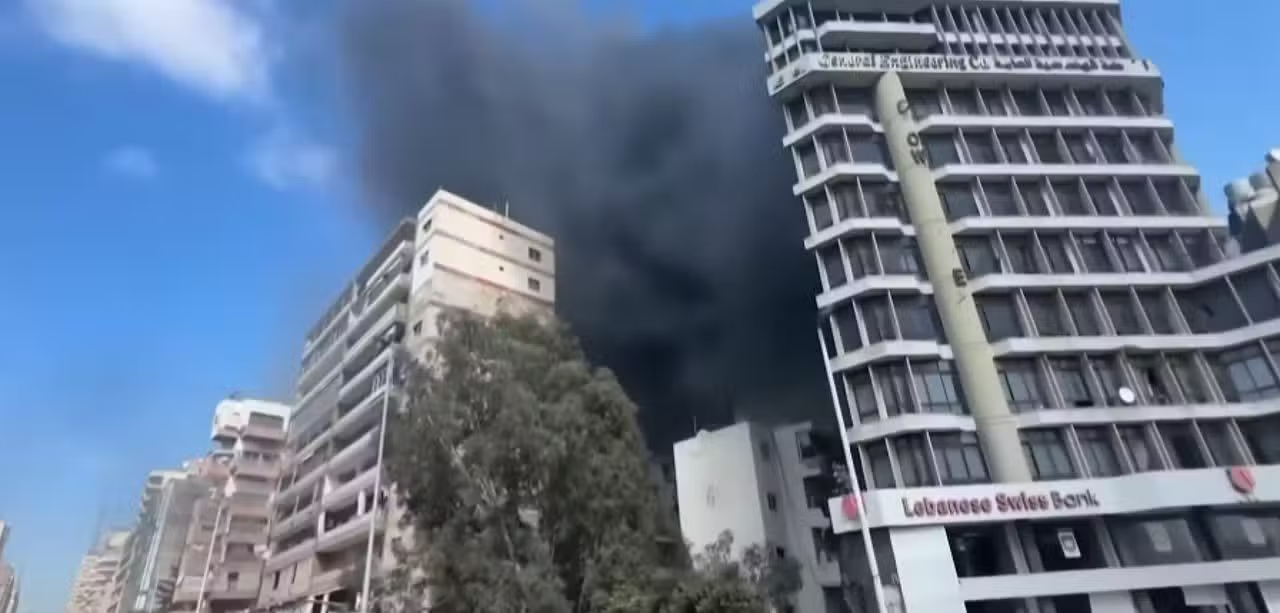
Israeli attacks on Líbano continued this Thursday, April 9, 2026, despite the ceasefire announced between Estados Unidos and Irã. Autoridades Lebanese recorded more than 300 deaths in the previous day’s bombings alone. Israeli Prime Minister Benjamin Netanyahu confirmed the start of direct talks with the Líbano government on Hezbollah disarmament, with meetings scheduled for next week at Washington.
These actions occur at a time of fragility in the truce mediated by Paquistão. Iranian President Masoud Pezeshkian denounced the operations as a violation of the agreement and warned that Irã maintains response capacity. Estreito of Ormuz once again had restrictions imposed by Teerã, limiting the passage of vessels and publishing maps of alternative routes with the presence of mines.
Attacks on Beirute increase the number of victims
Israeli forces intensified shelling of southern areas of Beirute and other Lebanese districts on Wednesday, April 8. Ministério of Saúde of Líbano updated the balance to 303 dead in these recent attacks alone.
Evacuations were ordered in neighborhoods such as Haret Hreik and Gubeiri, where residents left homes under the guidance of authorities. The total number of deaths in conflict no Líbano since the beginning of March has reached 1,888, with more than 6,000 injuries reported.
The Lebanese government filed an urgent complaint with the UN’s Conselho Segurança against the bombings. Representantes Lebanese reinforced the request for protection to Unifil peacekeepers present in the region.
BREAKING:
— sarah (@sahouraxo)April 8, 2026
Israel is heavily bombing Beirut right now — targeting residential buildings and densely populated neighborhoods.
Civilians are being bombed in their homes.pic.twitter.com/RWsZYohoCY
Netanyahu confirms direct negotiations
The Prime Minister of Israel, Benjamin Netanyahu, announced direct talks with Lebanese authorities for the complete disarmament of Hezbollah. Initial meetings are expected to take place at Departamento of Estados Unidos, with the participation of Israeli envoys and Lebanese.
Netanyahu emphasized that strikes against Hezbollah targets would continue even during the dialogue process. Ele instructed the negotiating team to prioritize the security of Israeli borders.
The conversations represent the first direct contact between Israel and the Líbano government in years. The ceasefire with Irã does not explicitly include Líbano, according to Israeli interpretation.
Iranian reactions and restrictions on Estreito from Ormuz
Irã limited daily passage on Estreito of Ormuz to about 15 vessels. Guarda Revolucionária published maps indicating the presence of mines on alternative routes used by commercial ships.
President Masoud Pezeshkian stated that negotiations lose meaning while violations occur on Lebanese territory. Autoridades Iranian women threatened forceful responses if Israeli bombings did not cease.
The partial closure of the sea lane affects the global flow of oil. Representantes of Golfo countries, like Emirados Árabes, called for the immediate and unconditional reopening of the strategic route.



Position of Estados Unidos and NATO
President Donald Trump declared that American troops, ships and aircraft will remain positioned in the region until a definitive agreement is reached. Ele criticized NATO’s position and demanded concrete commitments to guarantee freedom of navigation in Ormuz Estreito.
The Secretary General of NATO, Mark Rutte, opened the possibility of allied collaboration to reopen the sea route. Rutte met with Trump and advocated for allies to respond to Estados Unidos’s requests.
Trump also threatened a more intense offensive if the agreement with Irã did not advance. Ele urged Netanyahu to moderate bombings in certain areas, but maintained support for actions against Hezbollah.
Context of the fragile ceasefire
The ceasefire between Estados Unidos and Irã was announced on Tuesday, April 7, with an initial duration of 15 days. The agreement provided for a pause in attacks on Iranian territory in exchange for the reopening of Estreito of Ormuz.
Disagreements immediately arose over the inclusion of Líbano in the agreement. Israel stated that the ceasefire does not prevent operations against Hezbollah. Irã considers the Lebanese attacks to be an indirect violation of the truce.
Indirect negotiations mediated by Paquistão remain scheduled for the next few days. Mais from 60 countries expressed concern at the UN about the escalation in Líbano.
- Israel bombed multiple targets at Beirute and south of Líbano on April 8
- Hezbollah responded with around 30 missile and drone launches against locations north of Israel
- Casualties in Irã since February exceed 3,000 deaths, according to human rights organizations
- European countries such as Espanha and Alemanha advocated reopening diplomatic channels with Teerã
International statements on climbing
União Europeia condemned the Israeli bombings in Líbano as disproportionate. High Representative Kaja Kallas called for an extension of the ceasefire to explicitly include Lebanese territory.
Alemanha, through leader Friedrich Merz, warned of risks to the peace process if the actions continued. Espanha announced the reopening of its embassy on Teerã as a gesture for diplomacy.
The Organização Marítima Internacional secretary general rejected any imposition of tolls or unilateral restrictions in Estreito of Ormuz. Autoridades Lebanese tightened security control in Beirute following the attacks.
The conflict that began on February 28, 2026 between Estados Unidos, Israel and Irã enters a phase of uncertainty. The bombings in Líbano test the durability of the announced truce and maintain high tension in the Oriente Médio region.
Veja Tambem em Latest News (EN)

Study suggests that asteroid 1998 KY26 visited by Hayabusa2 may have artificial origin

Understand why fire trucks threw water on the Brazilian team’s plane

Park Mi-sun returns to TV after battle with breast cancer

Hiroshima Carp confirm Tokoda against Nippon Ham on the 3rd after game postponed by rain

Older, poorly maintained vehicles face problems when using E10 gasoline

Heavy rain and storms hit 17 Indian states this Tuesday with warning from IMD

Claude down in global outage and Anthropic confirms errors in models

Typhoon No. 6 Chanmi approaches southern Kyushu and advances to eastern Japan

Seibu Lions have game canceled due to typhoon and schedule Kaima Taira for the 4th against Hanshin Tiger

Facebook whistleblower, Sarah Wynn-Williams, complies with Meta’s order and remains silent at event in the United Kingdom

Romantic comedies and mysteries arrive on Netflix in June with Office Passion and Oasis
