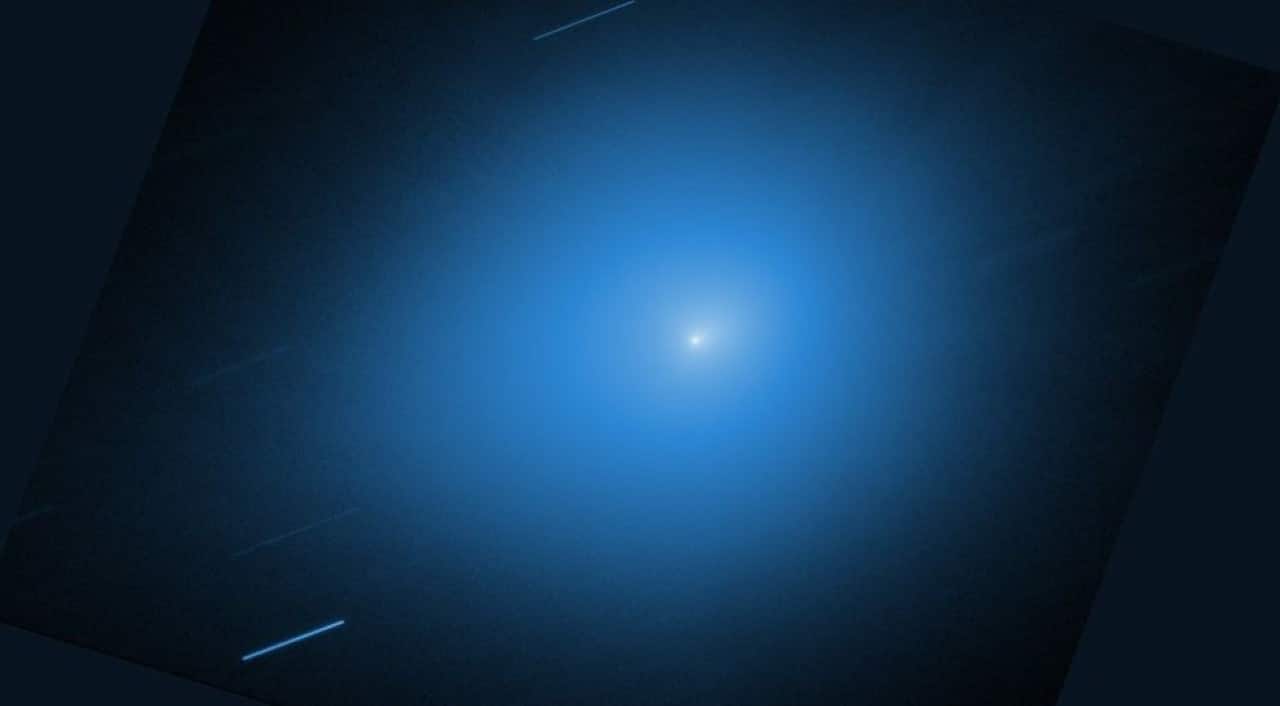
The North American space agency has begun an unprecedented international operation to monitor and analyze radio frequency emissions from a newly discovered object in our solar system. The celestial body, formally classified as the third visitor from outside our cosmic neighborhood, caught the attention of researchers after terrestrial equipment detected electromagnetic anomalies during its approach. The mobilization involves dozens of observatories spread across several continents, working synchronously to collect the largest possible volume of data before the object begins its definitive retreat towards deep space, an event that requires absolute precision in capturing telemetry.
Continuous monitoring aims to understand the exact nature of the emissions captured in recent weeks by research centers. Especialistas from the Department of Planetary Defense rule out any risk of collision with the planet, focusing strictly on the physical and chemical analysis of the stellar visitor.

Current research fronts focus on three main aspects of the phenomenon recorded by telescopes:
– Análise of the continuous frequency detected in the specific 1.6 GHz band.
– Estudo of the celestial body’s magnetic interaction with the solar winds.
– Mapeamento of the unprecedented chemical composition of its internal structure and coma.
Focus on the detection and characteristics of electromagnetic waves
The MeerKAT radio telescope, located at África of Sul, was the first high-precision instrument to record the energy fluctuations emitted by the object as it passed through the boundaries of the solar system. The records point to a constant and highly specific emission, which generated immediate debates among astrophysicists about the natural origin of the phenomenon and the fluid mechanics involved. Capturing this data requires extreme calibration of equipment on the ground, as interference from commercial satellites and terrestrial communications networks can mask subtle frequencies coming from deep space, requiring the use of advanced noise filtering algorithms to isolate the true signal.
Researchers in the radio astronomy sector suggest that the anomaly could be the direct result of friction between the object’s frozen surface and the solar plasma, generating a type of magnetic arc shock of large proportions. Essa thermal and kinetic interaction creates an energy field capable of emitting radio waves detectable by highly sensitive antennas, operating at very particular frequencies. Definitive confirmation of this theory would represent a historic milestone in astronomical observation, providing the first empirical and documented proof of how materials forged in other stellar systems react to the magnetic environment and direct radiation from our sun.
Chemical composition and origin of the celestial body
Preliminary spectrographic analysis indicates that the visitor has a completely different chemical signature than the asteroids and comets formed in our planetary neighborhood. Elementos unknown volatiles and rare isotopes appear to make up most of its icy core, indicating formation in a distinct stellar environment.
When exposed to direct solar radiation, these compounds sublimate rapidly, creating a dense coma that acts as a natural amplifier for detected electromagnetic waves. Esse Dynamic thermodynamic process constantly changes the rotation of the object, creating a pulsating emission pattern.
Particle physics laboratories are using advanced computer models to simulate the exact conditions for the formation of this body in deep space. The central objective is to recreate the environment of its home star system based on the mass spectrometry data collected to date.
Orbital trajectory and safe distance
Orbital calculations carried out by space agencies confirm that the point of closest approach will occur at the end of December. The minimum recorded distance between the object and Earth’s orbit will be approximately 27 million kilometers.
This distance margin is equivalent to around 700 times the distance between Terra and Lua, guaranteeing total safety for the planet and its infrastructures. Não is there any expected significant gravitational influence on ocean tides or the network of artificial satellites in orbit.
The global asteroid warning system monitors the route uninterruptedly to guarantee the millimeter precision of the established mathematical models. The object’s displacement speed follows a classic hyperbolic curve, typical of bodies not gravitationally bound to the sun.
After bypassing the central star of our system, the gravitational force will act like a natural slingshot, accelerating the celestial body out of the heliosphere. Projections indicate that he will never return to this specific region of Via Láctea.
International coordination of ground observatories
The integration of raw data between different nations has been essential to maintain continuous tracking of the object 24 hours a day. Assim that one telescope loses the ideal viewing angle due to the natural rotation of the Terra another astronomical complex in a different time zone takes over the task immediately, ensuring that there is no interruption in telemetry collection.
This global cooperation network eliminates blind spots in space observation and allows cross-validation of information collected by different measuring instruments. Agências government space agencies from Europa, Ásia and Américas share their records in real time through encrypted servers, optimizing the response time of the scientific community.
History of visitors from other star systems
The arrival of this new celestial body marks the third formally documented event of an interstellar object crossing the orbit of local planets, following the historic passes of the elongated ‘Oumuamua and comet Borisov in previous years. Cada One of these visitors presented radically different physical and behavioral characteristics, challenging pre-established theories about the uniformity of matter in the universe and the mechanics of planetary formation. Enquanto the first object surprised the scientific community by the absence of a visible tail and by its inexplicable non-gravitational acceleration, the second behaved in a very similar way to the local comets of Oort, releasing large amounts of gas and dust as it approached perihelion. The current discovery, with its unprecedented radio frequency emission, adds a new layer of complexity to the study of modern astrophysics, proving that the diversity of celestial bodies roaming interstellar space is infinitely greater and more dynamic than initial theoretical models predicted, requiring a constant update of detection and analysis methods by astronomers.
Technological advances in capturing spatial data
The development of new noise filtering algorithms was absolutely essential to isolating the true signal amidst the cosmic background static. Sem these recent innovations in high-performance data processing, detection of specific frequencies would have been impossible with radio astronomy technology available in the past decade.
Implications for modern astronomy
The massive volume of information extracted from this isolated event will provide practical study material for decades of space exploration to come. Pesquisadores are already preparing scientific articles detailing the fluid mechanics observed in the object’s tail and the radio anomalies associated with its passage.
The technical validation of current measuring instruments paves the way directly for the construction of even more sensitive and precise telescopes in the future. The main focus of upcoming missions will be to identify these interstellar visitors long before they enter orbit Júpiter, allowing for longer observation planning.