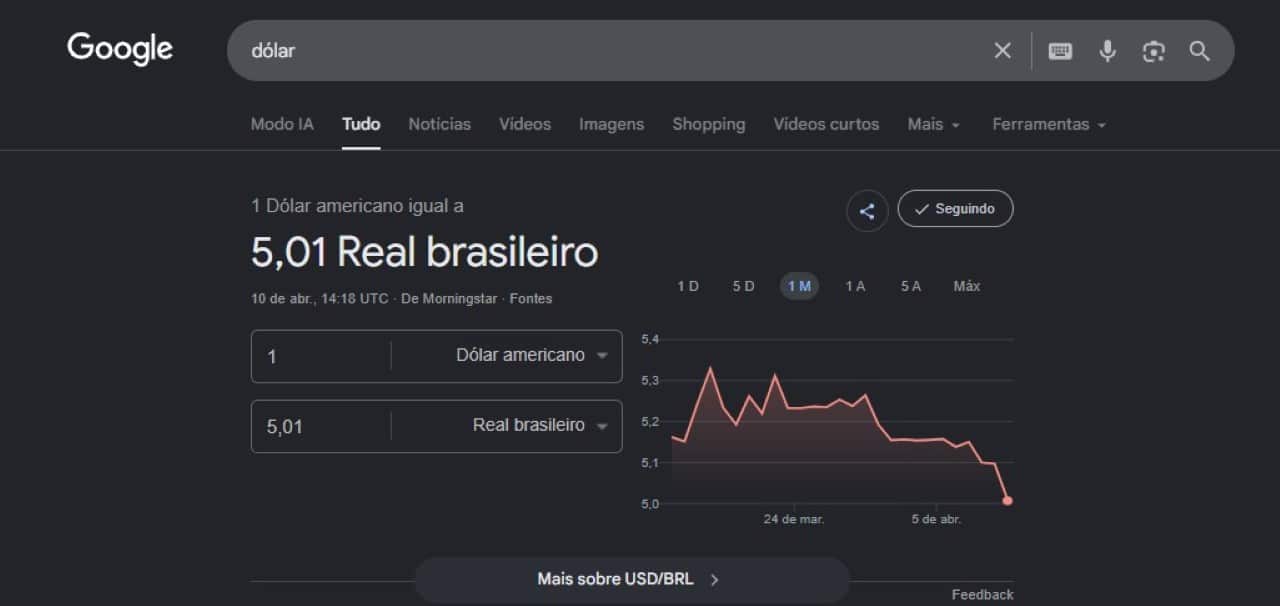
Real gains strength against the dollar, which falls to R$5.01 on April 10th, driven by truce


The North American currency registered a sharp drop against the real on the morning of this Friday, April 10, 2026, reflecting a global movement of devaluation of the dollar against other currencies from emerging economies. Este scenario is driven by the growing optimism of international investors regarding a possible ceasefire between Estados Unidos and Irã, an event that promises to ease geopolitical tensions.
At 10:38 am, the spot dollar was trading with a drop of 0.89%, being traded at R$5.0175 on sale, approaching the psychological mark of R$5.00. Paralelamente, on the B3 futures market, the dollar contract for May, considered the most liquid currently, registered a decline of 0.93%, reaching R$5.0350.
The day before, Thursday, the spot dollar had already closed operations down 0.80%, closing at R$5.0626. Este level represented the lowest closing value since April 2024, showing a tendency for the Brazilian currency to appreciate in the face of the dissipation of external risks and expectations of the reopening of vital trade routes.
Geopolitical scenario and its consequences on Brazilian assets
The main catalyst for the recent fall of the dollar has been the advance of negotiations for a ceasefire at Oriente Médio, specifically between Estados Unidos and Irã. The expectation that tensions in the region will decrease significantly has generated relief in global markets, with direct repercussions on risk aversion. Investidores tend to seek assets from emerging markets in periods of greater international stability.
The possible reopening of Estreito from Ormuz to tanker traffic is another crucial factor. Embora most of the ships circulating through Ormuz are still linked to Irã, the initial peace talks between US and Irã representatives, scheduled to begin on Saturday Paquistão, raise hopes of a complete normalization of traffic. Isso directly impacts oil prices and, consequently, the perception of global risk.
DXY movement and influence on other emerging currencies
In line with this scenario of reduced risk aversion, the DXY index, which measures the dollar’s performance against a basket of six strong currencies, has sustained declines. When operating below the 100-point mark, the DXY signals a widespread devaluation of the US currency, which amplifies the strength of other currencies.
This trend is not limited to the Brazilian real, but is observed in other currencies from emerging countries, such as the Chilean peso and the Mexican peso, which also appreciate against the dollar. José Faria Júnior, director of consultancy Wagner Investimentos, highlighted in an analysis to clients that “the reduction in risk aversion with the expectation of a ceasefire and the decline of the DXY to below 100 caused the real to rise in recent days, which approached the highest price of the year”. Ele added that the dollar still has room to fall a little further depending on the continued movement of the DXY index. Este movement reinforces the perception that external factors have been predominant in the current exchange rate dynamics.
Analysis of the March IPCA and expectations for the rate Selic
At the domestic level, Instituto Brasileiro from Geografia and Estatística (IBGE) announced that Índice Nacional from Preços to Consumidor Amplo (IPCA) registered an increase of 0.88% in March compared to February. Este number exceeded the projections of economists consulted by Reuters, who expected a rate of 0.77%. In the 12 months up to March, the IPCA increased 4.14%, also above the 4.00% projected by the market.
The higher-than-expected IPCA data caused an increase in short-term Depósitos Interfinanceiros (DIs) rates this Friday morning. Este result reinforces bets that the Brazilian Banco Central, at the end of the month, should promote a cut of just 25 basis points in the Selic rate, and not the 50 basis points that part of the market expected. Atualmente, the basic interest rate for Brasil is 14.75% per year.
The decision of Banco Central will be crucial for the balance between controlling inflation and stimulating economic activity. Embora Although the IPCA was higher than expected, monetary policy remains attentive to macroeconomic variables. More persistent inflation could limit the space for more aggressive interest rate cuts, which has direct implications for the cost of credit and investment in the country.
The interest differential between Brasil and the USA and the flow of investments
The interest rate differential between Brasil and Estados Unidos is one of the factors historically identified as attractive for the entry of foreign investments into the country. Atualmente, the interest rate in the US varies between 3.50% and 3.75%, while Selic in Brasil remains at 14.75%. Esta substantial difference makes Brazilian assets more profitable for foreign capital, encouraging the entry of dollars into the economy.
In recent months, this difference has contributed significantly to lower levels of dollar exchange rates against the real. The search for greater profitability by international investors results in a positive flow of capital that strengthens the national currency. Maintaining a high Selic, even in a context of economic slowdown, serves as a magnet for speculative capital in search of more attractive yields, which puts downward pressure on the dollar.
Banco Central strategies for the forex market
To manage liquidity and maturities in the foreign exchange market, Banco Central (BC) operates through foreign exchange swap auctions. This Friday morning, at 11:30 am, the BC held an auction of 50,000 traditional currency swap contracts. Essa operation was intended to roll over the May 4th expiration date, a standard measure to avoid imbalances in the transition of contracts.
These auctions are important tools for modulating the supply of dollars in the futures market and, indirectly, influencing expectations about the currency’s price. The active management of foreign exchange swaps is one of the ways in which the monetary authority seeks to stabilize the market and mitigate excessive volatility, ensuring a more predictable environment for economic agents. The continuity of these actions is essential for maintaining financial stability.
Expectations and projections for the future exchange rate of the American currency
With recent developments on the international scene and domestic macroeconomic data, projections for the dollar exchange rate remain under constant evaluation. The prospect of the continuation of the ceasefire in Oriente Médio and the possibility of the complete reopening of important trade routes suggest a global scenario of less risk aversion. No Brasil, although the IPCA surprised upwards, the attentive monetary policy and the interest rate differential still offer support to the real. The evolution of the peace negotiations, the next steps of the US Federal Reserve and the decisions of Brasil in relation to Selic will be decisive for the direction of the US currency in the coming weeks.