
Comet 41p/Tuttle-Giacobini-Kresák, belonging to the Júpiter family, has exhibited unprecedented rotational behavior that challenges conventional astronomical theories about the evolution of celestial bodies. File Dados obtained by Telescópio Espacial Hubble revealed that the object underwent a complete reversal in its direction of rotation during 2017. The discovery was detailed in a new paper by astronomer David Jewitt, but parallel interpretations suggest that the phenomenon may indicate something beyond natural processes.
Technical analysis indicates that the comet’s nucleus, approximately one kilometer in diameter, drastically changed its angular velocity after passing through perihelion, the closest point to Sol in its 5.4-year orbit. In March 2017, the object was rotating steadily, but subsequent observations of Observatório Neil Gehrels Swift showed a marked slowdown. In December of the same year, images captured by Hubble confirmed that the comet not only regained speed, but began to rotate in the opposite direction.
The main characteristics observed in the astronomical event include the following technical points that are fundamental to understanding the phenomenon:
- The rotation period varied from 46 to 60 hours to just 14 hours within a few months of solar approach.
- The rate of mass loss through outgassing is considered too high for the nucleus to survive in its current orbit.
- The force of the gas jets expelled by the surface is the primary scientific explanation for the torque that caused the spin reversal.
- The comet’s physical structure has a projected axial ratio of 1.4 to 1, demonstrating an irregular shape that facilitates propulsive influence.
Rotational inversion phenomenon challenges the longevity of the celestial body
The behavior of 41p/Tuttle-Giacobini-Kresák raises a puzzle about how the object still exists without having completely fragmented. Cálculos dynamics suggest that the intense activity observed should have destroyed the core or caused its total evaporation a long time ago, considering its stay of 1,500 years in the current route. The resistance of the material to the extreme torque applied by the gas jets suggests that the internal structure may be different from what is imagined for common space icebergs.
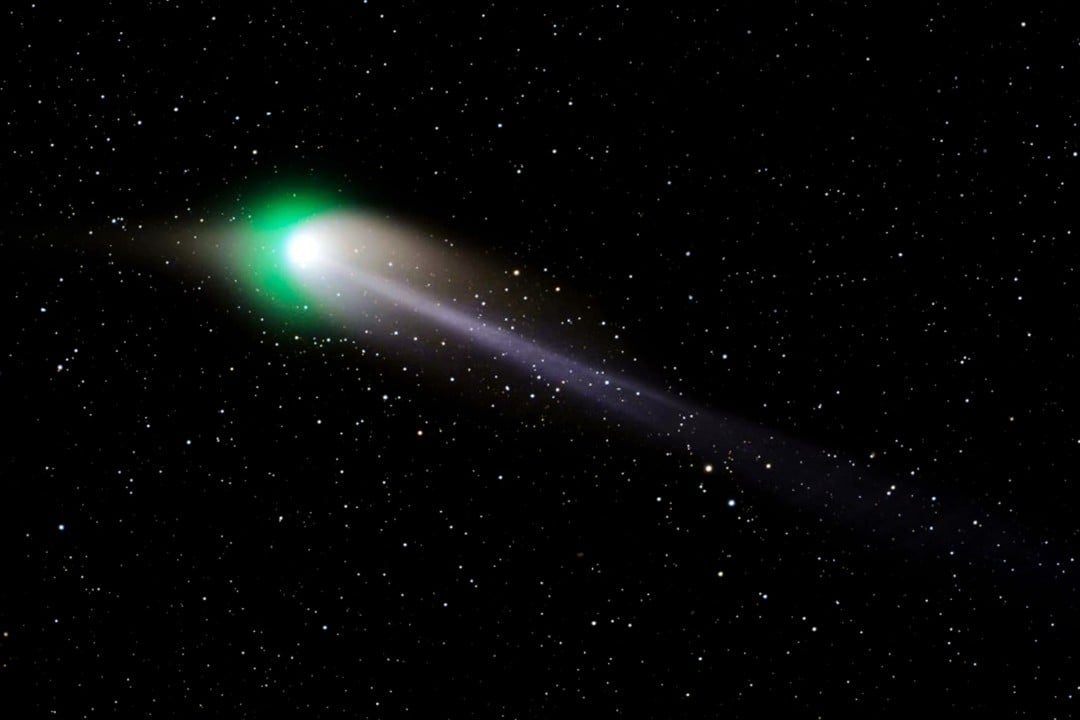
Experts point out that, if the degassing were so powerful as to reverse the rotation of a kilometer-long body, the structural integrity would be compromised. David Jewitt suggests that Hubble may have caught a moment of atypical activity, which would have inflated the data on mass loss. Outra academic possibility is that the current core is just the remnant of a much larger and more stable body that resisted solar erosion processes.
Embedded technology hypothesis emerges as an interpretative alternative
Astronomer Avi Loeb presented a divergent and provocative view of the data collected by Telescópio Hubble. Loeb suggests that the rotation reversal can be interpreted as a technological signature, functioning in a manner analogous to an artificial propulsion system. Segundo From this perspective, the comet could be a technological object camouflaged under the appearance of a natural body, using gas jets in a controlled manner for orbital maneuvers.
The idea that the 41p complex is a kind of spatial “Horse of Troia” gains strength due to the precision of the observed rotational change. Loeb argues that technological signatures are often omitted in traditional scientific articles due to academic rigor that avoids unnatural hypotheses. Para the researcher, the comet’s inexplicable survival of its own frenetic activity reinforces the need to consider artificial components embedded within its interior.
Degassing dynamics and the solar propulsion effect
The conventional explanation for the change in spin lies in the sublimation of surface ice as the comet approaches the solar heat. Bolsas of ice transformed into gas creates jets that act as natural propellants, exerting pressure on the irregular core. If the distribution of these jets is asymmetrical, the torque generated can brake the rotational movement until immobility and then start the rotation in the opposite direction, as observed in the 2017 data.
This process of acceleration and deceleration is common in smaller comets, but the scale and speed of the reversal in 41p remains unique in the astronomical record. The active fraction of the nucleus decreased significantly after perihelion, which would theoretically reduce the torque available for such drastic changes. The discrepancy between the decrease in surface activity and the increase in post-inversion rotational frequency is what fuels the debate between purely natural and artificial origin.
Hubble Space Telescope records confirm anomaly
The images integrated over 3,840 seconds allowed scientists to map the gas plumes around the comet with unprecedented precision. The use of specific filters on Hubble highlighted the brightness contours, highlighting the direction of material expulsion in relation to Sol and the object’s velocity vector. Esses Visual records are the factual evidence supporting both the irregular outgassing theory and the technological signature hypotheses.
The analysis of systematic brightness variations allowed the rotation period to be fixed at 0.60 days with a minimum margin of error. Esta metric precision rules out observation errors and confirms that the comet actually underwent an intense physical transformation in a short period of time. The astronomical community now turns its attention to the object’s next passage, seeking new data that can confirm whether the behavior is repeated cyclically or whether it was an isolated event.
Comet history and origin in the Kuiper belt
Comet 41p/Tuttle-Giacobini-Kresák is believed to have originated in Cinturão of Kuiper, an icy region beyond the orbit of Netuno. At some point in the past, gravitational interactions with Júpiter launched it into the inner solar system, where it now fulfills its periodic orbit. Essa trajectory exposes the object to constant heating and cooling cycles, which should accelerate its process of structural degradation and loss of volatile materials.
Comparison with other interstellar objects, such as 1I/`Oumuamua discovered at a similar time, places 41p in a context of constant surveillance for anomalies. Enquanto Most comets follow predictable patterns of wear and tear, the abrupt changes in direction and rotation observed in 41p place it at the top of the list of objects of interest for studies of extraterrestrial intelligence and advanced astrophysics. Continuous monitoring aims to determine whether the nucleus has a density that justifies its survival or whether there is a rigid internal structure.
Observation patterns and future monitoring missions
The coordinated use of multiple observatories, including Hubble, Swift, and the Discovery Channel telescope, was essential to triangulate the comet’s rotational changes. Cada equipment captured a different phase of the process, from the slow rotation in March to the inverted acceleration in December. Esse joint space monitoring effort is the model that scientists intend to apply to identify other bodies that present non-gravitational accelerations or unexplained spin reversals.
The expectation is that new imaging technologies and thermal sensors will soon be able to penetrate the gas cloud surrounding the comet to directly visualize the surface of the nucleus. Identificar The exact location of the jets and the morphology of the openings in the crust could end the debate about the nature of the object. Até until direct visual evidence of the internal structure is obtained, comet 41p will remain one of the greatest mysteries of contemporary celestial mechanics.
