
Astronomers detect pair of supermassive black holes on a collision course in the galaxy Mrk 501

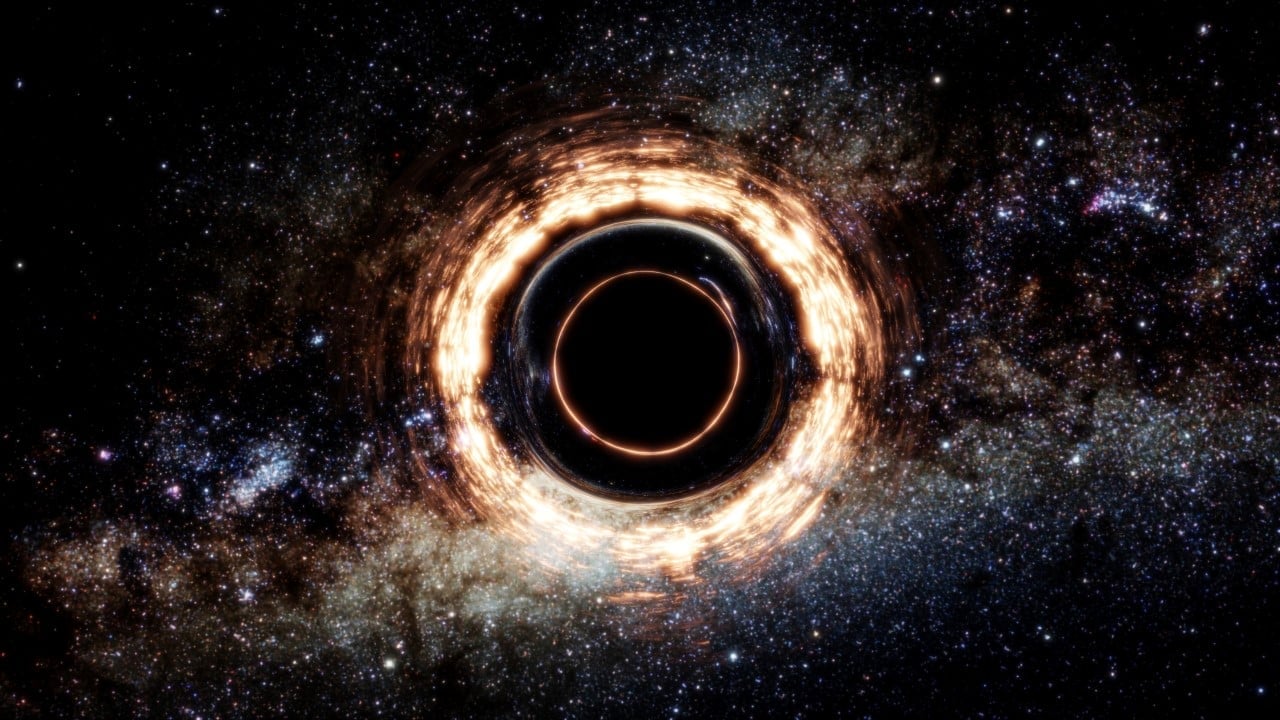
Continuous observation of deep space has revealed the existence of two supermassive objects in the process of spiraling in the center of the blazar galaxy Mrk 501. The phenomenon occurs approximately 500 million light-years from Terra and was identified through anomalies in the emission of light and electromagnetic radiation. Dados collected by radio telescopes indicate that the celestial bodies share a mutual orbital trajectory, with a physical separation that varies between 250 and 540 times the distance between our planet and Sol. Essa configuration points to an event of gigantic proportions in the fabric of space-time in the near astronomical future.
Orbital dynamics in the core of the constellation Hércules
The exact location of this binary system is in the region of the constellation Hércules, a sector widely monitored by international observatories. The extreme proximity between the two components suggests that the gravitational attraction process has already reached an advanced stage of evolution, changing the way matter behaves around the galactic center.
A second jet has been detected for the first time in a blazar—a sign of a rare black hole pair!
A second jet has been discovered in the core of the blazar Markarian 501 (Mrk)—rare evidence of the possible existence of a close pair of supermassive black holes on the verge of…pic.twitter.com/kzPzYPsI3O
— Black Hole (@konstructivizm)April 10, 2026
Systematic measurements carried out over more than two decades confirm that the mutual orbit is progressively shrinking. Esse continuous approaching movement generates significant disturbances throughout the environment around supermassive objects, emitting signals that can be captured and decoded by equipment at Terra.
Radiation emissions and particle jets
Detailed mapping of the galaxy’s active core demonstrated the presence of two distinct streams of particles that are accelerated to speeds close to that of light. The main jet has a higher intensity and is directed almost frontally towards the Earth’s line of sight, making it easier to capture its energetic data.
On the other hand, the secondary jet has a lower brightness and rotates around the primary axis. Essa double structure serves as proof that each component of the system maintains its own accretion disk independently, feeding on matter autonomously.
The decoding of the light signals captured by the instruments allowed the establishment of exact chronologies for the orbital movements. The researchers identified fluctuation patterns that mark the rhythm of the gravitational interaction between the two giants, providing the mathematical basis for calculating their masses.
- Identification of luminosity cycles with an orbital period of 121 days.
- Detection of double matter jets with asymmetric intensities.
- Measurement of masses equivalent to billions of times that of Sol.
- Confirmation of the loss of kinetic energy through gravitational waves.
Solving the final parsec puzzle
The current arrangement of celestial bodies in the galaxy Mrk 501 offers a practical answer to an ancient theoretical question in astrophysics. Modelos traditional data indicated that pairs of supermassive objects tended to stagnate their orbits when they reached a distance of one parsec, losing the ability to reach mechanically.
However, the observed configuration breaks this physical barrier due to the intense dissipation of orbital energy. The continuous emission of low-frequency gravitational waves acts as a natural braking mechanism, forcing a constant reduction in the distance between the components of the binary system.
Capturing frequencies in space-time
The extreme proximity between the masses makes the galactic nucleus an extremely important target for international pulsar timing networks. Esses scientific consortia are dedicated to detecting the ripples generated by continuously accelerating masses, using pulsars as high-precision cosmic clocks.
Tracking the frequency of these waves provides real-time information about the exact rate at which celestial bodies are approaching. The instruments operate with the expectation of recording the gradual increase in the intensity of the emitted signal, validating physical theories about gravity.
As the orbit shrinks, the disruption to the fabric of space-time becomes more pronounced and detectable by equipment on Terra. Essa continuous capture is critical to calculating the binary system’s energy loss and predicting the exact moment of unification.
The precision of this data allows scientists to predict the final stages of the mass interaction process. Uninterrupted monitoring ensures that any change in trajectory is immediately recorded and analyzed by research teams spread across the globe.
Thermal behavior of matter around the giants
The mutual gravitational interaction exerts very high intensity tidal forces on the vast clouds of gas and dust that orbit the central region of the galaxy. Esse constant and severe friction heats matter to temperatures that exceed the million-degree mark, resulting in an intense glow that can be captured in multiple bands of the electromagnetic spectrum. Cada central body autonomously attracts and consumes matter, generating exclusive energetic signatures that travel through space until they reach terrestrial and space detectors, allowing a clear distinction between the two emission sources.
Despite the independence in feeding of each component, the gravity of the companion body continually distorts the flows of matter around the system. Essa uninterrupted disturbance is mainly responsible for the irregular variations in luminosity recorded by telescopes dedicated to monitoring blazars. Maintaining two separate accretion disks in such a restricted orbit forces the scientific community to review the parameters used in computational simulations of astrophysical fluid dynamics, improving understanding of the behavior of matter in extreme conditions.
Structural transformation in the local universe
The in-depth study of the dynamics present in the galaxy Mrk 501 fills essential gaps in the understanding of the growth and evolution mechanisms of galaxies in the cosmos. The merger of supermassive centers serves as the primary driver for the formation of the giant elliptical galaxies that are frequently observed in the local universe. Durante In the final approach phase, the transfer of angular momentum acts to expel nearby stars from their original orbits, permanently altering the morphology of the entire central region. Esse process creates nuclei with a considerably reduced stellar density when compared to the structure of common spiral galaxies. Furthermore, the immense amount of energy released during the event has the capacity to completely halt the formation of new stars in the host galaxy, as the strong winds driven by radiation sweep away the cold gas necessary for stellar birth in the peripheral areas. Direct observation of this system provides the practical data needed to decipher the evolutionary history of other active galaxies scattered throughout space.
Applied radiointerferometry technology
Obtaining images with the necessary spatial resolution to distinguish details 500 million light years away requires the use of long-baseline interferometry techniques. Esse method connects radio antennas distributed across several continents, forming a virtual telescope with a diameter equivalent to that of Terra, whose signals are synchronized by high-precision atomic clocks and processed by supercomputers dedicated to analyzing petabytes of data.
Observational window in modern astronomy
The estimate that the main unification event will occur within approximately a century represents an extremely short period within the cosmological time scale. Diferentemente of events involving bodies of stellar mass, which last only fractions of a second, the merger of supermassive objects generates continuous signals that last for decades. Essa unique feature allows the planning of coordinated observational campaigns, involving ground-based observatories and space telescopes that operate in X-rays, gamma rays, infrared and radio waves. The preparation of the global scientific infrastructure to record this historic moment mobilizes space agencies and research institutes in several countries, testing the limits of the theory of general relativity in regimes of extreme gravity.





