Five complex sci-fi films require multiple rewatches to fully understand
The science fiction genre has established itself as one of the most respected and profitable pillars of the modern film industry around the globe. Sua The ability to expand horizons and explore the limits of human imagination attracts audiences of different age groups, offering everything from visual entertainment to deep philosophical reflections on the future and technology. The continued success of these productions lies in the ability of filmmakers to mix real scientific theories with fantastic elements, creating universes that seem distant and familiar simultaneously.
The inherent complexity of these scripts, however, often imposes a considerable challenge on the average viewer upon first viewing. Muitas times, the depth of the topics covered, such as quantum physics or temporal paradoxes, makes the narrative difficult to be fully assimilated in a single contact. Esse phenomenon generates a culture of revisiting, where enthusiasts and cinephiles watch the same titles repeatedly to decipher hidden clues and script nuances.
- Science fiction uses intellectual concepts to elevate the quality of dramatic storytelling.
- Complex films require careful attention to visual details and technical dialogue.
- Ambiguity in film endings is a common resource to stimulate debate.
- Great directors collaborate with scientists and writers to ensure theoretical veracity.
Narrative complexity in cult and modern classics
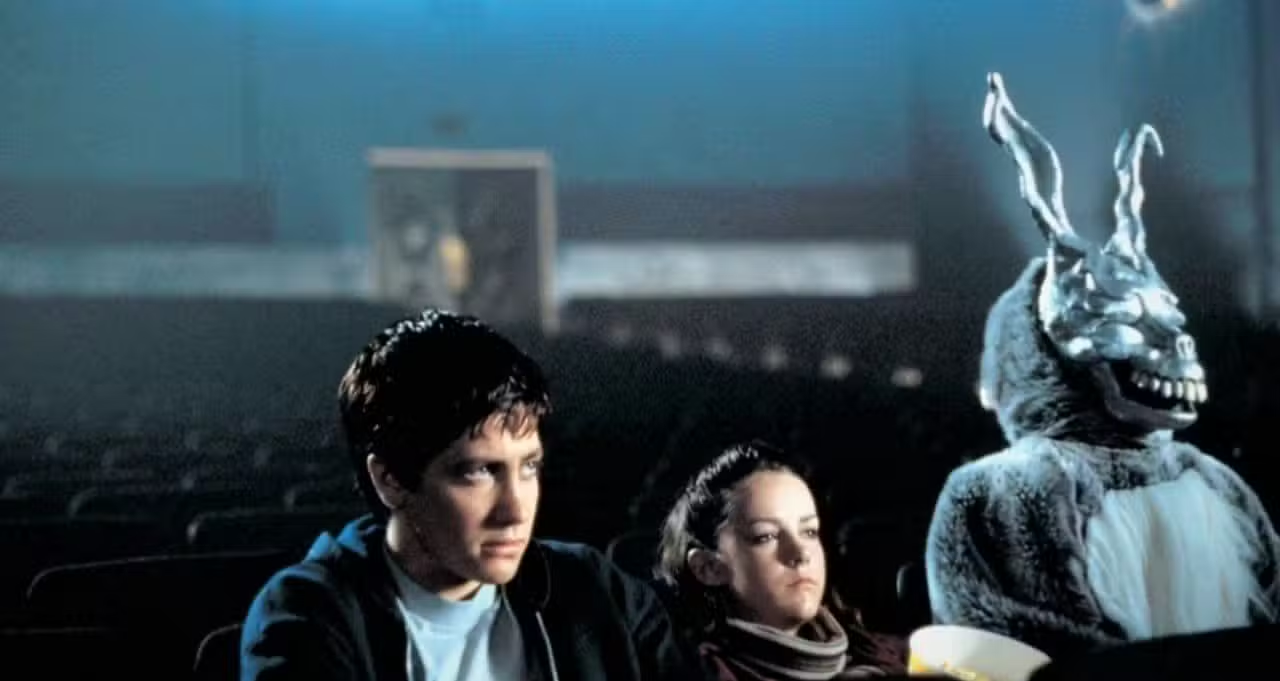
The 2001 production titled Donnie Darko serves as an emblematic example of how the genre can be dark and intellectually demanding at the same time. Inicialmente, the film looks like an ordinary teen drama, but it quickly turns into a dense exploration of divergent timelines and theoretical physics. The abrupt conclusion of the work leaves many questions open, forcing the audience to return to the beginning of the story to seek answers about the protagonist’s real motivations and the gears of that universe.
The film not only features a non-linear plot, but also utilizes a visual aesthetic that complements its purposeful mental confusion. Viewers often report that new layers of meaning emerge with each new viewing, making the film an ongoing learning experience. Essa characteristic turned the work into an absolute classic, respected for its courage in not offering simplistic explanations for extraordinary events that occur on screen.
The legacy of Stanley Kubrick in science fiction
Considered by many to be the definitive masterpiece of the genre, 2001: Uma Odisseia no Espaço remains one of the most debated films in the history of world cinema. Lançado in 1968, the project was the result of an intense collaboration between the director Stanley Kubrick and the renowned writer Arthur C. Clarke, resulting in an unprecedented sensorial experience. The final act of the film is notorious for its abstract nature, using psychedelic and symbolic images that speak more to themes of human evolution than to conventional narrative logic.
The absence of dialogue in long sections of the work requires the viewer to interpret the story through complex visual and sound metaphors. Assistir Watching this film just once is rarely enough to capture the grandeur of the message about the origin and destiny of humanity in the cosmos. Because it is visually arresting, the process of rewatching it becomes pleasurable, allowing each technical detail to be appreciated in its entirety as the mind tries to organize the pieces of the Kubrickian puzzle.
- The use of innovative practical effects in 1968 still impresses audiences today.
- The classical soundtrack replaces the traditional narration to guide the feeling of the plot.
- The monolith represents a narrative tool that requires subjective interpretation.
Psychological explorations and time travel
The film Solaris, directed by the Russian master Andrei Tarkovsky in 1972, approaches science fiction from a deeply psychological and emotionally charged perspective. The story focuses on a space station orbiting a sentient planet, where the crew begins to manifest mental crises and reconnect with figures from their past in physical form. It is a work that values silences and subtleties, where each scene contains metaphysical meanings that may go unnoticed in a superficial or hasty viewing.


Unlike space action films, the pacing of Solaris is deliberately slow to allow the weight of loneliness and regret to be felt by those watching. The complexity here lies not just in the science of the titular planet, but in the intricate nature of human consciousness and memory. Compreender What is real and what is mental projection requires a level of concentration that few modern works can demand from their audience in such an effective way.

Structures of time and spirituality in cinema
Fonte da Vida, directed by Darren Aronofsky in 2006, is often cited as one of the most ambitious and difficult to categorize films of the early twenty-first century. The narrative interweaves three distinct stories that take place in the past, present and a space-faring future, all connected by themes of love, mortality and the search for eternal life. Hugh Jackman and Rachel Weisz portray the protagonists in different eras, creating an emotional web that challenges viewers’ linear perception of time.
The mix of spiritual elements with pure science fiction creates a dense atmosphere that can be confusing during the first contact with the work. Fãs dedicated people say that the need to revisit the film is part of the artistic experience intended by the director to convey the immortality of human feelings. The film’s visuals, which use chemical reactions rather than computer graphics to represent space, add a layer of beauty that invites constant re-contemplation.
The ultimate challenge of the temporal paradox
Released in 2014 and starring Ethan Hawke, the film Predestinado adapts a classic tale by Robert A. Heinlein about the extreme consequences of time travel. The plot follows a temporal agent who tries to stop a historical criminal, only to find himself caught in a web of events that defy the logic of cause and effect. The film is famous for having one of the most shocking and cerebral twists in science fiction, completely altering the perception of everything that was previously shown.
The cyclical structure of the story is assembled with such precision that each dialogue and object in the scene serve as clues to the monumental outcome of the work. Upon finishing the film, the audience’s almost universal reaction is the immediate desire to start watching it again to see how the pieces fit together from a new perspective. It’s an exercise in pure logic that rewards those who take the time to analyze each frame, consolidating itself as one of the most intelligent and underrated scripts of the last decade in cinema.
Veja Tambem em Latest News (EN)

Heavy rain and storms hit 17 Indian states this Tuesday with warning from IMD

Claude down in global outage and Anthropic confirms errors in models

Typhoon No. 6 Chanmi approaches southern Kyushu and advances to eastern Japan

Seibu Lions have game canceled due to typhoon and schedule Kaima Taira for the 4th against Hanshin Tiger

Facebook whistleblower, Sarah Wynn-Williams, complies with Meta’s order and remains silent at event in the United Kingdom

Romantic comedies and mysteries arrive on Netflix in June with Office Passion and Oasis

Uruguay announces squad list for the 2026 World Cup with six Brazilian football players

When does the 2026 World Cup start? Date, time, first game and opening ceremony

Atlético-MG confirms agreement with defender Léo Duarte after period of prominence in Turkish football

Tiger shark bites 19-year-old girl and rips off her leg in Boa Viagem, Recife

2026 World Cup will have 32 athletes who play in Brazilian football