

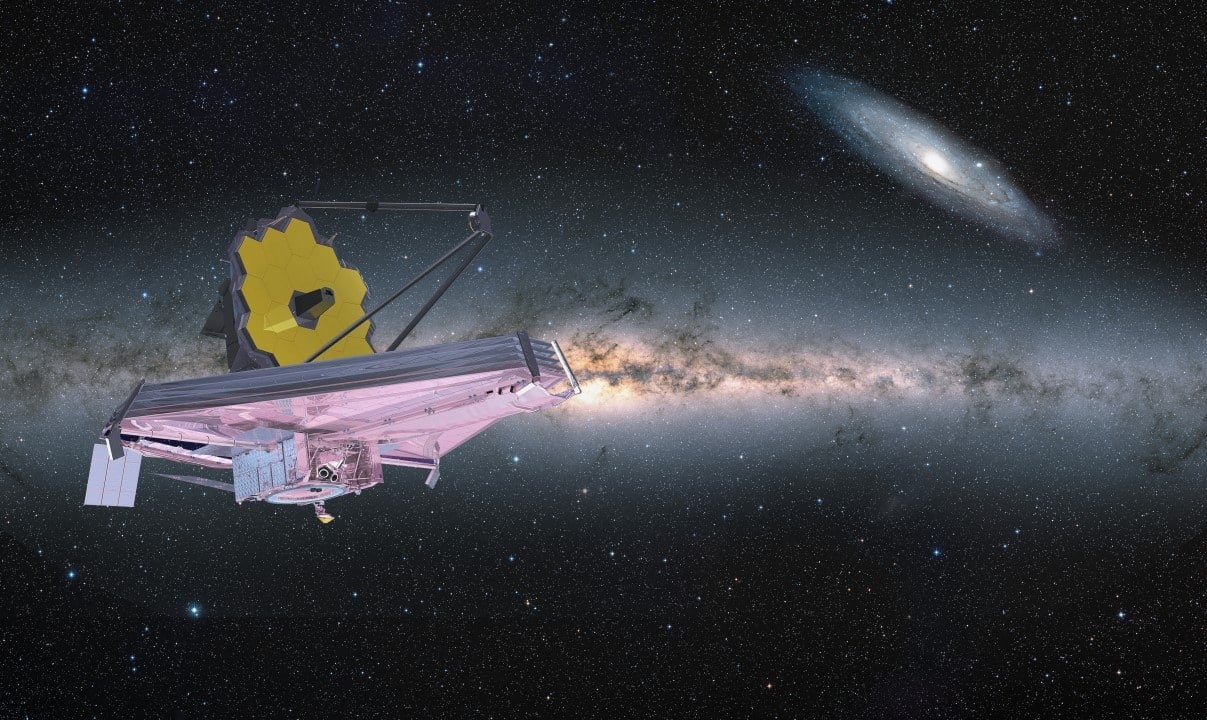
Telescópio Espacial James Webb detected spectral signals in a galaxy observed as it was 13.4 billion years ago. The data indicates the possible presence of stars from População III, the first generation formed after Big Bang. Dois independent studies analyzed the same system with complementary methods and reinforced the hypothesis.
The evidence comes from an object called Hebe, located near the galaxy GN-z11. The researchers observed strong emissions of doubly ionized helium with no detection of heavier elements. Esse chemical pattern is consistent with stars formed only from hydrogen and helium.
Galaxy GN-z11 Details
The GN-z11 galaxy is among the most distant ever observed. Ela appears as it did about 400 million years after Big Bang. Object Hebe lies approximately three kiloparsecs from the main galaxy.
The new observations used James Webb’s NIRSpec-IFU instrument with higher resolution. The data confirmed a helium emission line that had already been suggested in previous analyses. An independent detection of ionized hydrogen at the same location further supported the results. The helium emission appears resolved into two components separated by about 120 kilometers per second.
Primitive gas analysis
The team led by Roberto Maiolino, Universidade, and Cambridge investigated the gas surrounding the galaxy. The data show an environment with an almost exclusive composition of helium and the absence of metals. Esse gas type is considered primitive and compatible with initial Universo conditions.
Within the system, object Hebe showed intense emission of doubly ionized helium. Esse signal requires very energetic radiation sources, such as extremely massive and hot stars. The researchers tested other explanations, including direct-collapse black holes and Wolf-Rayet stars, but these scenarios did not explain all the observed features well.

- Confirmed emission of HeII λ1640 with equivalent width greater than 20 angstroms
- Absence of detectable metal lines in the region
- Gas with little evolved chemical composition
- Location about 3 kpc from the galaxy GN-z11
- Support independent detection of Hγ at the same point
Physical modeling of the object Hebe
The second study, led by Elka Rusta, Universidade, and Florença, focused on physical modeling. The team evaluated which scenarios best reproduce the measured emission lines. The results indicate that stars from População III with masses between 10 and 100 times that of Sol explain the observed properties.
This mass range is in line with theoretical predictions for the first stars. The authors highlighted that the primitive environment and the lack of heavy elements reinforce the interpretation. Ainda Thus, the researchers emphasized that the discovery requires further observations to eliminate remaining uncertainties.
Importance for understanding the initial Universo
The stars of População III would have appeared in a Universo composed basically of hydrogen and helium. Elas produced the first heavier elements through nuclear fusion. Studying these stars helps reconstruct how the first cosmic structures formed and how their chemical composition evolved over time.
Observations of James Webb allowed access to regions of Universo that were previously inaccessible. The high resolution of the instruments revealed spectral details in very old objects. The two studies used different approaches on the same data and reached converging conclusions about object Hebe.
Next steps in observations
The authors of both works indicated that new observations with James Webb will be necessary. The objective is to definitively confirm the nature of the emissions and validate the hypothesis of primordial stars. Equipes International continue to analyze the GN-z11 system and nearby regions.
The results were published as preprints and are in the process of being reviewed by the scientific community. Eles represents the strongest evidence to date for the observational existence of População III.