
Scarcity of cold interstellar gas in the universe reduces the rate of expansion of giant black holes

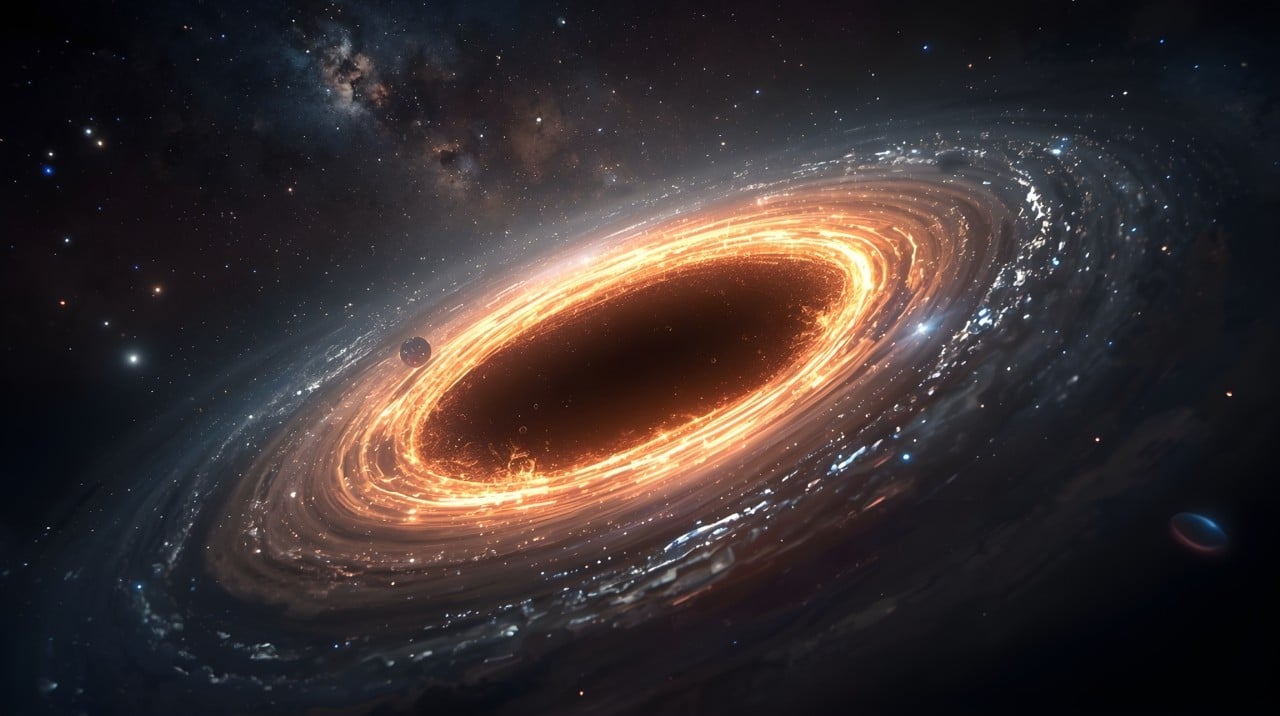
The rate of expansion of the largest objects in the universe has seen a steady decline over the past ten billion years. A comprehensive analysis of thousands of galaxies has revealed that gigantic black holes are consuming matter much more slowly today. The phenomenon occurs due to the progressive depletion of cold gas reserves in interstellar space.
This material acts as the main fuel for the mass gain of these extreme cosmic structures. Sem A sufficient amount of raw material is available, the accretion rate plummets, directly altering the dynamics of entire systems. The survey used data from multiple space telescopes to map the behavior of thousands of active nuclei spread across the cosmos.
The mechanics behind cosmic giants
Supermassive structures house a quantity of matter equivalent to millions or even billions of times the mass of our Sol, concentrated in a region of unimaginable density. The gravitational force generated by these bodies is so extreme that it completely dominates the center of most known galaxies, including Via Láctea. The outer limit of this region, called the event horizon, marks the point of no return, from which absolutely nothing can escape. Antes After crossing this border, the captured material forms an accretion disk that rotates at very high speed and reaches extreme temperatures. Esse intense heating generates a strong emission of X-rays, which travel through space and allow astronomers to measure exactly how much matter is being devoured. Quanto The brighter the energy signature detected by the instruments, the greater the volume of material consumed by the galactic nucleus.
In the case of our own galaxy, the central object has about four million solar masses. Continuous monitoring of this region helps to understand how the presence of such a massive body regulates the birth of new stars. The interaction between extreme gravity and dust clouds dictates the pace of evolution of the entire system.
The height of activity at cosmic noon
The current scenario contrasts sharply with the period of greatest turmoil in the history of the universe, which occurred around ten billion years ago. Essa golden age of astronomy is classified by scientists as cosmic noon, marking the absolute peak of star formation and black hole feeding. Naquela time, space abounded in vast clouds of cold gas, which served as an inexhaustible feast for active nuclei. Young galaxies had chaotic dynamics, with frequent collisions and an extremely high rate of conversion of matter into energy.
To reconstruct this timeline, researchers turned to cutting-edge observatories such as Chandra, XMM-Newton and eROSITA. The crossing of information made it possible to compare the intensity of X-ray emissions in different geological eras of the cosmos. Records confirm that consumption activity in the distant past exceeded levels measured in the contemporary universe by many times.
Mapping thousands of galaxies
The conclusion about the slowdown did not arise from isolated observations, but rather from one of the largest statistical surveys ever carried out on the topic. The scientific team processed information from approximately 1.3 million distinct galaxies, identifying around eight thousand black holes in full activity. Essa Massive sampling was key to separating the individual effects of each object from the overall trends of the universe. The data revealed that the drop in radiation emission did not occur because there are fewer black holes today, but because the consumption rate of each of them has plummeted dramatically. The precision of modern instruments has made it possible to isolate the accretion variable, proving that the hunger of these structures remains the same, but the pantry is increasingly empty. Estudos Complementary data in other bands of the electromagnetic spectrum validated the fuel shortage thesis.
Processing this mountain of data required advanced algorithms capable of filtering out interference and focusing only on the energetic signatures of galactic nuclei. The scan covered different distances, which in astronomy means looking at different times in the past. The end result draws a clear downward curve, showing a gradual loss of vitality in the central regions of galaxies as time progresses.
Fuel depletion mechanisms
The loss of raw material does not happen for a single reason, but for a combination of factors that drain the natural reservoirs of galaxies. The life cycle of stars and the activity of supermassive cores work together to disperse or consume the available material. Sem efficient external replacement, the system enters a state of irreversible decline.
- The mass birth of new stars rapidly consumes interstellar gas clouds.
- Supernova explosions generate shock waves that heat and expel remaining material into intergalactic space.
- Jets of radiation emitted by the black holes themselves sweep through the central regions, pushing matter away from the capture zone.
- The increase in ambient temperature prevents the gas from condensing and falling towards the event horizon.
- The absence of recent galactic collisions reduces the injection of fresh gas into older systems.
This sequence of events illustrates the concept of galactic feedback, where the galaxy’s own growth limits its future expansion. The energy released by the star formation processes and by feeding the black hole creates a physical barrier that keeps the food away. Como direct consequence, the average accretion rate drops, forcing the cosmic giants into a strict and prolonged diet.
The future of a calmer universe
The impact of this lack of resources profoundly alters the appearance and behavior of large-scale structures. Galáxias that previously shone brightly with the birth of blue stars now take on redder tones, indicating the aging of their stellar populations. The nuclei, previously active and bright, become dark and silent most of the time. The black holes are still there, exerting their gravitational force, but in a state of almost dormancy.
The current panorama points to a cosmos that is much less turbulent than in his youth. The long-term trend is for the universe to be increasingly dominated by ancient stars, stabilized systems and black holes with already consolidated masses. New generations of space telescopes will have the mission of refining these models and searching for isolated galaxies that still preserve untouched pockets of gas.





