
High-precision scanning alters identity of marine animal extinct 300 million years ago

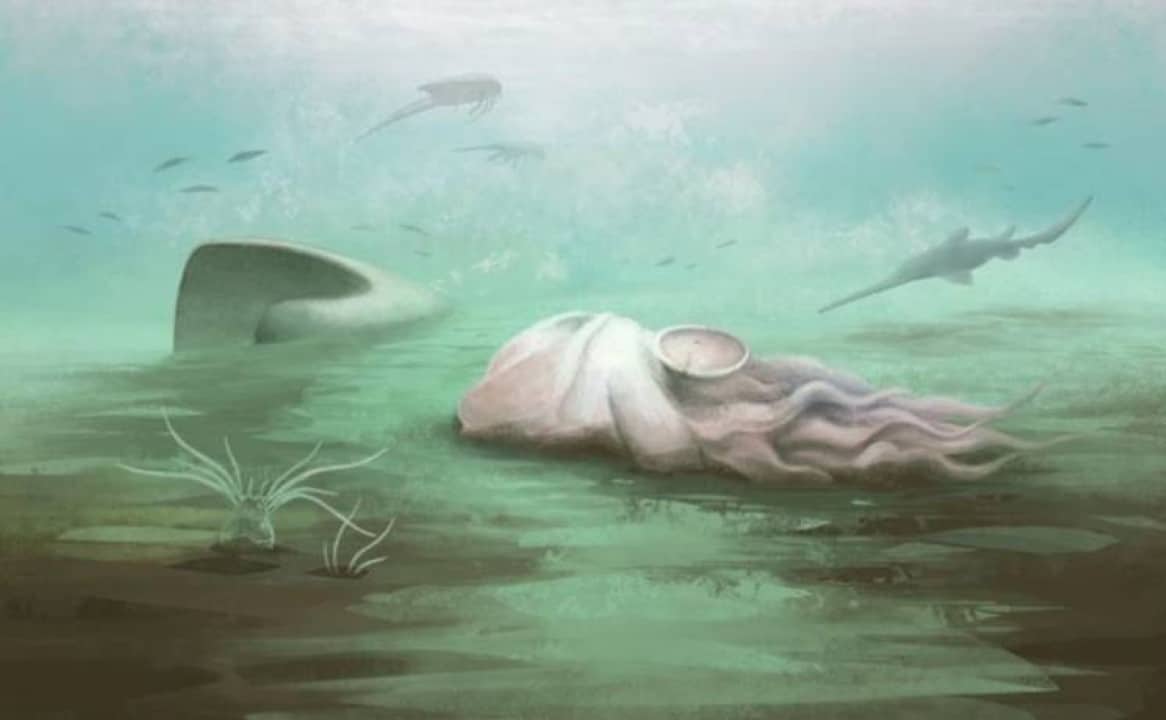
A marine fossil discovered south of Chicago has lost its title as the world’s oldest octopus after 26 years of incorrect cataloguing. Pesquisadores of Universidade of Reading used highly accurate imaging exams to reevaluate the 300 million year old piece. The specimen belongs to an extinct lineage of relatives of modern nautiluses. The detailed taxonomic correction appeared in the pages of the scientific journal Proceedings of the Royal Society B on April 8, 2026.
The scientific community based its studies on the premise that the animal represented the first evolutionary stage of octopuses. The new structural analysis proved that the external shape of the rock displayed only the remains of a severely decayed body. The historical error masked the organism’s true biological identity. The discovery demands an immediate rewriting of the timeline of early cephalopods.
Luz synchrotron reveals internal anatomy without damaging the material
The turnaround in the case depended on the use of complex equipment called a synchrotron. Essa machine acts as a giant particle accelerator. The system generates extremely powerful X-ray beams, reaching a brightness much higher than that of direct sunlight. The technology allowed scientists to perform full three-dimensional scans of the dense rock interior. The method preserved the physical integrity of the fossilized material throughout the process.
Initial assessments carried out in 2000 used conventional scanning electron microscopes. Esses old devices had a serious technical limitation. The instruments were only able to map the external topography of the piece, generating interpretations based purely on the visible surface contour. Synchrotron light passed through thick mineral layers and illuminated fossilized organs with unprecedented microscopic resolution. Technological advances ended decades of morphological debates.
Intact oral cavity Estrutura rules out any relationship with octopuses
The central element revealed by the new three-dimensional scan was the prehistoric animal’s radula. Essa structure functions as a complex mouth apparatus, used by several species of molluscs to scrape surfaces and process food. X-ray equipment identified the perfect preservation of entire rows of teeth within the rock matrix. The clear visualization of this internal organ provided the exact basis of comparison that paleontologists lacked.
Mathematical analysis of the radula demonstrated that the organism had at least 11 teeth arranged in each food row. Esse specific number contrasts starkly with the anatomy of all octopuses known to science. Species in the Octopoda group have a strict biological pattern of seven to nine teeth in the same region. The incompatible count represented definitive proof for excluding the specimen from this category. The researchers crossed the data with gene banks and found the exact match with the nautilus ancestors.
Processo of rotting at the bottom of the sea generated optical illusion
The external shape of the fossil misled dozens of experts due to an aggressive process of organic deterioration. The 2026 study indicated that the animal’s body underwent several weeks of decomposition on the ocean floor before final burial by sediment. Esse prolonged rotting completely disfigured the original structure of the marine organism. The collapse of the tissues created artificial folds and stretches in the flesh.
The physical distortion perfectly simulated the appearance of long, thin arms attached to a soft body. The proportions of the supposed tentacles already generated distrust among a minority of the scientific community. The tracks did not display the typical sucker markings found in other records of early octopuses. The new identification confirmed that the visible shapes were merely the crushed remains of an animal that had an entirely different body configuration. Fatores Environmental extremes have masked biological reality for nearly three decades.
Alteração drastic in evolutionary biology timeline
The historic specimen was rescued from geological deposits from the Carbonífero period in the North American region. Essa specific area of Chicago houses rock formations with rare chemical conditions, ideal for preserving the soft tissues of prehistoric creatures. The period marked an immense diversification of global oceanic fauna. Correctly cataloging the inhabitants of this era provides vital information about the geographic distribution of the first molluscs.
The removal of this fossil from the octopus category changes the understanding of the emergence of the species on the planet. The age of 300 million years placed the origin of the group in a very remote time. The oldest confirmed records of true octopuses now focus on the range 90 million years ago.
Taxonomic correction generates immediate consequences for academic research:
- Redefine the mathematical models on the genetic mutation rate of cephalopods.
- Adiciona a new extinct relative to the nautilus family tree of the Carbonífero period.
- Estabelece the need for new verification protocols for soft-body fossils.
Museus prepares mass review of paleontological collections
The outcome of the Chicago fossil drives a change in behavior in international scientific institutions. The proof that natural decomposition forges entire anatomical features raises a red flag about ancient pieces. Especialistas point out the urgency of re-examining other dubious fossils stored in museum drawers around the world. The use of synchrotron light is consolidated as the new gold standard for validating descriptions based only on external appearance.
The original fossil remains protected under the custody of institutions in Estados Unidos. The material will remain available for future investigations if even more powerful scanning technologies emerge in the coming years. Relocating the specimen to the tree of life keeps the significance of the discovery intact. Paleontólogos continues to map Chicago’s rocks in search of new specimens that help put together the puzzle of primitive marine life.





