Black holes don’t suck up the entire universe because of distance and gravity
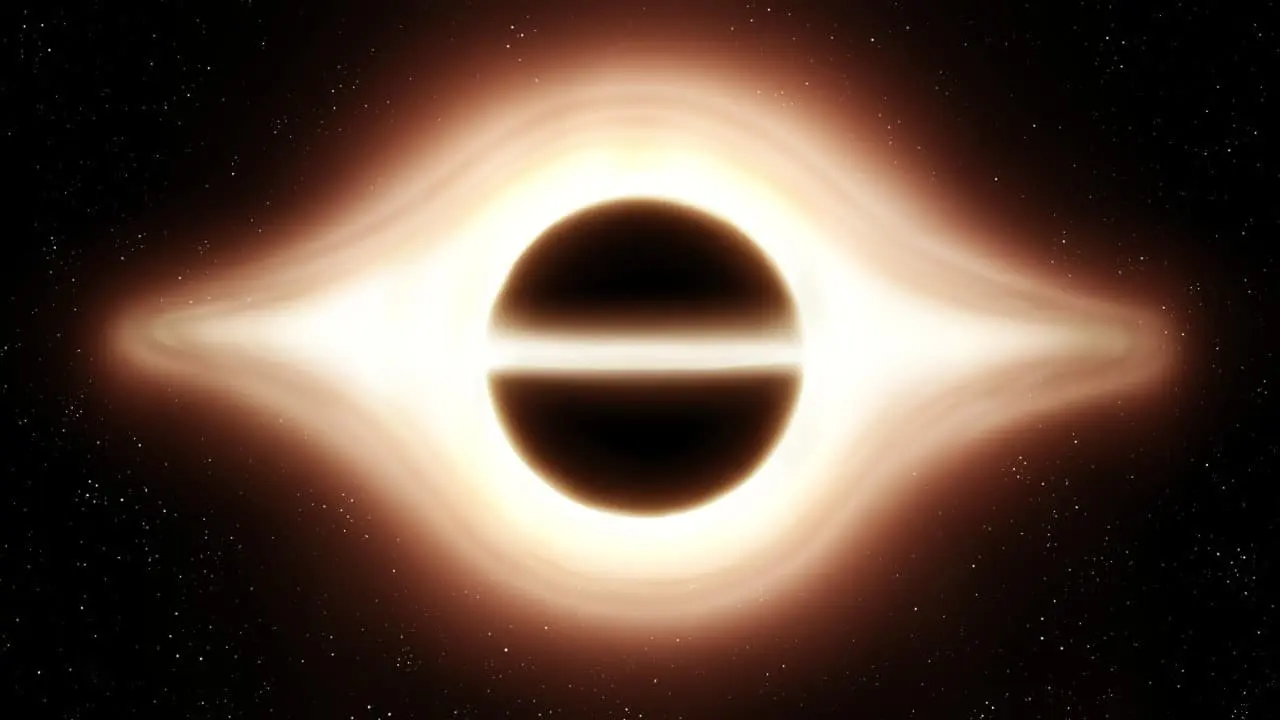
The gravity of a black hole follows the same rules as that of any other object with equivalent mass. Ela decreases with the square of the distance. That’s why objects very far away hardly feel the effect.
If Sol were replaced by a black hole with the same mass, the planets’ orbits would remain practically the same. The Terra would maintain its path around the center point. Nada would suddenly be pulled in. The difference would only appear if something got too close to the limit called the event horizon.
The event horizon marks the point of no return. Nada, not even light, can escape from there. Esse limit is named Schwarzschild radius. Ele depends only on the total mass of the object. Quanto the greater the mass, the greater the radius.
Concentrated Massa sets horizon size
Buracos blacks arise from the collapse of very massive stars. Quando nuclear fuel runs out, gravity overcomes other forces and compresses matter into an extremely small volume. What remains is a region where space-time curves so intensely that it forms the horizon.
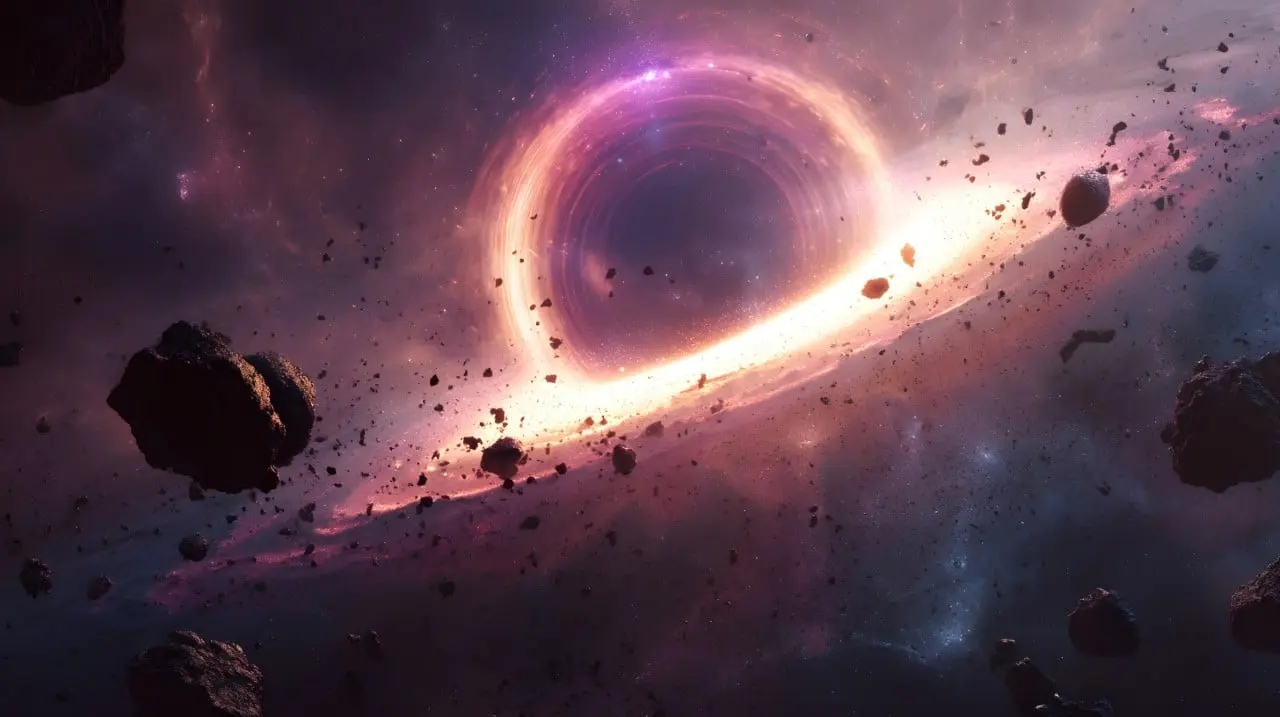
The radius of Schwarzschild from Sol would be about three kilometers. Já that of Terra would be around nine millimeters. Esses numbers show how much matter needs to be compressed to create the extreme effect.
- An ordinary star distributes its mass over a large volume.
- A black hole concentrates that same mass into a tiny space.
- Gravity at the horizon becomes strong enough to stop light from escaping.
- Fora From this limit, the gravitational field behaves like that of a normal star.
The basic formula for the radius of Schwarzschild takes into account the gravitational constant, mass and the speed of light squared. Ela confirms that size grows linearly with mass. Buracos supermassive blacks at the center of galaxies have radii that reach millions of kilometers, but still exert limited influence beyond a certain distance.
Distâncias cosmic reduce practical effect
The universe has immense scales. Estrelas and galaxies are separated by light years or millions of light years. Nessa order of magnitude, the gravitational force of any black hole drops to values close to zero.
Objetos with enough angular momentum can orbit black holes without falling. Eles form accretion disks or simply follow stable trajectories. Somente matter that crosses the event horizon is irreversibly captured.
Buracos stellar blacks, formed by the collapse of stars, have a mass a few times that of Sol. Eles stay inside galaxies, but do not pull distant stars. Supermassives, with millions or billions of solar masses, influence the movement of stars close to the galactic center. Mesmo thus most of the galaxy orbits at safe distances.
Gravity is not infinite “suction”. Ela obeys the inverse square law. Quanto further away, the weaker the attraction. This is why the entire cosmos does not collapse into a single point.
Leia Também

Messi reaches 19 goals in FIFA World Cups with great free kick for Argentina in clash with Jordan

Cristiano Ronaldo shines beyond the pitch at the 2026 World Cup with business empire and family luxury

At 41, Cristiano Ronaldo reaffirms his historic legacy and prepares to shine in the 2026 World Cup
Buracos blacks grow gradually
Quando matter falls into a black hole, part of it releases energy before crossing the horizon. Essa energy appears as radiation or jets. The black hole gradually gains mass, but the process depends on available matter nearby.
In empty regions of interstellar space, there is almost no matter to be captured. Buracos isolated blacks grow very slowly. Mesmo’s most active ones, like the ones that power quasars, consume gas and dust from surrounding disks, not entire stars light-years away.
Sol will never become a black hole through natural evolution. Sua mass is insufficient for final collapse in this path. Estrelas with at least three times the mass of Sol can follow this route at the end of life.
Comparação between types of black holes
Buracos black stars have small radii, in the range of tens of kilometers. Sua local influence is strong but restricted. Já supermassives occupy larger volumes in the centers of galaxies. Their average density can be low, similar to water in some extreme cases, because radius grows with mass.
In both cases, the behavior at large distances remains the same. Gravity is equivalent to that of any other body with the same mass. Extreme compaction only matters near the horizon.
What happens if something gets too close
Perto from the horizon, tidal forces can stretch objects. Isso occurs because gravity varies greatly between nearby points. But this effect only manifests itself in the immediate neighborhood. The vast majority of celestial bodies in the universe are far enough away to not experience any of this.
Filmes and science fiction often exaggerate the idea of a “vacuum” that devours everything. In practice, orbital mechanics and cosmic distances protect most matter.
Buracos black people are part of the normal evolution of the universe. Eles emerge, grow and influence the local environment. But they do not pose a global threat precisely because space is vast and gravity weakens quickly with distance.