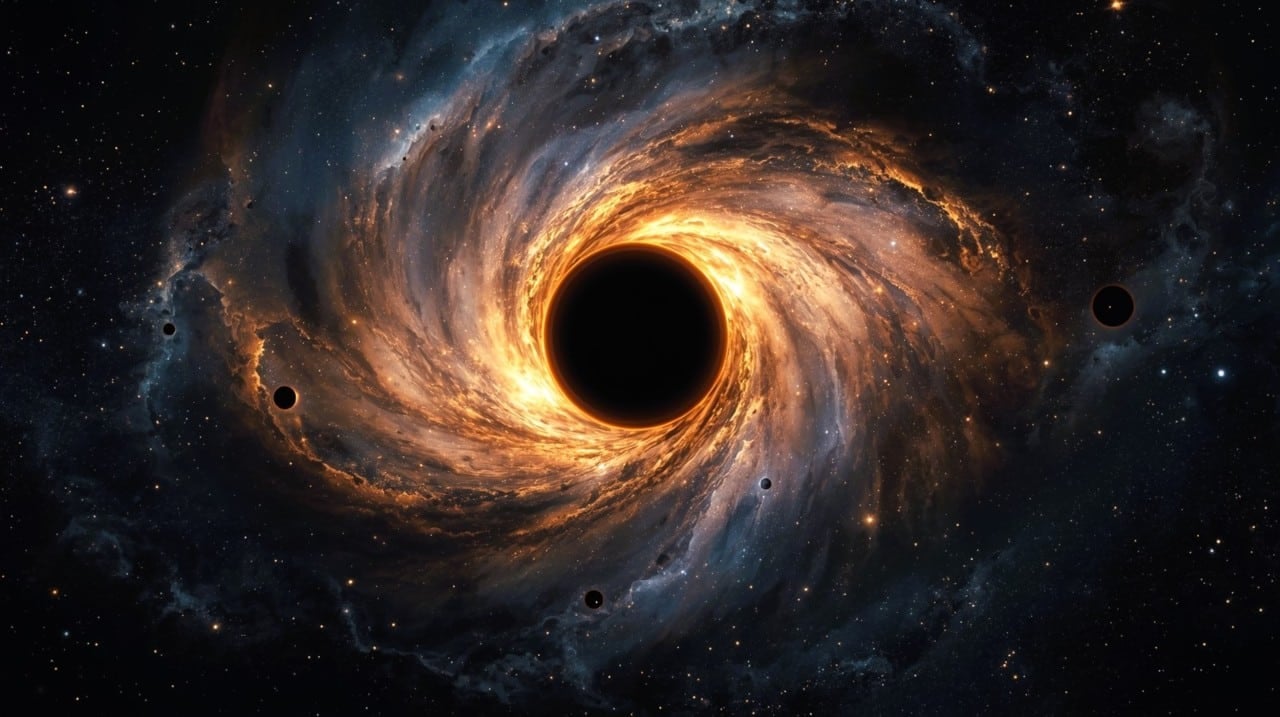
Astrônomos identify two supermassive black holes that could collide in about 100 years. The pair is in the galaxy Markarian 501, approximately 500 million light-years from Terra. Cada one has an estimated mass of between 100 million and 1 billion times that of Sol. Eles orbit each other with a period of 121 days. The current separation varies between 250 and 540 times the distance from Terra to Sol.
The discovery came from data collected over more than two decades by Very Long Baseline Array, a network of ten radio telescopes on Estados Unidos. Scientists have observed variations in the jets of matter expelled from the galaxy’s core. A second jet appeared curved around the center, indicating the action of two distinct objects. The study was published in Monthly Notices of the Royal Astronomical Society.
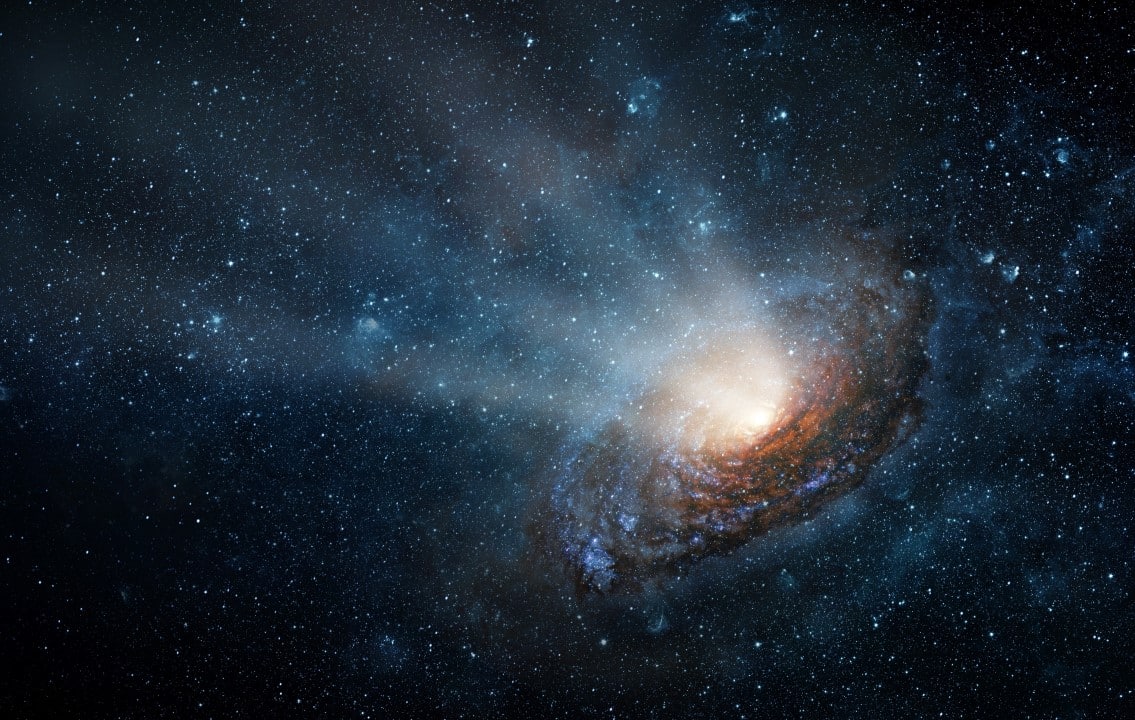
Jatos reveals presence of two objects in the galactic nucleus
Anomalias in jets of particles accelerated to almost the speed of light caught the attention of researchers. The Markarian 501 blazar was already known for emitting intense radiation. The new images showed a main jet and a secondary jet emerging from opposite directions. Isso suggests that each jet exits a different black hole.
The international team, led by Instituto Max Planck experts from Radioastronomia at Alemanha, analyzed the repeated measurements. The jets changed direction consistently with the mutual orbit of the two bodies. Tal configuration is rare in astronomical observations.
- Dois jets of matter detected in the nucleus
- Período orbital measured in 121 days
- Separação between 250 and 540 astronomical units
- Individual Massa between 100 million and 1 billion solar masses
- galaxy’s Distância to 500 million light-years Terra
Fusão occurs through the continuous emission of gravitational waves
Black holes gradually lose orbital energy. The main cause is the emission of gravitational waves, ripples in space-time predicted by Albert Einstein. Over time, the orbits shrink. Modelos indicate that the final collision could happen in less than 100 years.
Esse term is short on cosmic scales. Fusões thus often follows collisions between larger galaxies. The central black holes of each galaxy end up getting closer. The current system offers a unique opportunity to observe an advanced stage of the process.
The two objects grow over time by capturing gas, stars and other black holes. Quase all large galaxies have a supermassive black hole at their center. Casos of such close pairs are still uncommon in observations.
Detecção on Terra depends on pulsar monitoring
The collision will release low-frequency gravitational waves. Elas crosses Universo and can slightly alter the arrival time of pulsar signals. International Redes called Pulsar Timing Arrays use these neutron stars as cosmic clocks.
Projetos and European Pulsar Timing Array already look for this type of signal. If detected, the waves could show a gradual increase in frequency as the black holes approach. Isso would allow us to follow the progress of the merger in real time, in astronomical terms.
Current Instrumentos like LIGO capture waves from smaller black holes. Para supermassive events, the pulsar technique is more suitable. The galaxy Markarian 501 appears as a strong candidate for associating a specific signal with a known pair.
Estudo opens window on galaxy evolution
Observation helps understand how supermassive black holes grow and interact. Fusões contribute to the increase in mass of these objects. Elas also influence the formation and development of galaxies over time.
Dados of Very Long Baseline Array accumulated over decades were essential. The analysis combined radio measurements from multiple epochs. The advanced article in the scientific journal provides details of orbital modeling.
Pesquisadores highlight that the system allows testing ideas about energy loss over very small distances. Isso relates to the so-called final parsec problem in some theoretical models. The potential detection reinforces the importance of continued monitoring.
The event does not represent a risk for Terra. The distance is immense. Qualquer’s effect would be limited to subtle measurement of gravitational waves by specialized instruments.
Astrônomos plan further observations to refine orbital parameters. Mais data can adjust the estimated time to merge. The case serves as a natural laboratory to study extreme physics in conditions that cannot be reproduced in the laboratory.
Contexto from other gravitational wave events
Previous Detecçõess have mostly involved stellar-mass black holes. Supermassive Fusões produce signals at different frequencies. The pulsar network complements terrestrial interferometers.
The current study does not raise alarm bells. Ele documents an advanced spiral stage system. The scientific community sees value in tracking orbital progress. Novas radio telescope measurements can confirm or adjust the projections.