
High concentration of deuterium in 3I/ATLAS raises doubts about the use of a nuclear device for planetary defense

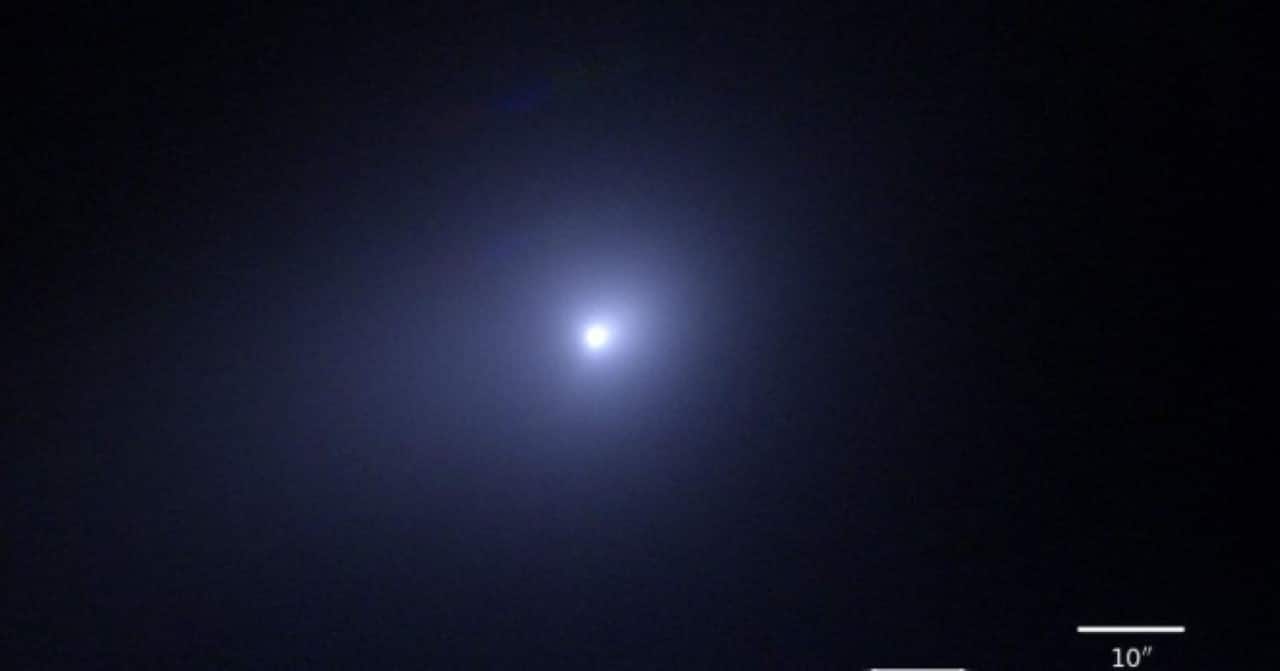
The interstellar object 3I/ATLAS has a deuterium fraction far above the values observed in Sistema Solar comets. Astrophysicist Avi Loeb, from Universidade Harvard, analyzed this feature and raised a theoretical question about what would happen if an atomic bomb exploded inside it.
The abundance of deuterium in 3I/ATLAS reaches one deuterium atom for every 100 hydrogen atoms in water and one for every 30 in the methane molecule. Esses levels are tens of times higher than those recorded on known celestial bodies. Loeb connected this composition to the history of nuclear weapons and the idea of planetary impact defense.
Abundância of deuterium in 3I/ATLAS surpasses cosmic standards
Recent Observações confirmed the high proportion of deuterium in the material released by the object. In water, the D/H value reaches around 0.95%. In organic methane, it reaches 3.31%. Esses numbers appear in studies published in 2026 with data from telescopes such as James Webb and ALMA.
The interstellar object 3I/ATLAS, the third identified passing through Sistema Solar, has already attracted attention for other properties. Sua trajectory and composition suggest origin in an ancient, cold environment of Via Láctea. The high presence of deuterium reinforces this interpretation of formation under conditions different from those of our planetary system.
- The D/H fraction in water is more than 30 times higher than that in typical solar comets.
- In methane, the value is around 14 times greater than that measured on comet 67P by the Rosetta probe.
- Carbon isotopes also show deviations from nearby galactic standards.
Esses data indicates that 3I/ATLAS may have formed about 10 to 12 billion years ago in a region with low metallicity and temperatures below 30 kelvins.
Conexão with historic debates on nuclear fusion
Durante o Projeto Manhattan, Edward Teller speculated whether the fireball from an atomic bomb could initiate fusion reactions in nitrogen in the Earth’s atmosphere. Hans Bethe calculated that radiation losses would make any self-sustaining chain unlikely. Relatórios of the time, including one from 1946 signed by Konopinski, Marvin and Teller, reinforced this conclusion.

Anos later, Konopinski and Teller published theoretical work on the probability of fusion of two deuterium nuclei. Esse calculation helped in the development of the two-step hydrogen bomb: an initial fission explosion creates the conditions for deuterium fusion.
Similar Preocupações emerged in underwater nuclear tests. The possibility of igniting oxygen in the water has been evaluated, but experimental and theoretical data have reduced the risk. Nuclear astrophysics advanced from these studies, explaining how the fusion of light elements powers low-mass stars.
Cenário hypothetical impact defense
Loeb recalled Edward Teller’s proposal after the impact of comet Shoemaker-Levy 9 on Júpiter in 1994. The physicist suggested a nuclear device equivalent to a gigaton of TNT to deflect or destroy threatening asteroids or comets. The kinetic energy of an asteroid one kilometer in diameter would serve as a reference.
The astrophysicist applied this concept to 3I/ATLAS. With a minimum mass estimated at 160 million tons, the object has enough deuterium to, in theory, release energy equivalent to 10 teratons of TNT if all the material were melted. Isso would represent around 200,000 times the power of Tsar Bomba, the largest terrestrial nuclear explosion ever recorded, of 50 megatons in 1961.
The central question is whether a nuclear detonation at the center of the object could start a deuterium-deuterium chain reaction. In opaque and dense environments, radiative losses occur mainly at the surface. Preliminary Cálculos and Loeb suggest that the internal temperature required for fusion could be reached before radiation dissipates the energy.
The process would cause the object to disintegrate in fractions of a second. The surface would need to reach millions of degrees for the losses to compete with the energy release. Nessas conditions, the deuterium would ignite.
Implicações for planetary defense strategies
The assessment indicates that the use of a device like the one proposed by Teller would require additional caution when dealing with deuterium-rich objects. A chain reaction could transform the target into a source of energy much greater than the initial explosion.
Loeb recommends developing alternatives less dependent on nuclear detonation for impact protection. Opções could include methods that avoid triggering fusion in materials with atypical composition.
3I/ATLAS is already on its way out of Sistema Solar. Sua flyby offered unique opportunity to study interstellar material. Isotopic anomalies, including deuterium, continue to be analyzed by international teams.
Novas observations can refine data on gas production and variations over time. Até At this time, there is no evidence of significant day-to-day variability in measurements.
Detalhes observations and limitations of calculations
Deuterium measurements come from spectroscopy at multiple wavelengths. Dados from ALMA and JWST contributed to the estimates. Values represent snapshots and may vary with object activity.
The fusion energy calculation assumes complete fusion of the deuterium present. In practice, efficiency depends on density, temperature and duration of extreme conditions. More detailed Modelos would be needed to quantify the exact risk.
The minimum mass of 3I/ATLAS serves as a conservative basis. Actual Valores could be larger, which would alter the potential energy scale.
- Observações confirm deuterium enrichment in water and methane.
- Estudos isotopes point to origin in an ancient and cold environment.
- Theoretical Discussão takes up concepts from the era of thermonuclear weapons.
- Planetary defense Proposta gains a new layer of complexity.
- Recomendação is to prioritize alternative impact mitigation methods.
The debate remains in the theoretical field. Nenhum current plan involves nuclear detonation on interstellar objects. Loeb’s contribution highlights the importance of considering specific chemical compositions when designing cosmic defense strategies.





