
Researchers find unprecedented empty spaces in the structure of the Mykerinus pyramid in Egypt


An international team of archaeologists and engineers detected two air-filled cavities inside Miquerinos’s pyramid. The monument makes up the famous burial complex of the Gizé plateau. The discovery came after a series of high-tech scans of the ancient structure. Especialistas of Universidade of Cairo and Universidade Técnica of Munique led the joint effort. The unprecedented data confirms long-standing suspicions about architectural anomalies at the site.
The hidden spaces were located just behind a specific section of the east face of the building. Esta area features granite blocks with a remarkably smooth and polished surface. The use of non-invasive equipment made it possible to map the interior of the rock without causing any damage to the historical heritage. The pyramid was built around 4,500 years ago. Ela is the smallest of the three main structures in the complex, which also houses the colossal buildings of Quéops and Quéfren.
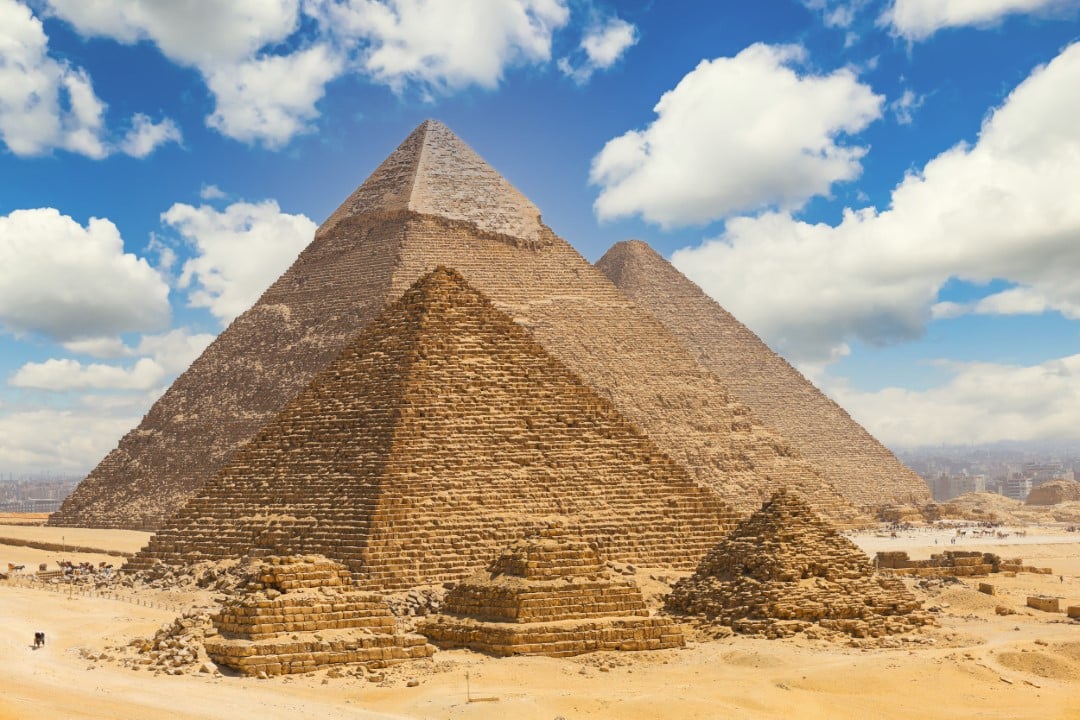
/ shutterstock.com
Unusual Acabamento on the east face prompted recent investigations
The eastern face of Miquerinos’s pyramid rises more than 60 meters high amid the desert landscape. Neste huge stone wall, a peculiar detail has always caught the attention of the most attentive observers. A delimited area, measuring approximately four meters high by six meters wide, displays a polished granite finish. Este type of aesthetic refinement is extremely rare on the exterior of the monument.
In the original architecture of the complex, surfaces with this level of polish often indicate access points. The pattern appears identically at the official entrance to the building, which is located on the north side. Essa visual similarity has intrigued the academic community for a long time. Faltavam, however, tools capable of proving what existed beyond the massive stone barrier.
Researcher Stijn van den Hoven was one of the first to formalize a theory about the site. In 2019, he publicly suggested that the polished section could hide a second entrance to the interior of the royal tomb. The hypothesis remained in the field of speculation for years. Agora, the new surveys provide the first concrete evidence base to support this line of reasoning.
Tecnologias scanners map the interior without drilling into the rock
The current investigation is part of the activities of the ScanPyramids project. Esta global initiative seeks to unlock the secrets of ancient Egyptian constructions using methods from particle physics and modern engineering. Para analyzing the east face of Miquerinos, the team selected three distinct technological approaches. The objective was to cross-reference different information to obtain an accurate diagnosis of the rocky subsoil.
Scientists applied ground-penetrating radar, ultrasound and electrical resistivity tomography. Cada equipment operated independently during the collection phase on the Gizé plateau. The radar emitted electromagnetic waves, while the ultrasound evaluated the behavior of sound through the granite. Tomography, in turn, measured the material’s resistance to the passage of subtle electrical currents.
- Penetrating radar provided detailed images operating at multiple frequencies.
- The ultrasound system identified significant acoustic variations just behind the facade.
- Electrical resistivity tomography mapped differences in thermal and physical conductivity.
- Data fusion integrated all measurements into a single three-dimensional model.
- Simulações on a computer validated the interpretation that the spaces contain only air.
The team needed to rule out other natural explanations for the anomalous readings. Simulações Exhaustive numerical tests were performed in the laboratories of the universities involved. The tests proved that common geological cracks or simple variations in the density of limestone would not produce the signals captured by the sensors. The conclusion unequivocally pointed to the existence of artificial empty spaces.
Exact Dimensões reveals two air-filled chambers
Jointly processing the readings allowed engineers to calculate the size and depth of the anomalies. The first cavity detected has wider proportions. Ela is located approximately 1.4 meters away from the outer granite wall. Suas measurements indicate approximately one meter high by 1.5 meters wide. The total volume of this larger space is around 1.5 cubic meters.
The second chamber is located a little closer to the polished surface. The data shows that it is 1.13 meters deep. Suas dimensions are noticeably smaller compared to the first empty one. The space measures 0.9 meters by 0.7 meters, with an estimated volume of 0.63 cubic meters. The irregular shapes of both cavities were taken into account during the rigorous mathematical calculations.
Christian Grosse, professor specializing in non-destructive testing at Universidade Técnica of Munique, coordinated a significant portion of this analysis. Ele highlighted the importance of the methodology applied at the archaeological site. The use of external sensors guarantees the absolute preservation of the original structure. Nenhum type of drilling, excavation or direct physical access was performed to confirm the presence of the chambers.
New entry Possibilidade changes understanding of monument
Miquerinos’s pyramid stands out for keeping a good part of its original coating intact in several sections. Esta characteristic makes it one of the best preserved monuments in the entire Egyptian funerary complex. The confirmation that there are empty spaces behind the east face opens new avenues for Egyptology. The likely existence of an additional entrance could rewrite what is known about the architectural design of the time.
Fieldwork required a broad network of institutional cooperation. The operations took place under the direct supervision of Conselho Supremo of Antiguidades of Egito and Ministério of Turismo and Antiguidades. Profissionais of Universidade Estadual of Portland, Dassault Systèmes company and Instituto of Inovação and Preservação of Patrimônio also collaborated. The full results of the study were officially published in the scientific journal NDT & E International.
The researchers remain cautious and avoid speculating about the exact contents or ultimate function of the cavities. Eles simply state that the theory of a secondary access route has gained a strong technical basis. The next steps of the mission include refining the three-dimensional models generated. The team plans to integrate new imaging techniques in the future, always focusing on conserving humanity’s historical heritage.





