Scientists reveal 3-million-year-old climate mystery in Antarctic ice
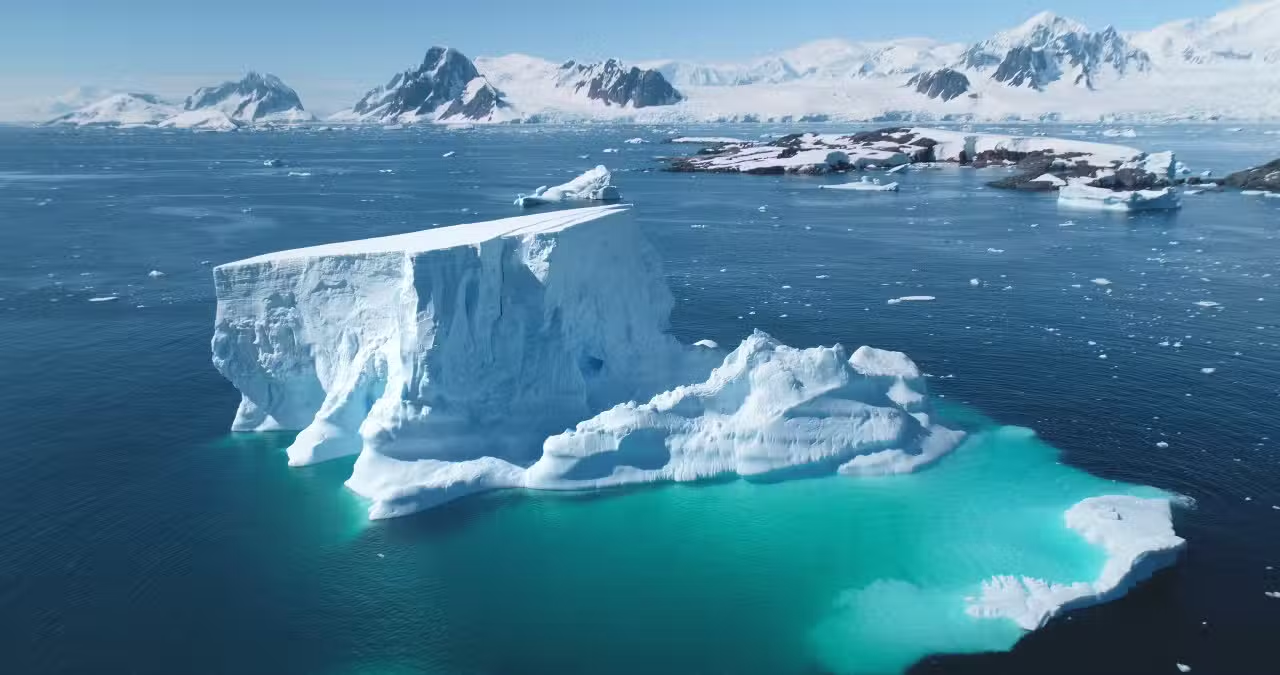
Cientistas analyzed ice from Antártida that records conditions up to 3 million years ago. The results indicate that the planet has cooled significantly, but levels of carbon dioxide and methane in the atmosphere have fallen only modestly. Dois studies published in the journal Nature present the data. The survey comes from Centro of Exploração of Gelo Mais Antigo, linked to Universidade Estadual of Oregon.
The findings expand the direct record of greenhouse gases and ocean temperatures. Até then, continuous cores reached a maximum of 800 thousand years. Amostras of Allan Hills, at the edge of the East Antarctic Ice Sheet, allowed “snapshots” of older periods.
Amostras of Allan Hills offers expanded view of the past
The ice in the region of Allan Hills was distorted by the movement of the layer. Isso generates samples from different epochs instead of a continuous linear sequence. Pesquisadores recovered air bubbles trapped in ancient ice. Julia Marks-Peterson, Universidade Estadual PhD student at Oregon, led one of the works. Sarah Shackleton, now a teacher at Instituição Oceanográfica Woods Hole, coordinated the other.
Ed Brook, director of the COLDEX center, highlighted that the records extend analyzes far beyond what was previously possible. The samples come from a collaborative effort funded by Fundação Nacional of Ciência of Estados Unidos. The project searches for even older ice, with recent evidence of up to 6 million years old in some spots.
- Bolhas of air preserves direct atmospheric composition up to 3 million years ago
- Gases nobles allow estimating average global ocean temperatures
- Amostras show conditions of Plioceno, period hotter than current
- Pesquisa cross-references ice data with evidence from fossils and ancient shorelines
- Equipe analyzes ancient ice preservation to plan new drilling
Temperaturas oceanic drops 2 to 2.5 degrees Celsius
One study measured noble gases in the bubbles to reconstruct changes in sea temperature. Average ocean cooling reached between 2 and 2.5 degrees Celsius over the period. The decline occurred most sharply at the beginning, about 3 million years ago. Esse interval coincides with the formation of large ice caps at Hemisfério Norte.
Surface waters continued to cool more gradually until about 1 million years ago. The researchers point out the possible influence of changes in the circulation of heat between surface and depth. Previous Métodos focused on specific locations. The new data provides a global signal of ocean conditions.
The cooling affected both deep and superficial layers, but at different rates. Evidências fossils from forests in today’s cold regions, such as Alasca and Groenlândia, confirm the hottest planet in Plioceno. Níveis from the sea were also higher, with ancient shorelines recorded on the east coast of Estados Unidos.

Níveis of CO2 and methane varied little in the long term
The second study produced the first direct measurements of carbon dioxide and methane in ice from this period. CO2 remained below 300 parts per million most of the time. Há about 2.7 million years ago, the level was around 250 ppm. Depois fell by about 20 ppm until 1 million years ago. Methane remained stable at approximately 500 parts per billion.



Previous sediment-based Estimativas suggested higher CO2 values. The ice results indicate discrepancy and reinforce the need for longer direct records. Hoje, according to Administração Nacional Oceânica and Atmosférica, the average CO2 in 2025 reached 425 ppm and methane, 1,935 ppb.
The data shows that the gradual cooling of Terra did not accompany a strong drop in greenhouse gases. Outros elements of the climate system gained prominence in the analyses.
Outros factors influenced long-term climate change
Mudanças on the reflectivity of Terra, on the ice and vegetation cover, in addition to variations in ocean circulation, probably acted in a relevant way. The researchers highlight that greenhouse gases do not alone explain the observed trend. The work helps to understand interactions between different components of the Earth’s climate.
Julia Marks-Peterson said the study refines the view about past warmer climates. The team continues to analyze samples to answer new questions arising from the results. Perfurações underway and improved methods search for even older ice.
The COLDEX project receives support from Fundação Nacional and Ciência programs. Field work at Antártida relies on the Programa Antártico infrastructure of Estados Unidos. Amostras are curated at Instalação at Núcleos at Gelo at Denver at Colorado.
Future Pesquisas seeks ice up to 6 million years old
Cientistas identified potentially older ice at the base of rock cores. Análises of these samples are already underway. Novas drilling aims to locate more preserved material. The goal includes improving CO2 reconstructions and studying other trapped gases.
The current findings expand the understanding of climate evolution. Eles offers a more solid basis for comparing past conditions with the current scenario. The research reinforces the importance of extensive paleoclimatic records.
See Also em Latest News (EN)

Rumors point to a special edition of the Nintendo Switch 2 with an unprecedented remake of the Zelda franchise
25/04/2026
Webb Telescope detects tiny red dots in young universe
25/04/2026
Sony subscription service updates library with golf simulator and online RPG in March
25/04/2026
Samsung reduces price of high-end smartwatch by 40% to intensify competition in the market
25/04/2026
New Sony smartphone changes rear camera design and uses new color to attract the public
25/04/2026
Where to watch Toulouse x Monaco with line-up confirmed for Ligue 1 duel
25/04/2026
Gang of Dragon faces financial crisis and brief disappearance of official videos scares fans
25/04/2026
Exclusivity for new generation guarantees technical revolution in the next game in the Forza Horizon franchise
25/04/2026
Subscribers to PlayStation’s premium service get movie bonuses when testing horror hits
25/04/2026
Valve releases four independent titles for free for computer users for a limited time
25/04/2026
PlayStation 5 owners gain lifetime access to the duo of titles at no additional cost
25/04/2026