

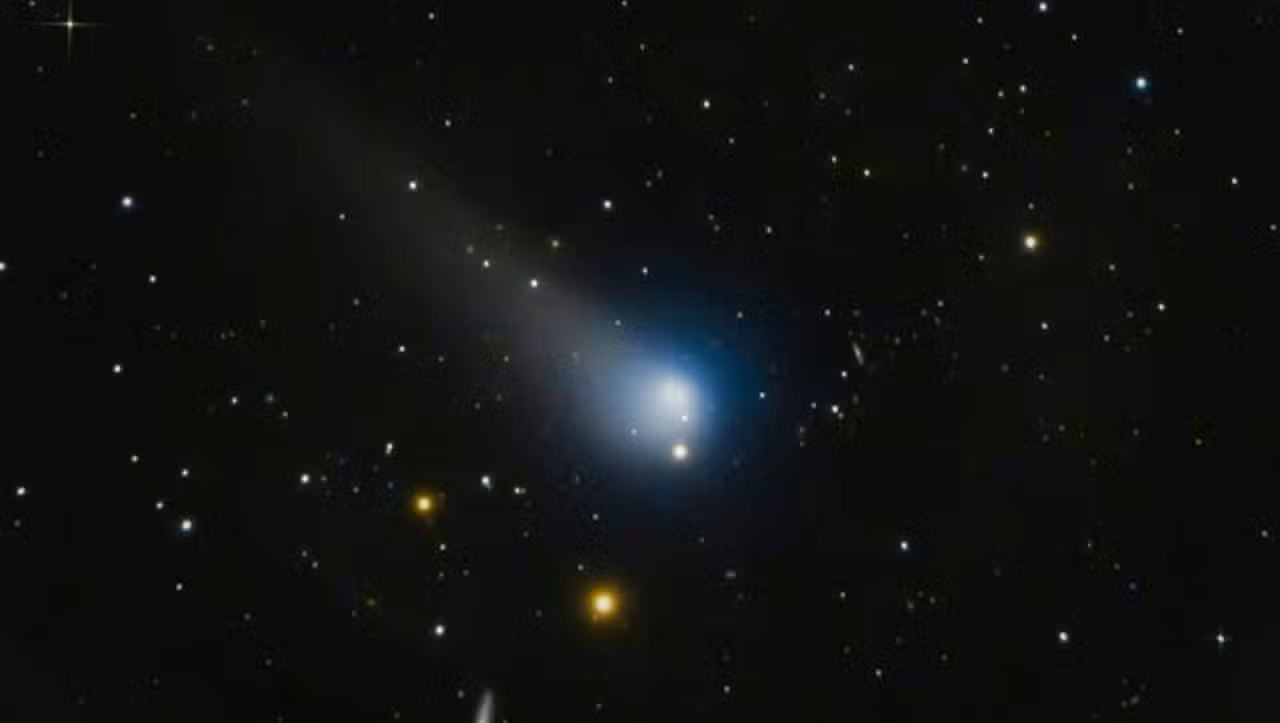
Comet C/2025 R3 (PanSTARRS) completed its closest approach to Terra this Sunday (26). The object passed about 72 million kilometers from the planet. The distance allowed astronomers to follow the celestial body despite observation challenges on the Brasil.
The comet had already resisted the closest passage of Sol on April 19th. Desde then gained brilliance as it released gas and dust. Especialistas indicate that the phenomenon could make PanSTARRS one of the most notable astronomical events of the year.
Maximum Aproximação occurred at 72 million km
The perigee, the point of closest proximity to Terra, occurred on Sunday. The comet traveled 0.49 astronomical units from our planet. Essa brand represents safe distance without any risk of impact.
Astrônomos used data from telescopes and the SOHO space observatory to track the movement. The images confirmed that the icy core withstood the intense heat of perihelion. The released material formed a visible coma and tail under suitable conditions.
The current position places the object close to the Baleia constellation. Observadores have noted magnitude around 4 to 5 in recent days. The value indicates possible visibility with binoculars in dark locations.
Front Dispersão can raise brightness to exceptional levels
The brightness potential draws attention. Estimativas conservatively points to magnitude 3. In an optimistic scenario, the comet could reach magnitude -2 due to the frontal scattering effect.
Essa scattering occurs when comet dust reflects sunlight directly to Terra. The phenomenon acts as a natural lens. Marcelo Zurita, of Associação Paraibana of Astronomia, highlighted this possibility in recent analysis. The brightness would surpass that of Sírius, the most luminous star in the night sky.
- Poeira released forms curtain that multiplies reflection of sunlight
- Favorable Geometria between comet, Sol and Terra amplifies the effect
- Magnitude -2 would allow vision even in twilight or moderately polluted skies
- Comparação with Sírius reinforces chance of rare show
The comet was discovered in September 2025 by the PanSTARRS system. Sua’s long-period orbit means the current pass is the first in about 170,000 years.

Desafios observation on Brasil this Sunday
The angular proximity to the Sol made direct vision difficult. The comet was just 6 degrees from the star. Essa configuration left it virtually invisible during the day and on the horizon near sunset.
Quem tried to observe, needed binoculars and a clear western horizon. Locais away from cities offered better conditions. Urban light pollution has further reduced the chances of detection by the naked eye.
Janela main visibility opens in May
Sol’s angular separation increases in the first few days of May. The comet should appear low on the western horizon just after dusk. Essa position favors observers on Hemisfério Sul.
Recomendações include checking the exact sunset time. Binóculos or small telescopes help identify the coma and possible tail. Clean Céu and no full moon increase the chances of success.
Visibility should only last a few minutes per night. The object continues to move away from Terra and Sol, which gradually reduces its brightness.
SOHO captured images during perihelion passage
NASA and ESA’s SOHO space telescope monitored the comet with the LASCO instrument. The coronagraph cameras recorded the object close to Sol. The data made it possible to calculate the trajectory and rate of material release.
Recent Imagens confirm that the core has maintained integrity. Muitos comets fragment at this stage. The survival of PanSTARRS fuels expectations for the coming weeks.
Astrônomos continues to update forecasts based on new observations. Sites SOHO officials make the captures available for public consultation.
The event reinforces interest in amateur astronomy in the country. Associações recommend preparing observation points in advance for May days. The comet offers a rare opportunity to follow a celestial body in real time.
The current passage poses no danger. Cometas like PanSTARRS help scientists study composition of early Sistema Solar. The preserved ice and dust reveal conditions from billions of years ago.
Observadores who manage to register the comet can share images with astronomy networks. Dados contribute to the global monitoring of the object.
What to expect in the coming weeks
Brightness should peak in the first nights of May. Depois, the comet heads towards outer space. The magnitude tends to decrease as the distance from Sol increases.
Previsões indicate that PanSTARRS remains visible for a few more weeks. The exact period depends on factors such as core activity and atmospheric conditions.
Entusiastas from heaven must mark the calendar. The combination of recent proximity and possible high brightness makes this one of the most anticipated comets of 2026.