Measurement of the Universe’s expansion reveals divergence that challenges current physics
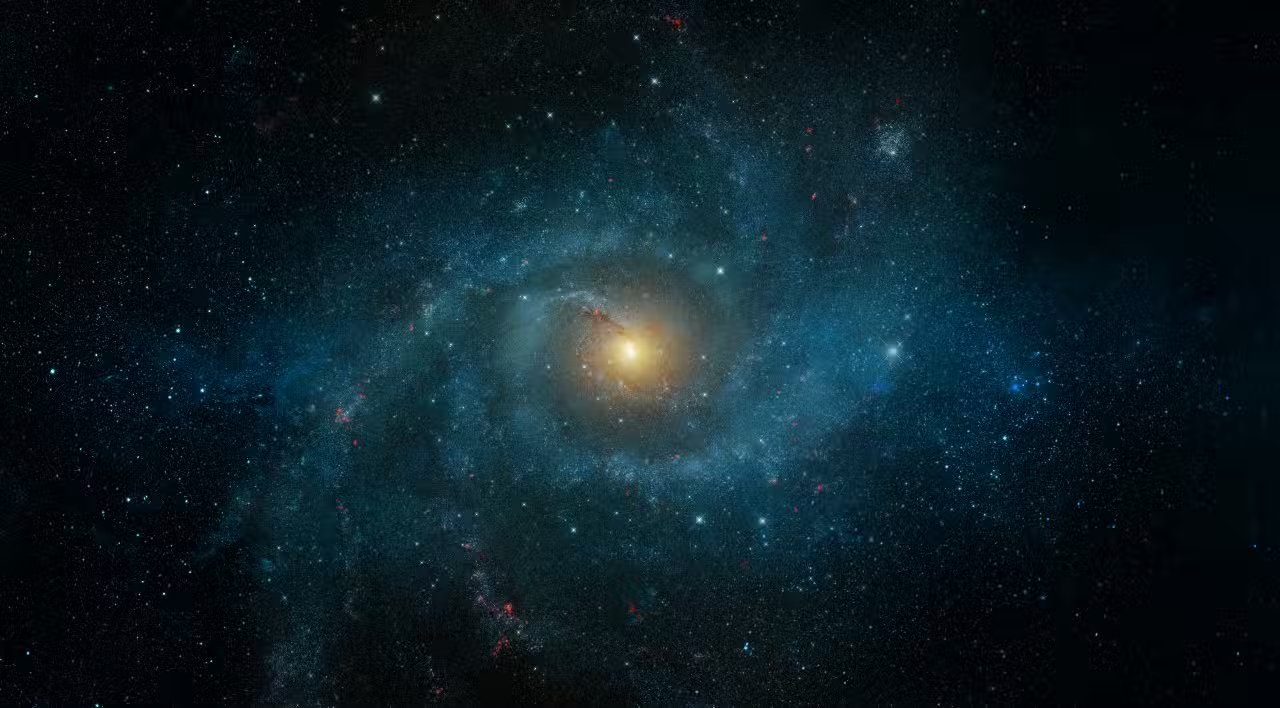
Universo’s expansion follows two different speeds depending on where astronomers look. Observações of the cosmic microwave background radiation indicates a rate of 67 kilometers per second per megaparsec. Já studies of nearby galaxies using supernovae and variable stars reach 73 kilometers per second per megaparsec.
Essa discrepancy is not a simple error. Ambas measurements are accurate, repeatable and consistent within their respective methodologies. The conflict has persisted for years, resisting increasingly sophisticated observations carried out with state-of-the-art instruments. Scientists call this the Hubble tension — one of the biggest enigmas in current cosmology.
Qual is the constant of Hubble
The Hubble constant (H₀) measures the expansion speed of the Universo relating distance and speed. Desde o Big Bang, about 13.8 billion years ago, the cosmos has been in constant expansion. Determinar accurately this rate is crucial to understanding:
- Universo’s exact age
- The total size of the observable cosmos
- The structure of galaxies and spacetime
- The final destination of cosmic expansion
Medir H₀ accurately helps reconstruct the entire expansion story and anticipate where Universo is headed. Quando different techniques produce incompatible results, this suggests something fundamentally wrong — either in the observations, or in the theory that explains them.
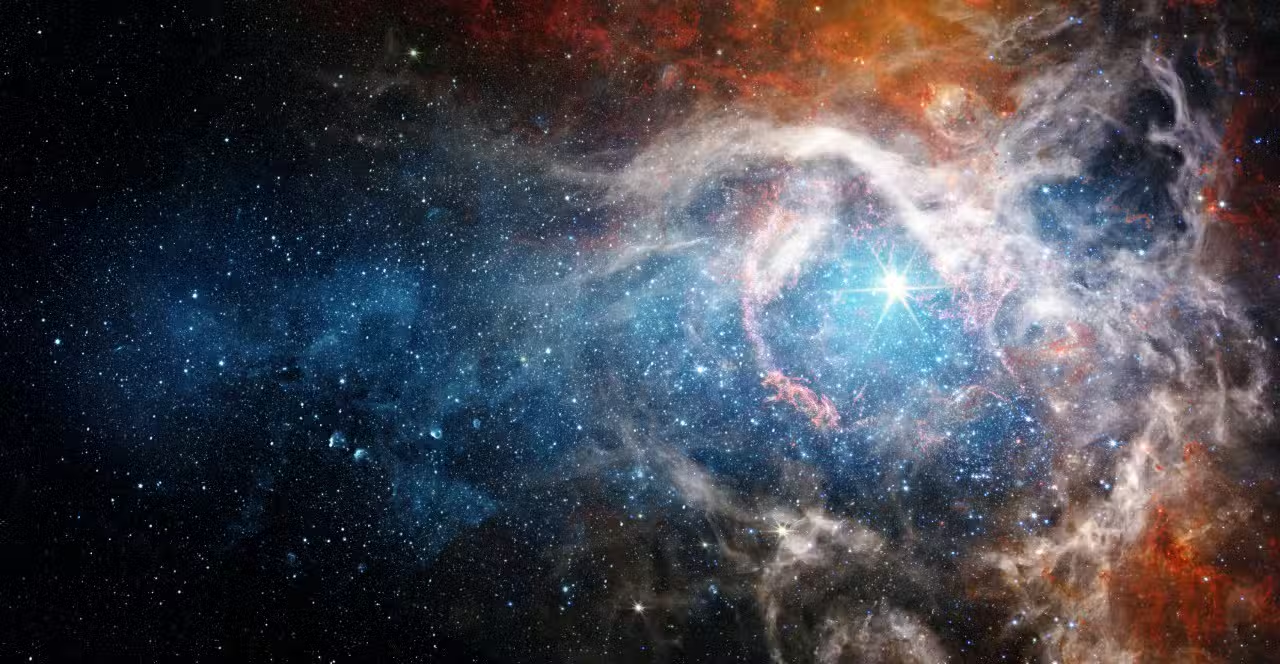
The most accurate measurement to date
A group of researchers recently presented one of the most accurate analyzes of cosmic expansion. The team employed methods completely independent of traditional approaches, drastically reducing the accumulation of systematic errors that arise after multiple successive measurements.
One of the techniques used was time-delayed cosmography, based on gravitational lenses. Quando a massive galaxy bends the light of a distant object, multiple images are produced. The variation in time between these images allows distances to be calculated with enormous geometric and physical precision. Esse method works because it directly obeys Teoria from Relatividade Geral, minimizing intermediate interpretations.
The researchers combined data from Telescópio Espacial James Webb with ground-based observatories like Keck. Simultaneous analysis of stellar dynamics and space geometry confirmed that the rapid expansion observed in local Universo is real. Não is merely an observational artifact or instrument calibration problem — the phenomenon exists and is measurable.
What the divergence reveals
Confirming the authenticity of this double expansion points to a disturbing conclusion: the standard cosmological model is incomplete. Durante decades, this model has been extraordinarily successful in describing the origin, structure, and evolution of Universo. Agora faces a failure that may indicate the existence of unknown physical processes acting in the first moments after Big Bang.



If the measurements are indeed correct, then something fundamental is missing from the current cosmological description. Isso paves the way for new physics — one that explains why local Universo expands faster than it should according to known laws. Esse scenario excites cosmologists because uncovering gaps in theory represents a historic opportunity to expand human knowledge.
Possíveis scientific explanations
Pesquisadores investigate two main hypotheses to resolve Hubble’s tension. The first proposes the presence of primordial dark energy, an exotic form of energy that would have driven an accelerated expansion shortly after Big Bang. Essa’s initial wave would have altered the entire subsequent evolution of the cosmos, leaving traces that we observe today as the discrepancies between ancient and modern measurements of the rate of expansion.
The second possibility suggests the existence of new subatomic particles that have not yet been detected. If the primordial Universo contained additional, invisible components, their interactions would have changed the global expansion rate. Isso would force physicists to drastically expand the theory’s repertoire beyond Modelo Padrão, which currently describes all known particles and forces.
Ambas explanations share something in common: they point to completely new phenomena, never observed or predicted before. Qualquer one of these, if confirmed, would profoundly transform scientific understanding of how Universo works at its deepest levels.
The way forward
Resolver the voltage of Hubble is not a technical detail for experts. Representa a unique opportunity for scientific discovery that could trigger a conceptual revolution comparable to the great transformations of 20th century physics. Observations continue to refine measurements, and new techniques emerge regularly.
Telescópio Espacial James Webb, which provided data for the recent study, promises even deeper observations. Future terrestrial Telescópios will increase the precision of measurements of nearby galaxies. Conforme uncertainties decrease, Hubble tension does not disappear — it intensifies, demanding a genuinely innovative theoretical response from the international scientific body.
The message is clear to the astronomical community: something fundamental is missing us in the description of the cosmos. The next decade may reveal what new physics has been needed all along.
See Also em Latest News (EN)

NASA photographs giant eye in the Sahara desert 50 kilometers wide
29/04/2026
WhatsApp debuts redesign on the conversation screen with quick access to Statuses
29/04/2026
Atlético de Madrid and Arsenal confirm starters for the first game of the European semi-final
29/04/2026
Deutsche Bank raises interest on 12-month deposits to 3.25% in Spain
29/04/2026
PlayStation 5 controller gets update and users have deadline to synchronize
29/04/2026
RedMagic Pro gaming tablet appears with Snapdragon and liquid cooling system
29/04/2026
Bia Haddad overcomes Ashlyn Krueger in an epic three-hour match and advances to the quarterfinals in Spain
29/04/2026
Samsung launches One UI 8.5 with new AI features for Galaxy line
29/04/2026
Study in England points to an increase in 11 types of cancer in young people and warns of overweight
29/04/2026
Manchester United selects Matheus Cunha for the classic and focuses on recovery for the World Cup
29/04/2026
Volkswagen ID.3 Neo debuts in Germany with retro design and 231 horsepower
29/04/2026