Telescope or binoculars? See how to observe galaxies and nebulae in 2026
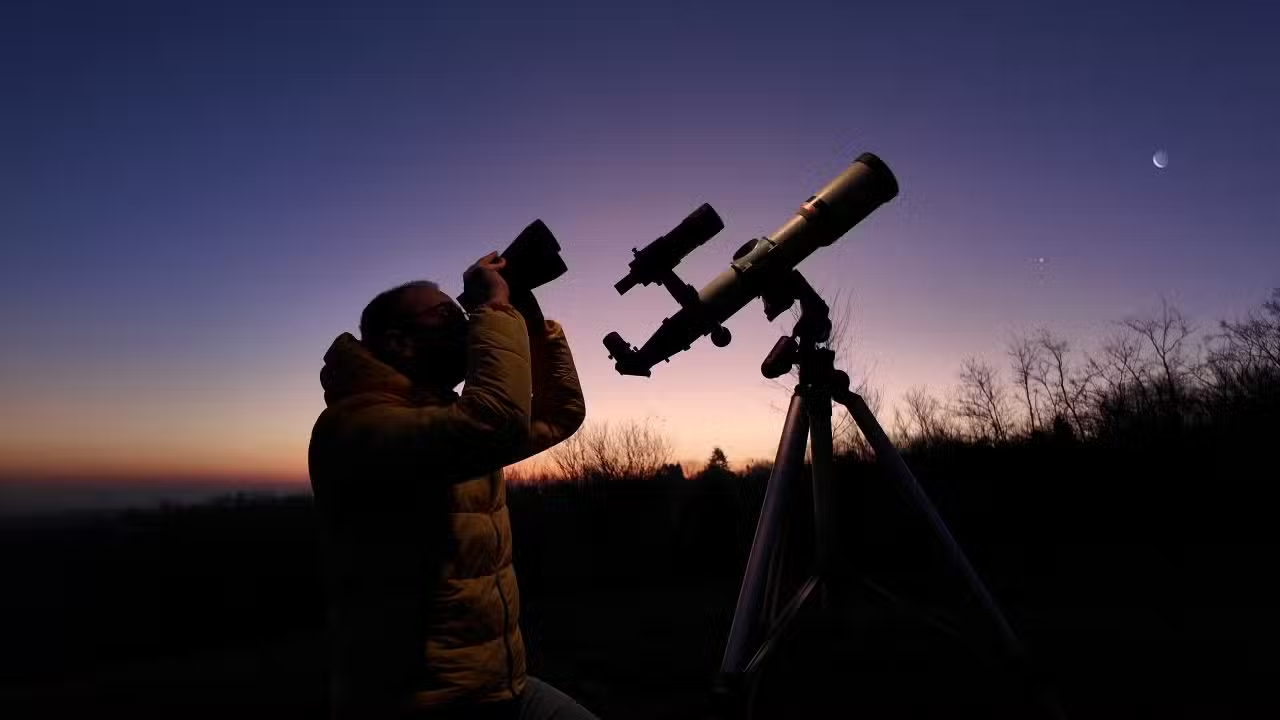
The most distant and rewarding objects in the night sky challenge even experienced observers. Após master the location of planets and constellations with the naked eye, it’s time to explore much larger structures: galaxies, nebulae and star clusters that inhabit deep space. Essa journey requires knowledge about optical equipment, observation techniques and careful planning.
The celestial targets that make up deep space fall into three main categories, each offering distinct and challenging visual experiences for the amateur astronomer.
What defines a deep sky object
Deep-sky Objetos differ radically from individual planets and stars. Trata itself from vast and distant cosmic structures. São formations whose light took millions of years to reach us. Suas visual characteristics, gray tones, diffuse glow, subtle details, require patient observation and truly dark skies.
Galaxies constitute vast systems containing billions of stars. Via Láctea, our own galaxy, serves as a reference. Outras appear from the front or side, revealing magnificent spirals or elliptical structures. Nebulosas are interstellar clouds composed of dust and gas. Elas come in different forms depending on their origin and interaction with the surrounding light. Existem emission, reflection and dark nebulae, as well as planetary nebulae and supernova remnants. Stellar Aglomerados are groups of stars bound together by gravity. Open clusters are young, dispersed and close to the solar system. Globular clusters, in turn, are old, compact and located in the galactic halo.
Colorful Imagens captured by space telescopes such as Hubble and James Webb have created high expectations among newcomers. Reality, however, requires perspective adjustment. Observações visuals produce gray tones instead of vibrant colors. Fine Detalhes disappear, leaving only subtle shapes that require careful observation and prolonged visual adaptation. Essa is the real reward: discovering structures that few humans have ever seen with their own eyes.

Deep Sky Optical Equipamento
Três instrument categories dominate amateur astronomical observation: affordable binoculars, modern smart telescopes, and traditional large-aperture telescopes.
Binoculars offer an excellent gateway for those moving away from naked-eye observation. Todos astronomers recommend this gradual transition rather than jumping directly into a telescope. Binoculars provide wide fields of view that reveal the night sky beyond the reach of the naked eye. Eles shows star clusters, nebulae and even galaxies with surprising clarity, especially along Via Láctea’s range. Pocket Modelos, however, are not fit for purpose. Magnification of about ten times is required with objective lenses of forty-two or fifty millimeters. The 10×42 and 10×50 models have become popular among amateur astronomers as they offer a balance between portability and performance. Versões with image stabilization costs more, but reveals details that justify the investment.
Smart Telescópios represent a recent innovation that does not require traditional eyepieces. Instead, they use image processing chips similar to those in the Hubble and Webb space telescopes. Combinam telescopic optics with advanced cameras and processing algorithms. Fazem short exposures that overlap, generating cleaner signals. In light-polluted urban skies, these devices filter out interference and reveal deep-sky objects in colors that appear directly on a smartphone or tablet. Ideal for those who live in big cities.
Traditional Telescópios require more complex choices. Altazimutal or equatorial? Refrator or reflector? Para observe the deep sky, a simple rule works: purchase a reflecting telescope with the largest aperture your budget allows. The diameter of the primary mirror determines the amount of light captured. Compact and portable Os Newtonianos dominate among beginners. Os Dobsonianos, large and with an excellent cost-benefit ratio, offer the largest openings at the most affordable prices.
Stellar Aglomerados: Visual First Steps
Nenhuma printed image compares to viewing an open star cluster through binoculars or a telescope. Esses clusters of stars bound by gravity are surprising for their ease of observation despite their apparent fragility. Centenas of them populate the night sky. What you see depends on brightness and distance, but many are best seen with simple binoculars. As Plêiades, a conspicuous jewel in Touro, reveals its seven main blue-white stars with surprising clarity. The Aglomerado Duplo in Perseu, NGC 869 and NGC 884, rewards small telescopes with magnificent views. Aglomerados opens further away and all of Via Láctea’s one hundred and fifty globulars require at least a small telescope. Alguns fill the entire visual field. Outros appear small and faint. Most, however, are visible even in urban skies with moderate light pollution.


- The cluster of Plêiades (M45) in Touro
- The Aglomerado Duplo (NGC 869 and NGC 884) in Perseu
- The Aglomerado Colmeia (M44) in Câncer
- The M35 cluster in Gêmeos
- The Grande Aglomerado Globular (M13) in Hércules
- The globular cluster M22 in Sagitário
Galáxias: vision of gigantic structures
Observar Distant galaxies present greater challenges than clusters. Galáxias are millions of light years away. Seu surface brightness is so faint that most require completely dark skies, moonless nights and large telescopic aperture. Poucas exceptions exist. Galáxia of Andrômeda is technically visible to the naked eye in truly dark skies. Galáxia of Redemoinho, Galáxia of Bode, and Galáxia of Charuto are relatively easy to observe with moderate equipment and medium magnification. An Dobsoniano telescope is an excellent choice for this purpose.
Duas Critical techniques amplify success: allowing the eyes to fully adapt to the darkness before going out looking for galaxies, and looking slightly to the side when a galaxy enters the scope of the telescope. Peripheral vision, more sensitive to dim light, reveals details that direct eyes cannot capture. Esse knowledge turns failed observations into memorable discoveries.
The most popular galaxies of Hemisfério Norte include Galáxia of Bode (M81) along with Galáxia of Charuto (M82), Galáxia of Redemoinho (M51), Galáxia of Andrômeda (M31), Galáxia of Triângulo (M33), the Galáxia of Cata-wind (M101) and the Trio of Leão formed by M65, M66 and NGC 3628.
Nebulosas: patience and technique
Nebulosas tests the patience of beginners more than any other type of object. Muitas disappoint expectations created by color images. Nebulosa of Órion constitutes a notable exception. Essa jewel shines and expands across the visual field of small telescopes or binoculars. Preenche the eyepiece with surprising details. Carina’s Nebulosa offers a similar spectacle for Hemisfério Sul watchers. Most other nebulae require lowered expectations and an abundance of patience, qualities that modern humans rarely possess.
Vislumbrar spectacular structure and texture in a nebula, even in black and white, demands a deeply dark sky. Specialized Filtros such as UHC and O-III block light pollution and increase contrast, making repeated observations essential. Apesar Furthermore, modest equipment produces impressive results under really dark skies. Para urban residents, sophisticated telescopes work miracles with fragile nebulae.
Popular Nebulosas from Hemisfério Norte: Nebulosa from Órion (M42) into Órion, Nebulosa Cabeça from Cavalo (Barnard 33 and IC 434) also into Órion, Nebulosa Olho from Gato (NGC 6543) into Draco, Nebulosa from Anel (M57) to Lira, Nebulosa from Haltere (M27) to Vulpecula, and Nebulosa from Lagoa (M8) to Sagitário.
Observando on a budget
Expensive Investimentos are not prerequisites for observing the deep sky. Binóculos 10×50 and a reflecting telescope with a ten centimeter aperture constitute sufficient equipment. Permitem contemplates globular clusters, galaxies and other objects with genuine entertainment for years. Após When observing these targets with smaller telescopes, the temptation to invest in larger instruments inevitably arises. A smart alternative is to purchase an affordable smart telescope that allows you to photograph faint nebulae for hours, providing excellent results in image form, not visual form. A truly dark sky location offers greater improvement than any expensive telescope. A used Dobsoniano telescope, if the size doesn’t bother you, will always be a solid option.
Planejamento from night observation
Determinar the best time to observe a specific object requires time and experience. Tudo in the night sky is seasonal. Cada object has a specific time of year when it reaches its highest point in the night sky, in the middle of the night, at your location. Esse is the pinnacle of observation. The object gets as close as possible to the zenith, the region directly above the observer, where it is darkest. Nesse point, the Earth’s atmosphere interferes less, producing superior visibility.
GoTo telescopes and smart telescopes, accompanied by appropriate software or applications, indicate which objects are best suited for observation at a specific time and location. Astronomy Aplicativos like Stellarium, Starry Night and SkySafari offer similar functionality. Escolha one, familiarize yourself with your tools and create short lists of objects to observe each night. Essa strategy keeps the viewer focused and maximizes every hour spent under the stars.
See Also em Latest News (EN)

GTA 6 fans point out signs that a new trailer will arrive by May
29/04/2026
Take-Two CEO confirms GTA 6 marketing campaign begins soon
29/04/2026
Apple announces foldable iPhone as new CEO John Turnus’ first product
29/04/2026
Spotify: Music application suffers blackout in the United States and interrupts subscribers’ routine this morning
29/04/2026
Spotify down: Streaming instability affects thousands of users in the US with failures this Wednesday
29/04/2026
Voyager 1 disables instrument to conserve energy and allow for future upgrades
29/04/2026
Where to watch Shabab Al-Ahli x Khor Fakkan in round 23 of the Emirates Pro League
29/04/2026
Former FBI chief faces arrest warrant for post with numbers that the court interprets as a threat to Trump
29/04/2026
Los Angeles FC x Toluca in the first semi-final of the Concacaf Champions Cup
29/04/2026
Virginia Fonseca reappears after disappearance and opens up about her family amid the fight with Luana Piovani
29/04/2026
Studies identify five daily habits that reduce abdominal fat
29/04/2026