The haunting story of the Spanish woman who planned the “perfect daughter” and then killed her
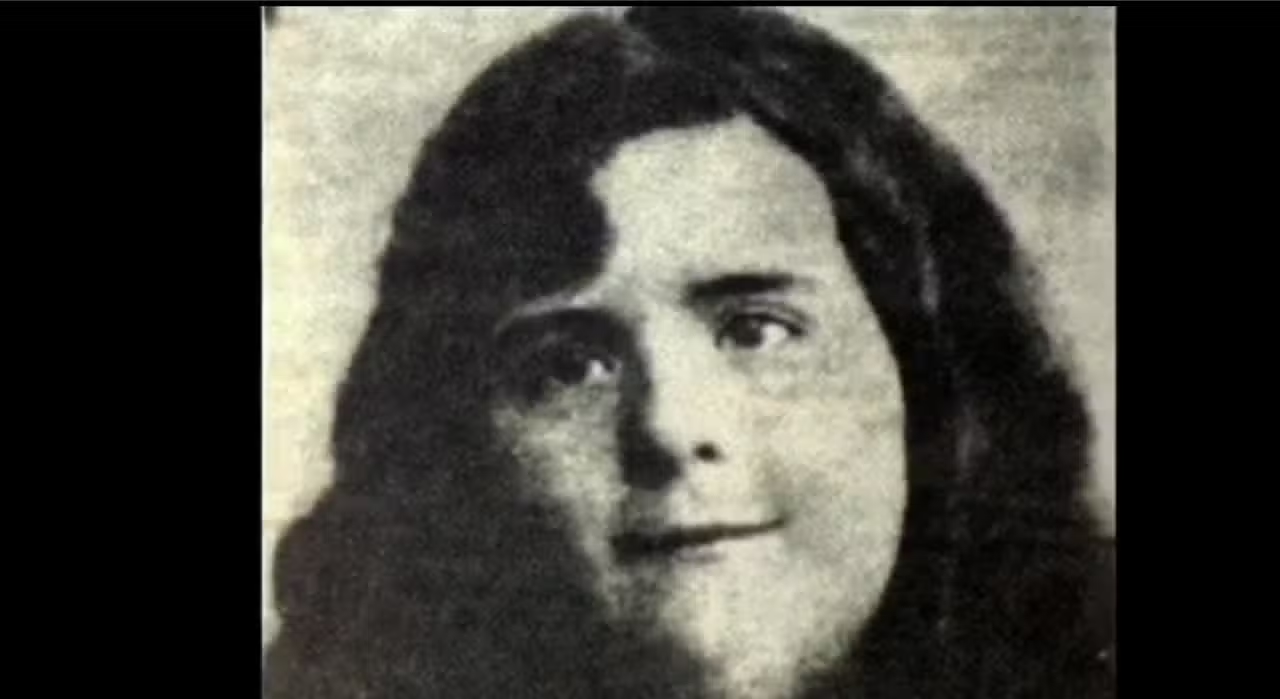
In the early hours of June 9, 1933, Aurora Rodríguez Carballeira took a shower, dressed and asked the maid to walk the dogs. Minutos later shot his daughter four times while she was sleeping — three shots in the face, one in the chest. Horas later calmly visited his lawyer.
The crime shocked Espanha. Não was a common case of family violence. The victim was Hildegart Rodríguez, aged 18, a young prodigy—feminist activist, prolific writer, honors legal scholar. The killer was a brilliant intellectual, a cultured woman who circulated in public environments. Ninguém understood.
The daughter planned as a masterpiece
Aurora Rodríguez was born around 1879 in Galícia and at the age of 35 he hatched an extraordinary plan. Ela admired eugenics, a theory then popular among European intellectuals that promised to improve the human species through selection and manipulation. Aurora decided to create not just a daughter, but the “most perfect woman, who, like a human statue, would be the standard, the measure of humanity.”
Escolheu meticulously a man with “the necessary characteristics”: physically perfect, mature age, intelligence with a touch of cunning, extensive culture. Quando became pregnant, moved to Madri, and applied strict eugenic techniques. Dietas restrictive exercises, absolute control of pregnancy. Desejava a girl because she was convinced that only women could generate social transformation.
On December 9, 1914, Hildegart was born. Aurora dedicated herself to transforming that child into her “flesh statue”, transferring accumulated knowledge from her father’s library, as she herself never received a formal education. The result was premature and disturbing. Aos two years, Hildegart read. Aos three, he wrote. Aos eight, spoke English, French and German. Aos 13, had completed his secondary studies with excellence.
From prodigy to intellectual prisoner
Aos 14 years old, Hildegart started studying Direito with special license. Simultaneamente entered public life as a socialist activist. Aos 17, finished college with honors and enrolled in Medicina and Filosofia. Nessa was already famous at the time — radical feminist who defended sexual education, birth control, divorce. Escrevia essays on sexual rebellion of youth, Malthusianism, venereal diseases.
But genius had a price. Hildegart never had a childhood. “I had to use [my childhood] all the time to study without rest, day and night”, he confessed to a journalist. Vivia in his mother’s literal shadow. Aurora accompanied her to everything — classes, political meetings, they slept in the same room. A professor at the university, Julián Besteiro, compared the situation to “a baby kangaroo stuck in the invisible pouch with the umbilical cord intact.”
Pesquisadores suspect that many of the writings attributed to Hildegart were actually from the mother. The most revealing was published on May 19, 1933 in the newspaper La Tierra, entitled “Injustices: Caim and Abel”. The article extolled Caim as “a man who once again equaled Deus in taking his life.” Aurora would confirm after the crime that he had written that text. Encerrava like this: “Let us evoke the progressive figure, with bold features, of the rebel Caim who achieved mastery in the triple art of Amar, Lutar and Matar”. Vinte and a few days later, the same newspaper would publish: “very painful event: Hildegart is dead”.
The mysteries behind the murder
Aurora’s motivations remained enigmatic. Ela never clearly explained why he killed “the girl in whom I deposited all my illusions.” Existem several theories. Alguns believed that Hildegart had fallen in love — an unacceptable situation for Aurora, which would compromise his daughter’s “mission.” Havia suspected candidates: a Norwegian scientist, a sculptor who made his bust, a writer from Barcelona.



Outros pointed to an international conspiracy. Writer H.G. Wells and sexologist Havelock Ellis had invited Hildegart to spend time at Inglaterra. In Aurora’s paranoid mind, this meant a plot to turn her into a secret agent and prostitute her. Talvez political disagreements, or simply because Hildegart wanted to emancipate himself and explore the world beyond the limits that his mother set.
Biógrafa Carmen Domingo offers different analysis. Para she, Aurora killed her daughter “because she was a result of the time in which she lived, her circumstances and her pathology.” A cocktail that exploded when Hildegart decided to follow an unforeseen path. Aurora herself felt clear internally. Confessaria after everything had been “a perfectly prepared plan, executed with mathematical precision.” “I created it, made it and formed it over the years. Sei is perfectly where it needs to be.”
- Key unanswered questions include:
- Why did Aurora change his mind about his daughter after 18 years?
- What specific trigger triggered the murder?
- Did Hildegart try to emancipate herself or reject her mother?
- Was Qual the “different path” that Hildegart intended to take?
Julgamento politician in times of instability
Aurora Rodríguez’s trial began in 1934 in a context of political crisis. Espanha had emerged from the proclamation of the republic, considered by the rest of Europa to be one of the most modern countries in Ocidente — with universal suffrage when the majority of Europa still denied it. But there was a change of government: from the moderate left to the right.
Essa transition contaminated the process. Progressive and left-leaning defense lawyers and psychiatrists believed that Aurora suffered from mental illness. The prosecution lawyer, however, was right-wing. Interessava to the government to demonstrate that she was not crazy — political gain by proving that a leftist had killed her own daughter out of her own radical desires, not out of insanity.
Prosecutor José Valenzuela Moreno attacked Aurora as a victim of “intoxication from a thousand poorly digested readings.” Publicou entire book about the case, arguing that books were dangerous in the hands of women without moral preparation: “The natural intelligence of an illiterate is a hundred thousand times preferable to the muddy mind of an unprepared reader.” The strategy worked. Aurora was sentenced as a person with full use of her mental faculties, to 26 years, 8 months and 1 day in prison.
Aurora received the sentence with satisfaction. Discordava from her own lawyer, denied being crazy, agreed with the conviction. Imediatamente began planning a complete reform of the prison system. Sua’s stay in jail was brief. In 1935 she was transferred to the Ciempozuelos psychiatric hospital, close to Madri, where she remained hospitalized until she died in 1956. Seu’s medical history of the asylum was published in 1977, enriching both knowledge about her and about psychiatry at the time.
See Also em Latest News (EN)

SuperEnalotto offers record jackpot of €156.8 million this week
29/04/2026
How much would a ticket to Shakira’s first show in São Paulo cost today?
29/04/2026
Google Tensor G6 leak reveals seven-core architecture for Pixel 11 line
29/04/2026
OnePlus’ new smart watch features titanium structure and battery life for more than two weeks
29/04/2026
Shooting game Yoibarai Tantei Miasma Breaker receives free pack with bosses and discount on Switch
29/04/2026
New title in the horror franchise exceeds commercial expectations and attracts unprecedented player base
29/04/2026
Avi Loeb suggests interceptor to analyze future detected interstellar objects
29/04/2026
Meta Messenger blocks access on old cell phones with Google system from September
29/04/2026
One UI 8.5 system expands artificial intelligence features on cell phones from the South Korean brand
29/04/2026
Episode 5 of The Boys Season 5 features vignette format and advances Firecracker arcs
29/04/2026
Identity of missing young woman confirmed after discovery of decapitated body in Belo Horizonte park
29/04/2026