United Launch Alliance rocket puts Amazon equipment into orbit and reaches historic milestone
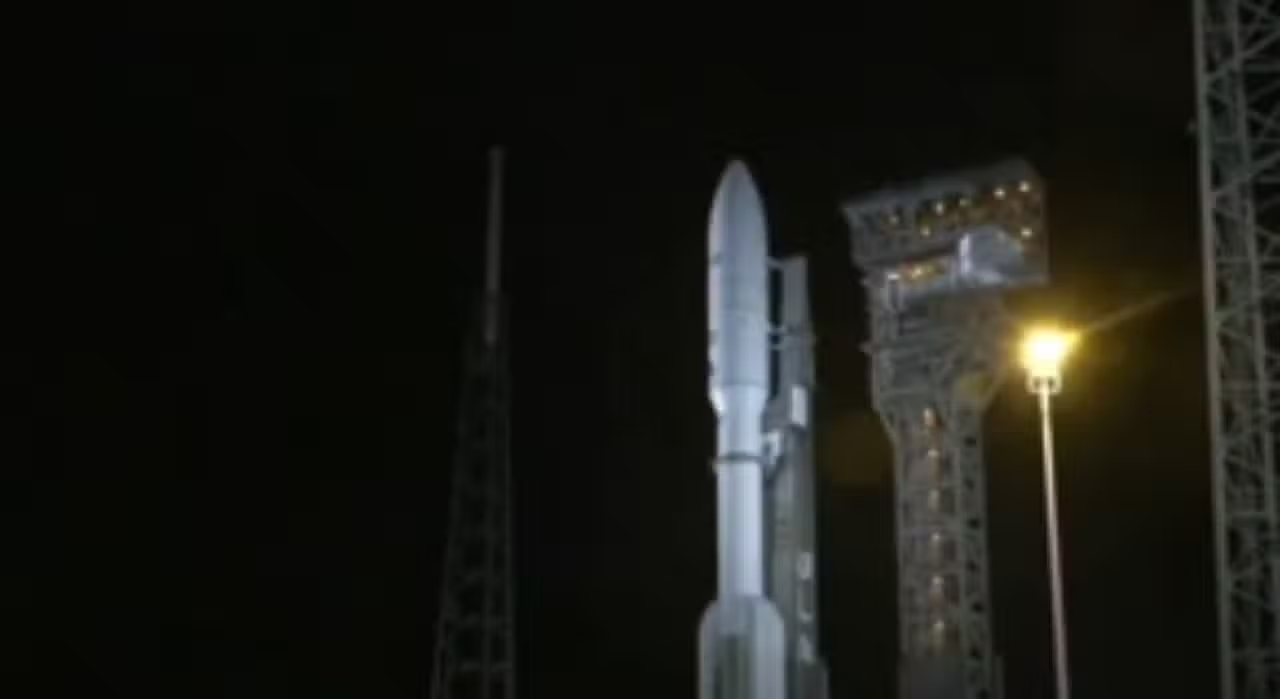
The rover operated by United Launch Alliance took off from Estação from Força Espacial from Cabo Canaveral during Monday night. The mission sent a batch consisting of 29 Amazon communications satellites into space. The equipment successfully reached low Earth orbit. The operation marked an important moment for aerospace engineering by transporting 18 tons of payload. The weight equals the maximum capacity ever recorded by this specific rocket model throughout its history of operations.
The launch occurred at exactly 8:53 pm Estados Unidos Eastern Time. The process of separating the ships began approximately 21 minutes after the main engines were ignited. The complete deployment lasted 16 minutes and occurred in ten distinct stages. The procedure guaranteed the correct positioning of each unit at the programmed altitude. Esta represents the sixth time that the space logistics company has carried out a flight dedicated exclusively to the North American technology giant’s connectivity project.
Detalhes space operation technicians at Flórida
The complexity of placing multiple units into orbit requires extreme mathematical precision. The rocket needed to maintain an impeccable trajectory to avoid collisions between the newly released equipment. The 18-ton mark demonstrates the vehicle’s lifting capacity in its most robust configuration. Engenheiros monitored each phase of the flight from the control center on Flórida. The success of the sequential release confirmed the effectiveness of the automated navigation systems guiding the machine’s upper stage.
The weight record had been set in early April during a previous mission in the same series. Repeating the feat proves the operational consistency of the propulsion system. Especialistas from the aerospace sector follows these numbers closely. The ability to carry massive payloads reduces the cost per satellite placed in orbit. The financial factor determines the viability of telecommunications megaprojects in the long term, demanding maximum efficiency in each take-off authorized by regulatory agencies.
Global Connectivity Network Expansão
The orbital infrastructure initiative was named Amazon Leo. The program plans to operate a massive network of more than 3,200 active satellites around the planet. The central objective involves providing high-speed internet to remote regions and urban areas with signal deficiencies. The construction of this communication network requires dozens of space flights over the next few years. The pace at which components are manufactured dictates the speed of expansion of the constellation that will cover the globe.
Até At the current time, partner companies have executed only ten of the more than eighty launches necessary to finalize the network architecture. The number seems small compared to the final objective set by the executives. The flight rate, however, presents a constant acceleration curve. Assembling a structure of this magnitude in space requires synchronization between production on the ground and the availability of launch platforms. Engineering teams work under tight schedules to meet the goals set for the decade.
Aerospace Supplier Diversification Estratégia
The project administration chose not to depend on a single space transportation company. The distribution of launch contracts involves multiple large international providers. The tactic prevents significant delays if a specific rocket model needs to undergo unforeseen technical revisions. Logistical flexibility guarantees the continuity of equipment shipping operations. The approach also stimulates competitiveness in the orbital services market, forcing providers to maintain high quality standards.
The current portfolio of completed missions illustrates this strategic division of financial and operational resources. Public data shows the active participation of different launch vehicles and bases around the world to sustain the program’s momentum.


- The Atlas V model carried out six successful missions from North American territory.
- Vehicle Falcon 9 completed three trips transporting batches of communications equipment.
- The Ariane 6 rocket performed a maiden flight focused on validating systems for the program.
- A new operation from the European base at Guiana Francesa is on the short-term agenda.
The use of launch pads on Flórida and América of Sul optimizes windows of opportunity to achieve different orbital inclinations. The proximity of the Equador line to the Guiana Francesa offers physical advantages for certain types of space trajectories. Global logistics planning reflects the complexity of the commercial enterprise. International coordination of spaceflight requires regulatory approvals from multiple government telecommunications agencies.
Competição direct through the broadband market
The low-orbit satellite internet sector has become a field of fierce competition between technology corporations. The Starlink network already has thousands of units in operation and serves customers on several continents. The entry of a new competitor with vast financial resources changes the dynamics of the global market. The dispute promises to reduce the prices of reception terminals for end consumers. The scenario directly benefits populations in isolated rural areas that lack basic infrastructure.
The time difference in the start of operations forces the new project to accelerate its practical implementation phase. The commercial strategy will depend on the quality of the signal and the stability of the connection offered to the first users. Analistas market watch the movements of the two companies with increased attention. Space infrastructure has become a strategic asset not only for civilian use but also for sensitive government applications. Digital sovereignty involves the ability to transmit data without relying on vulnerable submarine cables or terrestrial towers.
Launch Vehicle Reliability Histórico
The rocket used in the recent mission has a long history of service to scientific and commercial space exploration. The equipment has built a reputation based on the precision of its orbital insertions and the very low rate of anomalies during flight. The choice of this model to transport the heaviest loads in the constellation demonstrates the confidence of the program managers. The machine combines high-power engines with state-of-the-art avionics systems. The consistent performance justifies the high investment in takeoff operations.
The transition to new generations of rockets will occur gradually over the next few years across the industry. The current vehicle will continue to fulfill its role until the available inventory in the assembly warehouses is exhausted. The aerospace industry is experiencing a period of technological renewal accelerated by private investments. The ability to place 29 satellites in space at once with millimeter precision attests to the level of maturity reached by contemporary engineering. Flórida’s coastal night flight represents another step in building the communications infrastructure that will dominate the coming decades.
See Also em Latest News (EN)

New auto-shooter Arms of God confirmed for release on Nintendo Switch in 2027
29/04/2026
American manufacturer evaluates return to Asian foundry to produce top processor
29/04/2026
TCL’s new premium television hits the Japanese market with unprecedented light control technology
29/04/2026
Studio responsible for Spider-Man promises news about Wolverine game on PlayStation 5
29/04/2026
Sony requires online verification every 30 days for digital PS5 games
29/04/2026
New Sapphire ecosystem hides power cords and redefines computer assembly
29/04/2026
Samsung cuts price of Galaxy Watch Ultra by 40% to dominate premium watch market
29/04/2026
PlayStation tests 30-day restriction on games purchased without internet
29/04/2026
Olivia Wilde’s appearance causes uproar after film premiere in San Francisco
29/04/2026
Discount on premium Motorola smartphone with 12GB of memory moves digital retail
29/04/2026
NASA rover identifies 21 organic molecules in Mars rocks
29/04/2026