Jared Isaacman may lead mission to intercept interstellar object 4I/Rubin
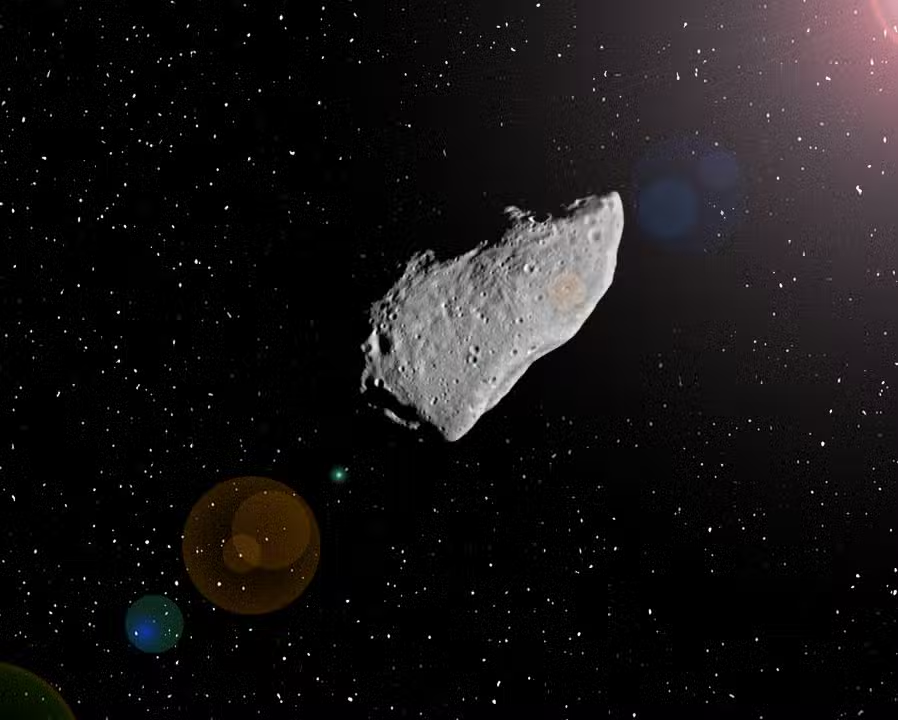
An ambitious plan could transform the way humanity studies deep space visitors. Billionaire businessman Jared Isaacman, known for his private space missions, is named as the potential leader of an operation that would intercept the interstellar object 4I/Rubin — the next opportunity to directly investigate the origin of bodies coming from outside Sistema Solar.
Observatório Rubin, located at Chile and operated by Ciências’s Fundação Nacional (NSF) in partnership with Estados Unidos’s Departamento, is expected to detect dozens of interstellar objects over the next decade. Esses bodies travel at extraordinary speeds, exceeding 42 kilometers per second — the speed needed to escape solar gravity. The most recent visitor, 3I/ATLAS, reached approximately 60 kilometers per second, surpassing the speed of any human rocket developed to date.
The unlikely alignment of 3I/ATLAS
Comet 3I/ATLAS aroused scientific interest not only because of its extreme speed, but because of a disturbing geometric detail. Sua’s trajectory arrived at Sistema Solar aligned with remarkable precision — just 4.89 degrees relative to Terra’s orbital plane. Esse alignment is statistically unlikely.
If trajectories were random, we would expect interstellar visitors to be evenly distributed in all directions. The ecliptic plane is tilted 60.3 degrees relative to Via Láctea’s stellar disk. The observed convergence raises a question that defies conventional understanding: did these objects arrive by chance, or were their routes technologically engineered?
Estudos estimate that billions of objects like 3I/ATLAS orbit toward Nuvem of Oort — the sphere of cometary bodies that surrounds our system at distances up to 100,000 astronomical units. If each star in Via Láctea produced a similar quantity of these blocks during its formation, the volume of material ejected into interstellar space corresponds to one-sixth of the Earth’s mass per stellar system.
The Cavalo Hypothesis of Cosmic Troia
The true nature of these visitors remains a mystery. Most are likely cosmic icebergs — blocks of ice and rock that release gaseous tails as they approach Sol. Entretanto, if trajectories demonstrate a systematic preference for the ecliptic, it will be necessary to consider a disturbing possibility: that some visitors may be deliberately targeted technological artifacts.
The 3I/ATLAS probe carried a minimum mass of 100 million tons. Sua composition has not yet been directly analyzed. Instrumentos spectrographics detected signals consistent with water and organic compounds, but remote data has fundamental limitations.
- Hipótese 1: natural Icebergs ejected during planetary formation
- Hipótese 2: Technological Estruturas disguised as natural bodies
- Hipótese 3: Hibridos — natural structures with internal biological or technological components
Como the interceptor would reveal the truth
The most direct solution would be to crash into the surface of the object, replicating the success of the DART mission — the spacecraft that impacted asteroid Dimorphos in September 2022. A high-resolution camera would capture detailed images just before impact, revealing textures, surface composition, and any irregularities that suggest an unnatural origin.
An interceptor would not merely be a passive detector. Poderia carry analytical instruments capable of examining the plume of gas and dust released by the impact, measuring chemical composition in real time. Espectrógrafos would analyze organic molecules. Biological Detectores would look for markers of life as understood in Terra.



Essa approach would open a completely new avenue for astrobiology. Atualmente, scientists search for life on exoplanets through distant telescopes and in stellar atmospheres by remote spectral analysis. An interceptor impactor would turn an interstellar visitor into a mobile laboratory, bringing back data that telescopes could never provide.
The technical challenges of interception
Lançar, an interceptor on a collision course with an interstellar object, requires precision and speed that test the limits of current technology. 3I/ATLAS was detected 3.5 astronomical units from Terra on July 1, 2025, and reached its closest point — 1.8 AU — in December 2025. Esse six-month interval is too short for an effective response with available technology.
4I/Rubin will offer improved opportunity. If detected at 10 AU and taking a year to approach to 2 AU, a rocket launching from Terra at 10 kilometers per second — a speed achievable with conventional chemical propulsion — could intercept the trajectory and crash into the surface before the object escapes Sistema Solar.
The window is narrow. Cada interstellar visitor remains accessible for only a few months. Após its closest approach, Sol’s gravitational pull returns it to deep space at increasing speed. Nenhuma existing human technology would catch up with him again.
Isaacman’s role in commercial exploitation
Jared Isaacman has built a reputation as a pioneer in space tourism and high-risk private missions. Sua company, Axiom Space, has developed rapid launch capabilities and tailoring rockets for specific objectives. A mission to intercept 4I/Rubin would represent a radical escalation in ambition—it would not be tourism, but privately funded frontier science.
The cost would be substantial. Desenvolver, an interceptor equipped with cameras and analytical instruments, integrating into a fast-launch rocket and coordinating with international space agencies would require an investment of hundreds of millions of dollars. Apenas organizations with exceptional resources — government agencies or billionaires with scientific vision — could afford such an undertaking.
Se Isaacman accepting this challenge would become responsible for answering one of the deepest questions in astronomy: do life and technology exist beyond Terra? A 4I/Rubin impact would not provide a definitive answer, but it would generate data that scientists would analyze for decades. The next decade will define whether this opportunity will be seized.
See Also em Latest News (EN)

Luka Doncic’s slow recovery leaves Lakers without star in possible clash with OKC
30/04/2026
Does Jefferson Savarino play today? Bolívar x Fluminense in the third round of the Libertadores
30/04/2026
Visa scandal in the Netherlands threatens to cancel 133 national championship games
30/04/2026
Does Germán Cano play today? Where to watch Bolívar x Fluminense in the Libertadores
30/04/2026
Jensen Ackles, Jared Padalecki and Misha Collins have a bloody reunion in The Boys
30/04/2026
SpaceX launches Falcon Heavy with communications satellite for the first time in 18 months
30/04/2026
Lucho Acosta plays today? Where to watch Bolívar x Fluminense in Libertadores 2026
30/04/2026
Full Flower Moon in Scorpio brings intense transformation to all signs in May 2026
30/04/2026
Chinese smartphones adopt iPhone visual features and create their own identity
30/04/2026
Bolívar x Fluminense in the Libertadores: where to watch and likely lineup for the game in La Paz
30/04/2026
3I/ATLAS Interstellar Object with High Deuterium Content Raises Question about Nuclear Chain Reaction
30/04/2026