SpaceX launches Falcon Heavy with communications satellite for the first time in 18 months
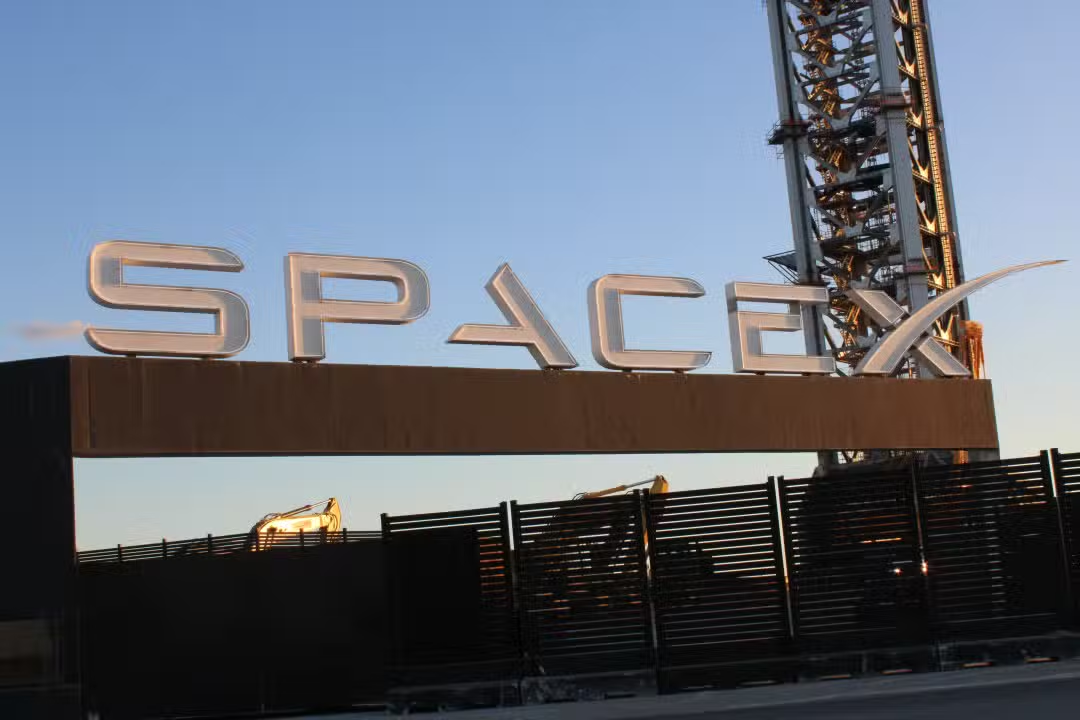
SpaceX’s Falcon Heavy rocket lifted off from Centro Espacial Kennedy into Flórida on Wednesday (April 29), carrying the ViaSat-3 F3 communications satellite toward geostationary orbit. Era the first flight of the powerful launcher in a year and a half — the last mission had taken place in October 2024, when the rocket took NASA’s Europa Clipper spacecraft toward Júpiter. The 6.6-ton satellite is on its way to its orbital position, 35,786 kilometers above Terra, and is expected to deploy five hours after launch.
The rocket that leads the industry
Falcon Heavy uses three modified, interconnected initial stages of Falcon 9, SpaceX’s flagship rocket. Juntos, these three boosters generate approximately 5.1 million pounds of thrust at liftoff, making the Falcon Heavy the second most powerful launcher in operation today. NASA’s Apenas Space Launch System (SLS) dwarfs it, at 8.8 million pounds. SpaceX’s Starship, still in development, promises 16.7 million pounds — an even bigger leap forward.
The Falcon Heavy core stage houses an upper stage integrated into the payload. Esta architecture enables large-scale missions to geostationary orbit and beyond. The combination of power and reliability has established the Falcon Heavy as a global benchmark among operational commercial launch vehicles.
Histórico successful since 2018
Falcon Heavy debuted in February 2018 with a memorable test flight. The rocket launched SpaceX founder Elon Musk’s cherry-red Tesla Roadster into orbit around Sol — an audacious demonstration of the company’s capabilities. Desde that inaugural launch, the rocket carried out ten more missions. Todas were successful.
- Fevereiro 2018: test flight with Tesla Roadster (heliocentric orbit)
- Abril 2019: Al-Amal research satellite (lunar orbit)
- Junho 2019: space refueling service and commercial satellites
- Dezembro 2020: JCSAT-18 communications satellite (geostationary orbit)
- Outubro 2024: Europa Clipper spacecraft (mission to Júpiter system)
The string of successes reflects the maturation of SpaceX’s reusable rocket technology and the confidence of government and private customers in the platform.



ViaSat-3 F3 satellite on the way
ViaSat-3 F3 is a high-capacity communications satellite intended to expand global connectivity coverage. At 6.6 tons, it represents a significant payload for geostationary orbit. Seu positioning at 35,786 kilometers — where the orbit is synchronized with the Earth’s rotation — will allow continuous coverage of a specific region of the planet.
The satellite integrates modern transmission technology and should offer internet, telephone and data transmission services to urban and remote areas. Deployment in GEO orbit places it alongside other stationary communications satellites, expanding the global connectivity infrastructure. Este launch marks another step in SpaceX’s commercial strategy of serving customers who depend on precise placement into geostationary orbit.
Contexto from the space industry
The success of Falcon Heavy as part of the larger series of commercial launches reflects the transformation of the aerospace sector. Reusable Foguetes reduced costs and increased frequency of operations. SpaceX, along with other companies, has democratized access to space for satellite missions, scientific research and exploration.
The return to operation of the Falcon Heavy after 18 months does not indicate reliability issues, but rather the selective nature of demand for a launcher of such capacity. Grandes Communications satellites, interplanetary spacecraft and specialized missions require the unique power of the Falcon Heavy. The spacing between flights is common for rockets of this size, whose missions are less frequent than those of the Falcon 9, which is more versatile and widely used.
See Also em Latest News (EN)

Researchers advocate instrumental UFO data over report analysis
30/04/2026
Luka Doncic’s slow recovery leaves Lakers without star in possible clash with OKC
30/04/2026
Does Jefferson Savarino play today? Bolívar x Fluminense in the third round of the Libertadores
30/04/2026
Visa scandal in the Netherlands threatens to cancel 133 national championship games
30/04/2026
Does Germán Cano play today? Where to watch Bolívar x Fluminense in the Libertadores
30/04/2026
Jensen Ackles, Jared Padalecki and Misha Collins have a bloody reunion in The Boys
30/04/2026
Lucho Acosta plays today? Where to watch Bolívar x Fluminense in Libertadores 2026
30/04/2026
Full Flower Moon in Scorpio brings intense transformation to all signs in May 2026
30/04/2026
Chinese smartphones adopt iPhone visual features and create their own identity
30/04/2026
Bolívar x Fluminense in the Libertadores: where to watch and likely lineup for the game in La Paz
30/04/2026
3I/ATLAS Interstellar Object with High Deuterium Content Raises Question about Nuclear Chain Reaction
30/04/2026