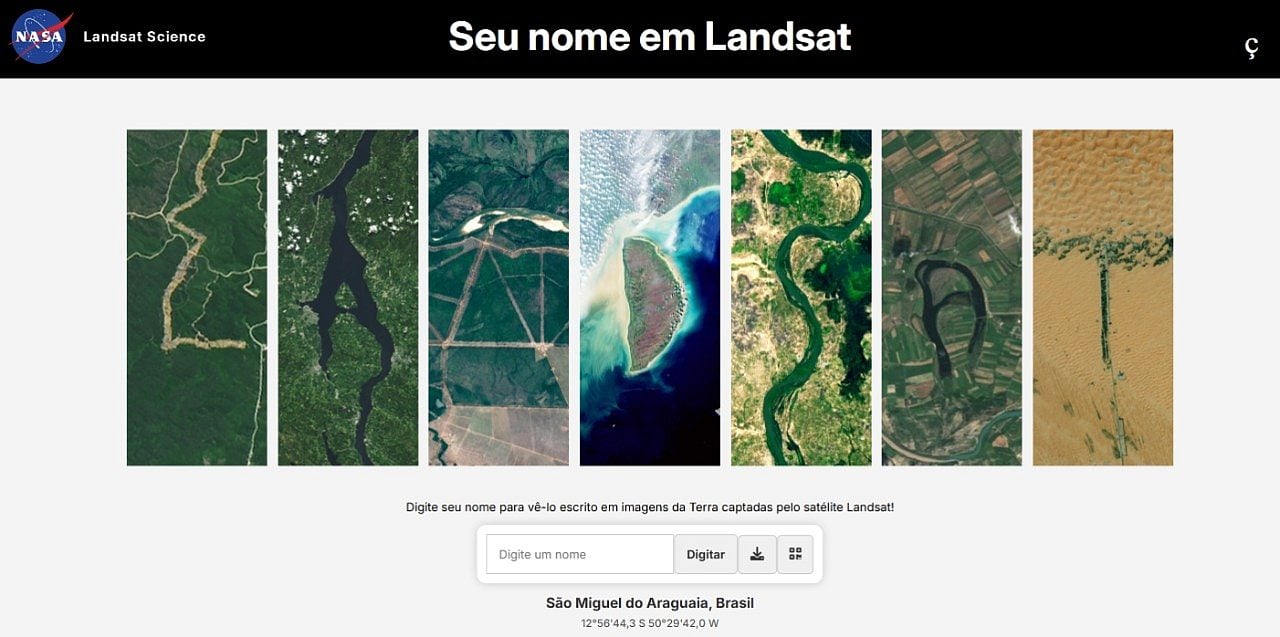
A free resource developed by the American space agency has become a rage on social media in recent days. The “Your Name in Landsat” (Seu Nome in Landsat) tool uses images captured by satellites to transform words into unique visual compositions. Qualquer person can access the website, type a name or word and see the sequence of letters form from real photographs of the Earth’s surface. The joke gained strength especially after Terra’s Dia celebration on April 22, when Nasa re-released the app to its followers.
The platform works in a simple and intuitive way. Basta accesses the email address, enters a word and the system displays the composition made up of satellite images. Como there are multiple photographic options associated with each letter of the alphabet, it is possible to request new combinations by clicking an update button. The service does not accept accents, numbers or spaces between words, maintaining compatibility with simple characters and facilitating search processing.
Origem images and technical data
The images used by the tool come from the Landsat program, a partnership between Nasa and Serviço Geológico of Estados Unidos that has been operating since 1972. Durante For more than five decades, satellites linked to the program have recorded the Earth’s surface in high resolution, generating a massive collection of geographic data. Essa image base is public and available for educational, artistic and scientific purposes, which allowed the developers of Nasa to create this interactive application accessible to the general public.
An interesting functional detail of the application is the possibility of clicking on each individual image after it has been generated. By doing so, the user obtains information about the exact location where that photograph was captured. Essa feature turns play into an educational opportunity, allowing people to discover geographies from different regions of the planet while creating their personalized compositions with names or brands.
Vai me dizer que você ainda não escreveu seu nome usando imagens de satélite da NASA?https://t.co/rdmqzMLkDo pic.twitter.com/CmiL4I7GGt
— JAMES WEBB (@jameswebb_nasa) April 23, 2026
Why it became a trend on social networks
Interactive and visually appealing Aplicativos have played a central role in the dynamics of contemporary social networks. “Your Name in Landsat” combines elements that attract users: it is free, easy to use, produces visually interesting results and allows immediate sharing on platforms such as Instagram, TikTok and Twitter. Nos In recent days, it was common to find posts with people’s names, trademarks and even random terms transformed into mosaics of colorful satellite images.
Going viral did not happen by chance. Nasa, as a scientific institution with a large digital presence, took advantage of Terra’s Dia commemorative date to reintroduce the tool on its official channels. The timing coincided with greater engagement from audiences interested in the environment, sustainability and topics related to the planet. Influenciadores and network personalities quickly embraced the trend, creating a ripple effect that took the tool to the top of searches.
Como works the compounding algorithm
The system behind “Your Name in Landsat” uses artificial intelligence to recognize geometric patterns in images that resemble letters of the alphabet. Cada’s Landsat image is automatically analyzed to identify visual characteristics that resemble the shape of a specific letter. Once these correspondences are catalogued, the algorithm creates an associative database where each letter has multiple image options that can represent it visually.
Quando the user types a word, the system searches sequentially in this database, selecting an image for each letter. The ability to generate “new combinations” works because the algorithm has access to dozens or even hundreds of images that visually represent each letter. Isso explains why two users typing the same word receive different compositions — the system offers variability within a finite but broad set of options.
Impacto educational and scientific
Além from the playful and viral aspect, experts in science education highlight the pedagogical potential of the tool. The application manages to awaken curiosity about satellite data, cartography and environmental monitoring in audiences that normally do not engage with these topics. Estudantes from geography, environmental biology and engineering have used the resource as a starting point for deeper discussions about remote sensing satellites.
Professores reported that the tool works as an initial hook for classes on space technology and monitoring the planet. Quando students create their names using satellite images, questioning where those images were captured, how satellites work and what the scientific importance of this data is. Landsat, in particular, is critical for researchers studying land use change, deforestation, accelerated urbanization, and global climate impacts.
The Landsat program in context
The Landsat program represents one of the longest-lasting space missions in history. Decades of continuous operation have generated an unparalleled archive of Terra images. Cientistas around the world rely on these images to monitor ecosystems, predict agricultural yields, track natural disasters and assess the consequences of climate change. The quality and consistency of the data made it possible to create time series that track planetary changes over generations.
The decision by Nasa and the American Serviço Geológico to keep this data public reflects a commitment to the democratization of scientific knowledge. Qualquer researcher, government entity or interested individual can access these images for free through specific platforms. “Your Name in Landsat” is a creative embodiment of this principle, transforming complex scientific data into interactive art.
Limitações techniques and functionality
Como mentioned, the tool has deliberate restrictions in its operation. The rejection of accents, numbers and spaces between words reflects design choices focused on stability and compatibility. Essas limitations, although they may seem restrictive initially, simplify processing and ensure that letter combinations work consistently. Usuários adapt quickly, typing names in simplified versions — “José” becomes “Jose”, “São Paulo” becomes “Saopaulo”.
The platform also operates with internet connectivity, depending on the loading speed to display the images. On slower networks, response time increases, but the tool remains functional. Access can be made from any device with a web browser — computers, tablets and smartphones —, further democratizing the experience.
Perspectivas future
The momentary viralization of “Your Name in Landsat” raises questions about the sustainability of public interest in digital tools. Tendências on social media typically spikes in engagement and then disappears. Porém, Nasa maintains the tool as a permanent resource, suggesting that the intention is long term. The agency can take advantage of this renewed interest to promote educational initiatives, such as online courses on satellite image interpretation or webinars on Landsat applications.
Independent Desenvolvedores also explore derivative possibilities. Alguns created customized versions using data from other satellites or adding features such as color filters, visual effects or native social media integration. Essa secondary innovation indicates that the original concept has extensive potential beyond the official application of Nasa.
The tool exemplifies how scientific agencies can engage contemporary audiences using technology as language. By transforming technical data into fun, shareable visual experiences, Nasa not only promotes its programs, but also cultivates scientific literacy in an organic and accessible way.