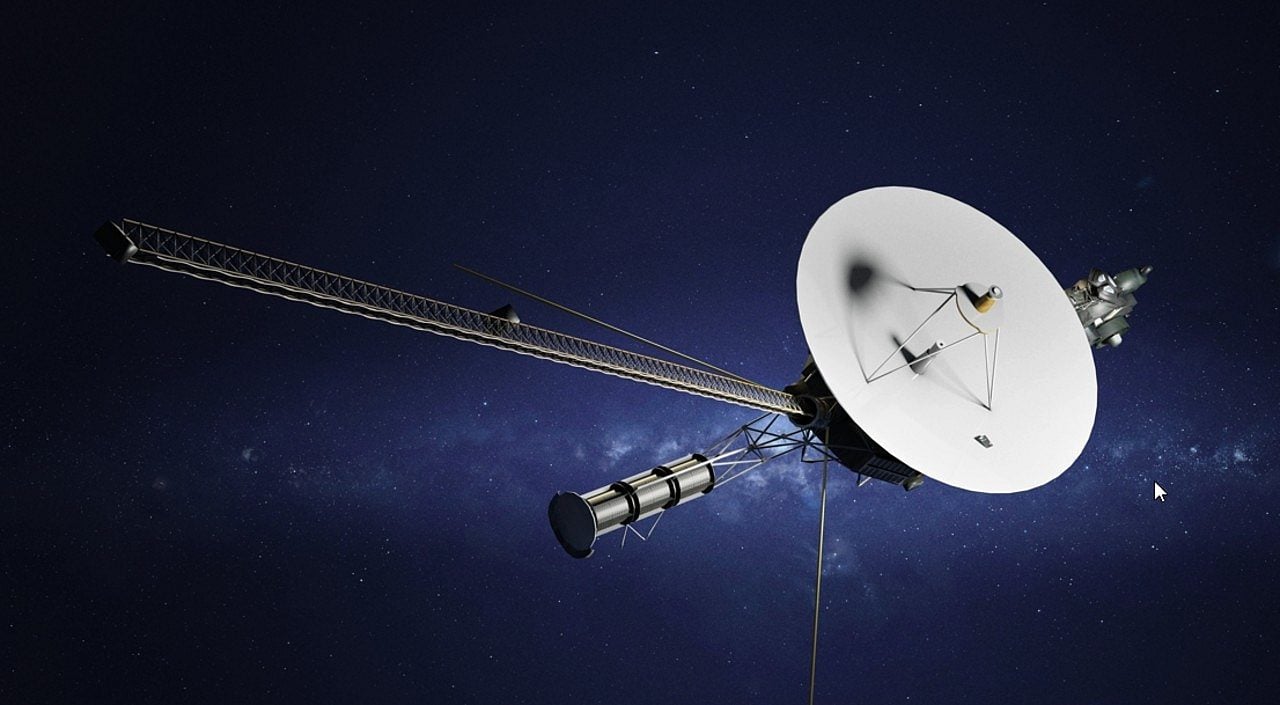
The North American space agency has deactivated yet another scientific instrument on the Voyager 1 space probe. The measure directly affects the Medição, Partículas Carregadas, and Baixa Energia equipment. The central objective of the maneuver is to save the remaining electrical energy in the spacecraft. The probe is currently traveling through interstellar space in a region never before explored. The equipment was successfully turned off through commands sent from Terra after careful analysis by the technical team.
The shutdown reflects the reality of the aging of the mission that began in the seventies. The structure’s nuclear power supply loses efficiency with each year of continuous operation. Engineers need to choose which systems to keep operational to extend the life of the historic project. The decision ensures that basic communication with our planet will remain active for years to come. Data collected at the edge of the solar system continues to reach research centers for scientists to analyze.
Extreme Distância and remaining equipment
Voyager 1 is located at a distance of approximately 25.4 billion kilometers from our planet. Communication with the structure requires extreme patience from flight operators. A radio signal takes tens of hours to travel from Terra to the probe in deep space. Returning confirmation requires exactly the same waiting time at the control center. The technical team waited patiently to confirm the successful shutdown of the scientific instrument.
The spacecraft’s operational scenario has become quite restricted over the decades. Apenas two scientific instruments remain in operation today on board the structure. The plasma wave subsystem continues to record valuable information from the cosmic environment. The magnetometer also remains active in collecting magnetic data in the region. The two devices represent the entire current observation capacity of the pioneering mission.
The sister probe’s situation presents similarities and small operational differences in the current scenario. Voyager 2 travels at a distance of 21.35 billion kilometers from Terra. The Medição, Partículas Carregadas, and Baixa Energia equipment of this second unit had already been deactivated in March 2025. Voyager 2 still maintains three scientific instruments in full operation. Ambas structures have already surpassed the heliosphere and navigate cosmic territories completely unexplored by humanity.
The decay of the nuclear energy source
The operation of the probes depends on an energy system based on radioactive material. Radioisotope thermoelectric generators use plutonium-238 as the main fuel for operation. The natural decay of this element generates constant heat inside the main compartment. The heat is then converted into electricity to power computers and internal heaters. The physical process has intrinsic limitations and loses strength over time.
The loss of power generation capacity is continuous and completely inevitable. Generators lose a fraction of their electrical power each year spent in space. Internal heating also decreases with the drastic reduction in available energy. The extreme cold of deep space threatens to freeze the spacecraft’s fluids and vital electronic components. Shutting down instruments serves precisely to redirect energy to essential survival heaters.
Power management became the mission control team’s primary activity. Engineers constantly analyze the consumption of each spacecraft circuit before taking any action. Choosing which instrument to shut down involves extensive debates about the scientific value of the data. Low-energy particle equipment has provided crucial information about the structure of interstellar space. Its deactivation marks the end of a specific era of data collection on cosmic radiation.
Especificações mission techniques and milestones
The original design of the probes predicted an extremely short useful life compared to current reality. The launch took place in 1977 with objectives well defined by scientists. The primary mission was only supposed to last five years in the vacuum of space. The initial focus was on exploring the gas giant planets in our solar system. Prolonged success completely transformed the scope of the space project.
- Sonda Voyager 1 operating at 25.4 billion kilometers with two active instruments.
- Sonda Voyager 2 positioned 21.35 billion kilometers away with three devices in operation.
- Equipamento of Medição of Partículas Carregadas of Baixa Energia fully disabled.
- Planejamento initial five years of space exploration between 1977 and 1982.
- Operação continues surpassing forty-eight years of uninterrupted activity.
The timing of the launch allowed for the shipment of a considerable technological load for the time. Cada one of the probes departed from Terra carrying ten different scientific instruments in its structure. The technological arsenal included high-resolution cameras and various spectrometers for atmospheric analysis. The progressive deactivation of this equipment began shortly after passing through the last planets in the itinerary. Energy saving was already a latent concern in the eighties and nineties.
Estratégias software and data recovery
The technical team develops creative approaches to address severe hardware limitations. Engineers analyze the original code of on-board computers in search of innovative solutions. The probes’ central memory houses instructions programmed almost half a century ago by the project’s creators. A deep understanding of this old software allows you to optimize the functioning of current systems. Reading the code requires knowledge of programming languages that are rarely used these days.
Working with the software generated an internal plan focused on preserving central memory. The strategy involves direct manipulation of data to bypass physical failures in aging circuits. Technicians can isolate damaged sectors of computers and redirect tasks to healthy areas. The process requires sending software updates across the vastness of deep space. Rewriting code billions of kilometers away represents a highly complex technical feat.
Existe a technical possibility of future reactivation of some specific components. Current shutdown cuts off continuous operating power to the particle instrument. Engineers evaluate whether short reclosure cycles could be performed in a future scenario. The maneuver would depend on a temporary surplus of energy in the spacecraft’s main system. The absolute priority remains maintaining basic communication with the Terra antennas.
The historical journey through the solar system
The initial script for the two spacecraft rewrote the modern astronomy textbooks. The trajectory was meticulously calculated to take advantage of an extremely rare planetary alignment. The gravity of each planet visited acted as a cosmic slingshot for the probes. The gravitational pull accelerated the structures towards the journey’s next target. The technique saved years of travel and tons of fuel that would have been impossible to carry.
Exploration began with the largest celestial bodies in our space neighborhood. The probes captured never-before-seen images of Júpiter’s storms and Saturno’s complex rings. Voyager 2 proceeded to historic encounters with ice giants Urano and Netuno. The data revealed active moons, extraterrestrial volcanoes and dense atmospheres. The end of this planetary phase marked the beginning of the long journey towards interstellar space.
Crossing the border of the solar system represented the last major geographic milestone of the mission. The heliosphere functions as an invisible protective bubble created by the solar wind. The probes detected the abrupt change in particle density upon crossing this magnetic boundary. The external environment turned out to be dominated by cosmic radiation from other stars in the galaxy. Radio transmitters continue to send records of this inhospitable environment in weak pulses of energy that cross the void to terrestrial receivers.