
Formula 1 renews debate on safety thirty-two years after Ayrton Senna’s tragic accident
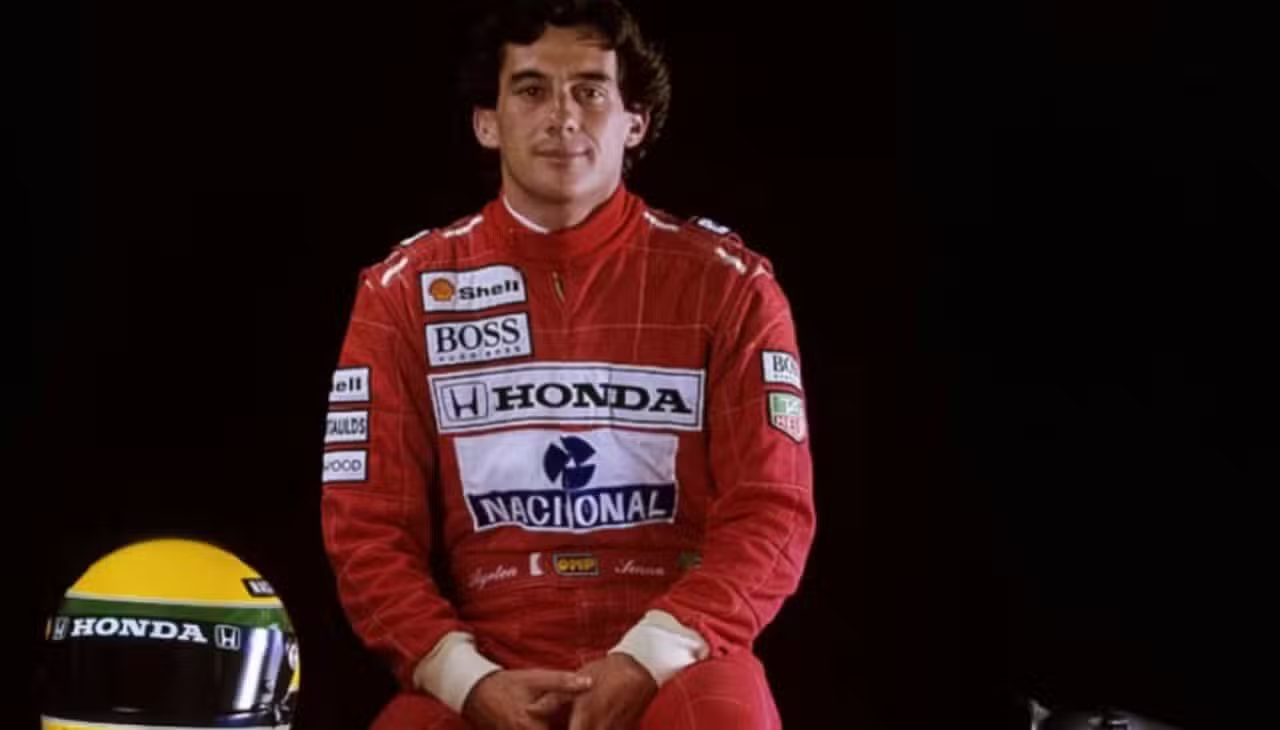
Trinta and two years after the tragic death of Ayrton Senna, which occurred on May 1, 1994, the debate on security at Fórmula 1 is once again gaining centrality. The category, which underwent a profound restructuring of its protection standards, now faces the complexity of managing risks in an environment of constant technological evolution and the search for performance. Advances implemented since that fateful day, such as the introduction of the halo, symbolize a new era, but recent episodes have reignited important discussions about the limits of security.
The death of the three-time world champion exposed vulnerabilities that Fórmula 1 could no longer ignore, driving technical, structural and cultural changes that transformed the sport. The path followed since then has consolidated the category as one of the safest in motorsport, with innovations that have saved lives. Contudo, the inherent nature of high speed and extreme competitiveness means that security is an ongoing process, and risk, rather than disappearing, simply transforms and adapts to new dynamics.
Legado eternal: the transformation of safety in F1
Ayrton Senna represented a turning point in the history of Fórmula 1, forcing her to undertake a critical self-evaluation. Starting in 1994, Federação Internacional of Automobilismo (FIA) and teams began an intensive safety improvement program. Cockpits have been reinforced to offer greater protection to riders against frontal and side impacts. The strength of car structures has been significantly increased through new crash tests and the use of more advanced materials, such as carbon fiber, designed to absorb and dissipate energy in the event of an accident.
The changes were not limited to cars. Medical protocols have also undergone a revolution, with the optimization of the rescue team, the presence of highly trained doctors and paramedics on the tracks and faster service. The deployment of the medical car, which follows the single-seaters in the first laps of the race, guarantees almost immediate intervention in the event of accidents. Décadas later, the introduction of the halo, a cockpit protection device that generated initial controversy, became an undeniable symbol of this phase of advances. Sua’s ability to deflect debris and direct impacts on the pilot’s head proved to be crucial in several extreme situations, proving the effectiveness of the measures adopted.
Technology as a shield: the impact of the halo on accidents
The halo, implemented in 2018, is perhaps the most visible proof of the safety evolution on the Fórmula 1. Sua structure, made of titanium, is designed to withstand forces equivalent to 12 tons. Antes of its mandatory nature, several extensive tests were carried out to ensure that it did not compromise the pilot’s visibility, nor the ability to evacuate in the event of an emergency. The initial resistance to the device, based on aesthetic arguments and the “purism” of the sport, was gradually overcome by data and, more importantly, by incidents where its presence was decisive.
One of the most emblematic cases was the accident of Guanyu Zhou in Grande Prêmio of Grã-Brittany of 2022, in Silverstone. Após a collision at the start, the Chinese driver’s car overturned and slid upside down for a long distance, impacting the tire barrier and safety fence. The halo kept the cockpit structure intact, protecting Zhou’s head from direct contact with the asphalt and barriers, allowing him to emerge unharmed. Esse incident, widely documented, demonstrated unequivocally the vital role of the halo. Outro example was Romain Grosjean’s crash in Grande Prêmio of 2020’s Bahrein, where the halo protected the driver from a roll bar after his car broke apart and caught fire.
Changing risk: recent incidents and the search for limits
Apesar Of all the advancements, the nature of high-performance motorsport ensures that risk will never be completely eliminated. Ele adapts, transforms and manifests itself in new ways. Technological evolution itself, which aims to mitigate dangers, also introduces new variables and challenges. Recent Incidentess, such as those involving the young driver Oliver Bearman, although they did not result in serious injuries, have reignited debates about the operational limits of modern cars and the intrinsic relationship between performance and safety. The discussions revolve around:
- Comportamento of cars:Como aerodynamic characteristics and energy management affect stability and predictability in extreme situations.
- Limites track:The definition and enforcement of track limits to prevent drivers from seeking maximum risk in each curve, potentially leading to accidents.
- Pilots’ Qualificação:The preparation and experience of young drivers who quickly rise to the category, confronting machines of increasing technical complexity.
- Desenvolvimento of new materials:The continuous search for materials that offer greater resistance and impact absorption without compromising weight and performance.
Esses episodes serve as constant reminders that each advance in security at Fórmula 1 often arises from a limit that has been tested or, in tragic moments, crossed. Learning is a continuous cycle, where telemetry data, accident analysis and simulations are constantly used to improve protection standards.
Novos 2026 regulations redefine challenges and variables
Fórmula 1 is on the verge of another phase of transformation with the introduction of new technical regulations from 2026. Essas rules promise to redesign cars, racing strategies and, consequently, competitive dynamics. One of the pillars of the new guidelines is an even more central and complex energy management, with engines that will have a significantly higher proportion of electrical power. Essa change aims to make the category more sustainable and relevant to the automotive industry, but it also raises new safety concerns.


Speed differences between cars in different stages of energy management can create unprecedented track scenarios. The behavior of pilots, who will need to optimize the use of electrical energy and fuel in a more sophisticated way, will also be influenced. The FIA and the teams are devoting substantial efforts to predicting and mitigating any additional risks that may arise with these new variables. Isso includes:
- Revisão aerodynamics:Carros designed to be more efficient and potentially smaller, changing the way they interact on the track.
- Sistemas security assets:Potenciais advances warning systems for pilots about speed differences.
- Análise of impact in collisions:Simulações went in-depth on how new chassis and power unit designs would react to impacts.
- Treinamento from pilots:Adaptação of training methods so that pilots fully understand the new dynamics of performance and safety.
With each new generation of cars and regulations, the Fórmula 1 becomes more accurate and technically dependent on calculations and simulations. However, by creating new variables, the category inevitably tests new limits, keeping the debate about safety ever present.
Risk Gerenciamento: the delicate balance between control and instinct
The premise that sport becomes safer the more controlled it is, does not always apply linearly to Fórmula 1. Embora Although technical and regulatory control is essential, excess control can, paradoxically, generate artificial scenarios, unexpected differences in performance and less natural behaviors on the track. The goal has never been to eliminate risk completely — an impossible task in a sport founded on extreme speed and technological innovation. The goal has always been to understand it, manage it and reduce it as much as possible, without denying its fundamental existence.
Esse’s delicate balance is central to the identity of Fórmula 1. Parte’s allure of sport lies in the demonstration of human skill at the limit of the machine, where the margin for error is minimal. Engineers work to create cars that are both safe and extraordinarily fast, defying the laws of physics at every turn. Pilots, in turn, are elite athletes who combine sharp reflexes, impeccable physical fitness and an unparalleled ability to make decisions under extreme pressure. Completely removing the risk element could distort the essence of the competition.
Senna as a compass: the continued responsibility of the category
Mais three decades later, Ayrton Senna continues to be an inescapable reference in discussions about security at Fórmula 1. Sua memory is not just a tribute to talent, but a perennial reminder of the responsibility that the category has towards the lives of its participants. Foi after his death, Fórmula 1 was compelled to accept that the spectacle, however great it was, could not be above protection. The conjunction of unparalleled talent and vulnerable structures has become unacceptable.
Senna’s legacy has shaped a proactive security culture, where the search for innovation is constant. Today’s Fórmula 1 operates with a level of security that would have been unimaginable in the 90s, but this security is the result of permanent vigilance and adaptation. With each new season, each new car design, each regulation adjustment, the Senna lesson echoes: safety is not a state of absence of risk, but an incessant attempt not to be surprised by it.
Today, sport is experiencing one of the safest moments in its history, but also one of the most complex. Growing technology, greater control and multiple variables demand constant questioning and a multifaceted approach to security. At its core, the Fórmula 1 is not just about speed, but about handling that speed responsibly. Senna’s greatest legacy perhaps lies not just in what he did on the track, but in what the sport was forced to do afterwards: learning that risk, although it transforms its form, never completely disappears, and remains there, at every turn, challenging human ingenuity in its management.
See Also em Latest News (EN)
Formula 1 idol Michael Schumacher attends his daughter’s wedding under strict private control in Spain
01/05/2026
Michael Schumacher attends his daughter’s wedding under heavy security lockdown on Spanish island
01/05/2026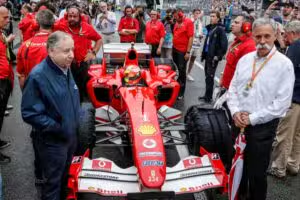
Secret 24-hour meeting in the principality of Monaco secured the signing of Michael Schumacher by Ferrari
01/05/2026
Michael Schumacher’s recovery requires intensive neurological care after more than a decade
01/05/2026
Jair Bolsonaro hospitalized in Brasília for shoulder surgery after judicial authorization
01/05/2026
Formula 1 Miami GP reveals full schedule for training and sprint classification this weekend
01/05/2026
Actor Samuel Monroe Jr. fights for life on support after untreated meningitis for months, family reveals
01/05/2026
Paraná prosecutor demands arrest of accused for abuse after family member reads history on AI app
01/05/2026
Paraná court revokes release of suspect for rape of 12-year-old girl after MP complaint; family discovered through artificial intelligence
01/05/2026
Former federal deputy Átila Lira shares intimate recording by accident on Instagram and digital material goes viral; nude published
01/05/2026
Risk of storm in Miami forces race management to put together an emergency plan in Formula 1
01/05/2026