
Interstellar object 3I/Atlas crosses the solar system at record speed towards outer space

A celestial body originating from outside our planetary system crosses the vicinity of Terra at extreme speed. The object, officially classified by astronomers as 3I/Atlas, travels at an impressive 57 kilometers per second through the vacuum. The unprecedented milestone in modern astronomy ensures that the gravity of Sol will not be able to capture the visitor during its passage. The extreme hyperbolic trajectory points to a unique visit. The comet follows a direct path back into the depths of outer space.
This cosmic traveler’s journey began in the galactic disk of Via Láctea a long time ago. Pesquisadores estimate that the body wandered through the void for a period between 1.4 and 4.5 billion years before crossing our territory. The crossing offers a rare opportunity for the global scientific community. Astrônomos from several space agencies mobilize ground and orbital equipment to collect accurate data. The central goal of the joint effort involves unraveling the chemical composition of a material formed far beyond our bubble of stellar influence.
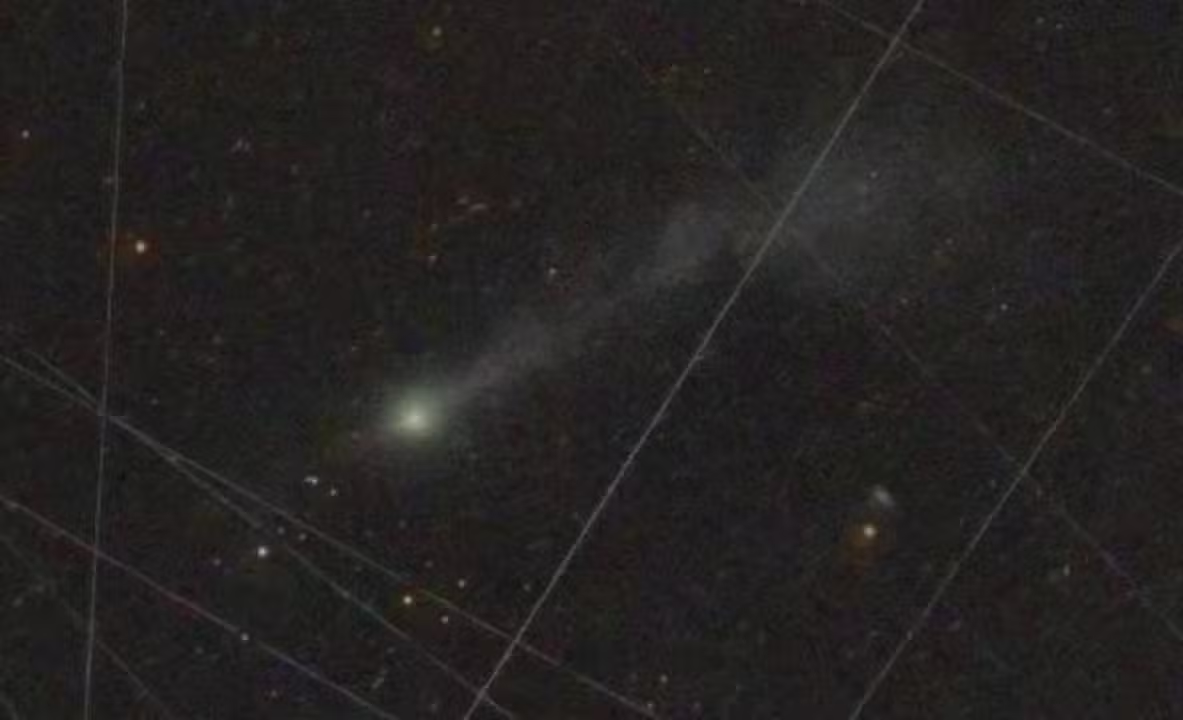
Descoberta on Chile and trajectory immune to solar gravity
The first visual confirmation of the visitor occurred on July 1, 2025. The ATLAS project telescope system, installed in the mountains of Chile, captured a weak light signal during a routine nighttime scan. The discovery mobilized research centers. Logo After the initial alert, teams searched for old records in astronomical databases. The detailed investigation revealed that the object had already appeared in archive images since June. The TESS satellite, managed by North American agencies, had also recorded the comet’s activity in May of the same year.
Orbital calculations quickly confirmed the alien nature of the celestial body. The eccentricity of the orbit exceeds level 6 on the astronomical scale. The number mathematically proves that the object will only make one visit to our system. The point of closest approach to Sol occurred on October 29, 2025. Durante At this critical moment, the star’s gravitational force acted like a giant slingshot. The natural maneuver slightly changed the flight angle. The comet’s kinetic energy easily overcame the solar attraction.
The object’s visual behavior evolved rapidly after initial detection. Telescopes recorded the formation of a bright coma and a tail three arcseconds long. Activity remained stable during the first few months of continuous observation. Nenhuma sudden fragmentation or explosion occurred by the end of August. The solid structure resisted the drastic increase in temperature caused by the stellar approach.
Composição chemistry reveals older age than our system
Spectroscopic analysis brought surprising answers about the visitor’s internal structure. The core has a significant amount of water and high levels of diatomic carbon. The chemical signature differs greatly from the pattern found in the local comets of Nuvem and Oort. 3I/Atlas displays a very peculiar reddish color. Scientists attribute this specific tone to the presence of complex organic compounds. The material has suffered a constant bombardment of cosmic radiation for eons in dark space.
The physical dimensions of the core vary over a wide range of estimates. The actual diameter must measure between 320 meters and 5.6 kilometers in length. The surface bears the scars of an unimaginable journey through the cosmos. Theoretical models suggest that the comet’s total age could reach the 7 billion year mark. The data places the object as an entity older than the solar system itself. The dust that breaks away from the nucleus acts as an intact time capsule.
The preservation of these volatile elements provides clues about the galaxy’s primordial chemistry. Researchers believe that the celestial body formed in an extremely cold environment. The absence of intense heat for most of its existence prevented the degradation of organic molecules. The detailed study of the gaseous coma allows us to identify the building blocks that orbited other stars. The academic community treats the event as a direct delivery of interstellar samples for remote analysis.
Comparação history with other celestial bodies
Contemporary astronomy has a very restricted catalog of confirmed visitors from other stars. 3I/Atlas represents only the third case documented by modern science. The speed of movement places it in an isolated category of study. The dynamical behavior helps calibrate the galaxy’s planetary formation models.
- Object 1I/Oumuamua traveled at 26 kilometers per second and had an elongated shape without the formation of a visible coma.
- Comet 2I/Borisov crossed the system at 33 kilometers per second and released a reddish tail rich in cosmic dust.
- The current 3I/Atlas breaks all records with its 57 kilometers per second and displays an increasing brightness in its gaseous structure.
The physical similarities with 2I/Borisov and D-type asteroids indicate a common formation process in neighboring star systems. The ejection mechanism that launched these bodies into deep space still generates academic debate. Gravitational interaction with giant planets in other systems could be the main cause of the launch. The fragmentation of stars is also among the viable hypotheses analyzed by astrophysics centers.
Continuous monitoring of these bodies helps to understand how often interstellar material crosses our region. Astronomers estimate that thousands of similar objects pass through the solar system invisible to our instruments. Improvements in detection technology allow science to identify smaller, faster targets. Comparing data between the three known visitors lays a new foundation for modern astrobiology.
Próximos steps of observation and final farewell
A global monitoring campaign gained momentum from November 2025. Observatórios spread across all continents synchronized their equipment to monitor the continuous path. The comet’s brightness reached magnitude 14.7 on the astronomical scale. The brand impresses experts. The brightness level requires telescopes with apertures greater than 20 centimeters for adequate viewing of the night sky. Telescópio Espacial James Webb entered the priority scale to analyze the gas cloud around the core. The infrared equipment collects unprecedented data on water evaporation and the release of volatile particles.
The closest approach to the planet Terra is scheduled for December 19, 2025. The comet will pass at a completely safe distance of 270 million kilometers. Não there is any risk of impact or interference with terrestrial dynamics. The orbital schedule predicts that the object will cross the Júpiter line in March 2026. The extreme speed guarantees a quick exit from our neighborhood. The definitive farewell to the solar system will take place in mid-2027.
The raw data generated by this passage will fuel academic research for decades. The comet’s direction of arrival coincided with the general movement of our system through the galactic disk. Humanity will have to wait a long time before a new messenger from the stars offers such a rich opportunity for study. Scientists process chemical information daily to map the distribution of heavy elements in the galaxy. The passage of 3I/Atlas redefines the limits of space exploration based on remote observation.
See Also em Latest News (EN)

Apple prepares launch of iPhone 17 Air with record thickness of 5.5 millimeters and new screen
02/05/2026
Sony console system receives three definitive free games with no subscription required
02/05/2026
Apple transforms the look of the iPhone 18 Pro with translucent chassis and unprecedented 5200 mAh battery
02/05/2026
PlayStation 5 receives two free major titles on the official store to attract players
02/05/2026
Leak reveals specifications of the first foldable iPhone with high-capacity battery and ultra-thin design
02/05/2026
PlayStation 5 manufacturer releases definitive redemption of three big-budget games without requiring subscription
02/05/2026
Nintendo reveals new generation console and confirms remake of the classic Zelda Ocarina of Time
02/05/2026
PlayStation 6’s aggressive price surprises analysts and could redefine the console market
02/05/2026
King Charles’ medical treatment changes official routine and Prince William assumes leadership of the monarchy
02/05/2026
Virtual store guarantees twelve free hits permanently for computers in Brazil
02/05/2026
Adidas unveils 97-gram shoes with unprecedented carbon technology for elite marathon runners
02/05/2026