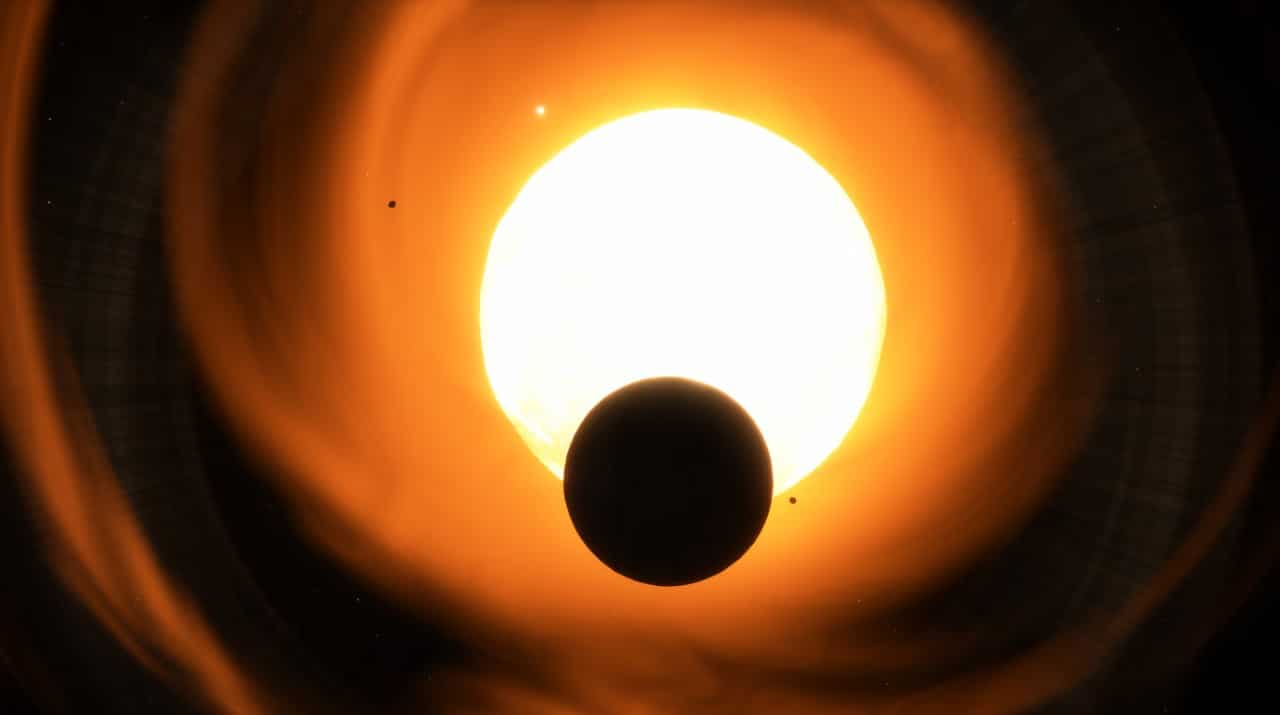
Simulações computations performed by Universidade and Lancashire researchers reveal that outer regions of binary star systems can produce planets with greater efficiency than orbits around isolated stars like Sol. The study contradicts decades of scientific conviction that such environments were hostile to planetary formation.
Matthew Teasdale, lead author of the research, highlights that near the two stars the environment is extremely turbulent. Porém, in more distant regions, the scenario changes completely. The protoplanetary disk could become unstable enough to fragment under its own gravity, triggering a process of rapid creation of multiple young worlds.
Zona prohibited delimits chaotic region
The simulations mapped rotating disks of gas and dust surrounding young binary stars. Próximo to the two stars, intense gravitational forces form a “forbidden zone”, a turbulent region where no planet can form. Essa gravitational barrier acts as a natural filter that prevents the aggregation of planetary material.
Além beyond this critical limit, however, the dynamics are reversed. The disk manages to accumulate enough mass to fragment due to gravitational instability, a phenomenon that quickly generates a large number of planets, mainly gas giants similar to Júpiter.

Formação accelerated beyond the gravitational barrier
Dimitris Stamatellos, co-author of the study and Universidade professor of astrophysics at Lancashire, highlights that protoplanetary disks in binary systems can be “extremely productive” once the danger zone is overcome. Computer modeling shows that planets emerge at surprising speed and numbers when the gravitational environment finally stabilizes.
The research also suggests that complex gravitational forces may eject some newly formed planets, launching them into interstellar space as wandering bodies. Esse accelerated dual formation process combined with planetary ejection shapes the population of worlds around dual star systems.
Tatooine may be more common than imagined
The findings have direct implications for understanding circumbinary exoplanets. Astrônomos have already identified more than 50 planets in orbit around two suns. Esses worlds include several discoveries in wide, distant orbits from their host stars. The results suggest that real-world versions of Tatooine with its two suns may be much less rare than the scientific community believed.
The discovery offers viable explanations for how these planets manage to form and survive despite opposing gravitational forces acting simultaneously. Sistemas binaries are no longer seen as planetary deserts to be recognized as factories of worlds.
Powerful Instrumentos opens new observational possibilities
The researchers indicate that future observations with high-precision instruments will revolutionize the field. ALMA (Atacama Large Millimeter/submillimeter Array), Telescópio Espacial James Webb and the future Telescópio Extremamente Grande have sufficient sensitivity to detect protoplanetary disks in binary systems.
Essas tools will be able to:
- Identificar planet-forming disks around distant double stars
- Captar direct evidence of real-time gravitational fragmentation
- Mapear material distribution and gas density in the disks
- Confirmar theoretical models through spectroscopic observation
- Revelar populations of newly formed planets still embedded in disks
Technological advancement transforms simulations into concrete observations, allowing astronomers to witness the birth of worlds. The next decade promises observational data that will validate or refine the theoretical predictions generated by the work of Teasdale and his team.