China opens first humanoid robot factory with production of 10,000 per year
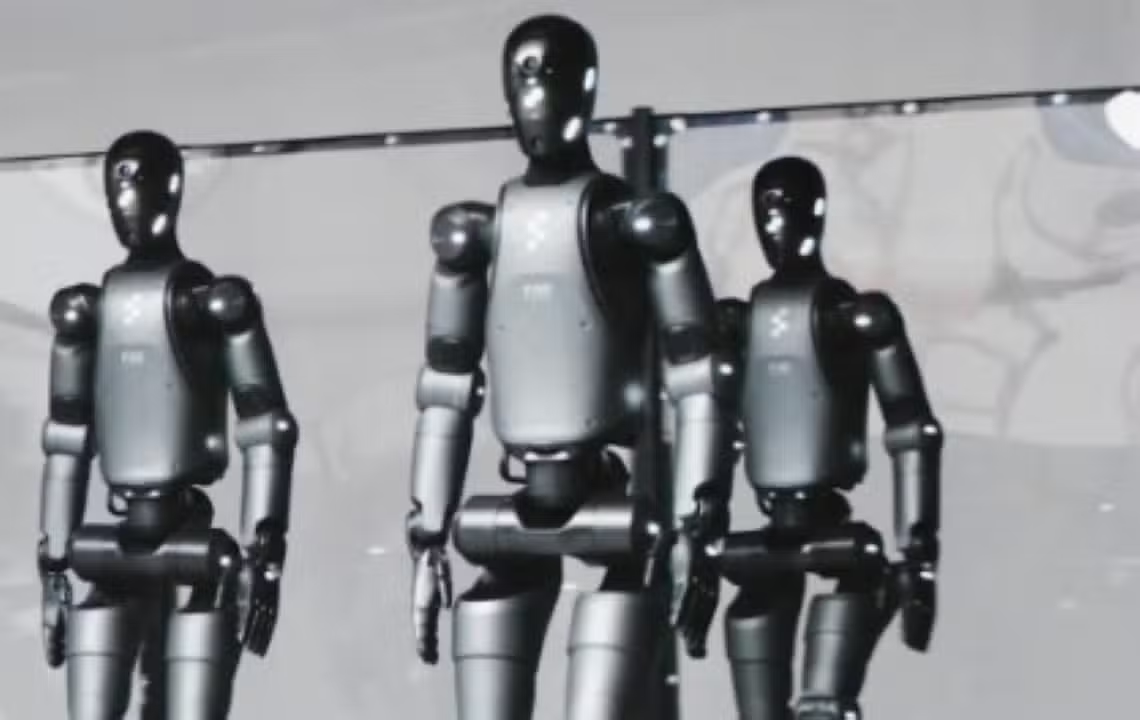
Shenzhen, the former fishing village transformed into Vale from Silício from China, received the country’s first humanoid production line. The factory is capable of manufacturing 10,000 robots per year — one every 30 minutes. The report was released by Jornal Nacional this Friday (1st), during a special series on Chinese technological transformation.
The country presented the robots as the main attraction of Primavera’s Festival celebration of Ano Novo Chinês with 400 million viewers, the most watched television program in the world. In the presentation, the humanoids danced and performed kung fu movements, demonstrating significantly superior capabilities compared to models from the same company identified nine months earlier.
Desenvolvimento accelerated in 45 years
Shenzhen was just rice fields and countryside until 1979, when President Deng Xiaoping chose it to be a laboratory of capitalism within a communist regime. The first special economic zone created there would function as a reflection of Hong Kong, but under state control. Quatro decades and a half later, the city is home to mega technology companies and positions itself as a global innovation center.
The Chinese population has been shrinking since 2022 and aging continuously. Salários have doubled in the last decade, but the cost of living has also grown proportionately. Diante In this scenario, the country accelerated research into humanized robotics to meet work and personal care demands.
Expansão from the humanoid market
China already has more than 140 companies building humanoid robots. Essas manufacturers have developed 330 different versions to date. Applications vary widely:
- A robot guides Cantão subway passengers through security before boarding
- Atendentes in Pequim pharmacies perform customer screening
- Modelos specialists collect apples in plantations
- A version with facial expressions simulates grandmotherly behavior for domestic companionship
Perto from Shenzhen, one of the manufacturers has developed robots capable of working in car assembly plants, transporting parts between positions. The eyes work like cameras, allowing adaptation to different functions through computer vision.




Desafios technical and marketing
Coordenação hand fine motor skills remain one of the biggest difficulties for Chinese engineers. A company claims to be the first in the world to achieve a level of precision in humanoids that allows delicate manipulation of objects. Outro manufacturer works to reduce costs to the point of making domestic purchasing viable for Chinese families.
The Chinese government has created humanoid training centers in several cities. Neles, robots learn through real-life simulations. By falling repeatedly, they can improve their balance. By dropping books several times, they learn to position them correctly on shelves. Esse process resembles school presentations — demonstrate specific skills, but still do not function autonomously without constant supervision.
Competição global and autonomy
Estados Unidos competes intensely in this market. Optimus, Elon Musk’s robot, promises to perform domestic and work tasks for 20 thousand dollars each, positioning itself as fundamental for the company’s expansion. Outro American model, the Neo, is already sold for the same price for residential cleaning. Entretanto, Neo works with remote operation — a company employee manipulates the robot by remote control when the owner leaves home.
The technological race between China and Estados Unidos aims to achieve a truly autonomous robot. Once exported globally, these humanoids will collect data on the inner workings of companies around the world. Essas information will feed its own artificial intelligence models, building algorithms with unprecedented computational power. The central question is no longer whether robots will replace humans, but when and in what contexts — and how much power will be delegated to them.
See Also em Latest News (EN)

Asian brand launches Elite version of the Jaecoo 7 utility for R$ 179,990 in the national market
02/05/2026
European retailer starts selling the Samsung Galaxy A17 5G smartphone for 149 euros at the end of the month
02/05/2026
New Heroes of Might and Magic: Olden Era debuts in early access with a focus on classic tactics
02/05/2026
Subnautica 2 studio guarantees Krafton in publication after change in Steam storefront
02/05/2026
Sony reveals PS Plus May catalog with football simulator, action RPG and platform
02/05/2026
Subnautica sequel arrives on Steam in May with early access model for players
02/05/2026
PlayStation maker confirms lifetime gaming license after initial online check
02/05/2026
Fortnite servers return to normal with an unprecedented package of items from the Star Wars franchise
02/05/2026
Independent game Vampire Crawlers surpasses one million users and confirms cooperative mode
02/05/2026
Apple rolls out iOS 26.5 Beta 4 with a focus on performance and RCS messaging
02/05/2026
Video shows Ayrton Senna with tricolor belt after São Paulo’s second championship in 1993
02/05/2026