
Researchers identify giant jet of larger particles in the interstellar comet 3I/ATLAS aimed at the Sun

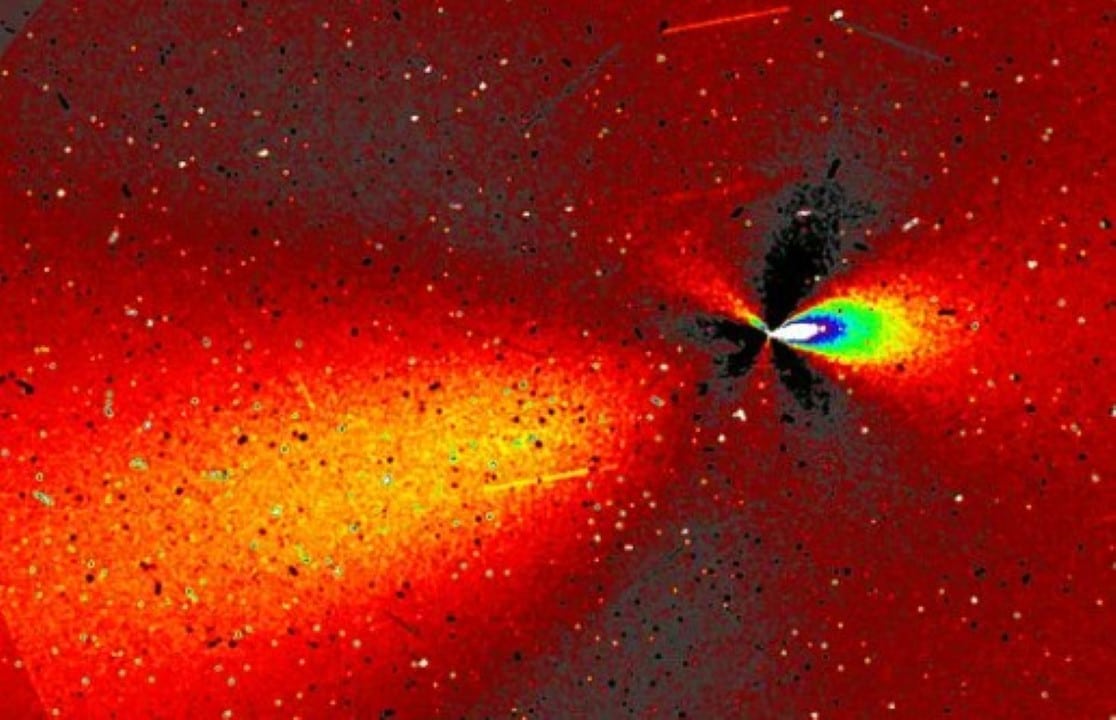
The interstellar comet 3I/ATLAS features an unusual structure that intrigues astronomers at observatories around the world. Recent Imagens captured in December 2025 show a narrow jet of material stretching more than 400,000 kilometers into space. The formation points directly towards Sol. The phenomenon differs from the standard behavior observed in celestial bodies originating from our planetary system.
The light anomaly results from the scattering of sunlight by dust grains considerably larger than the common dust found in a vacuum. The space object travels at a distance of approximately two astronomical units from the center of the system. Especialistas applied advanced filters to visual data to isolate and understand the dynamics of this flow of matter. The discovery reinforces the uniqueness of the third interstellar visitor confirmed by modern science.
👽🚨 Inicio de 2026 y el espacio ya da que hablar
Entre el 30 de nov. y el 27 de dic. de 2025, Hubble captó 17 imágenes del objeto interestelar 3I/ATLAS.
🔭 Tres jets simétricos, uno apuntando hacia el Sol (anti-tail).
¿Fenómeno natural extremo… o una anomalía real?#3IATLAS pic.twitter.com/dpx4tR8CfU— TIO OVNI CHILE (@OvniChile1) January 1, 2026
Dinâmica and composition of the light structure
The force of solar radiation acts as a natural brake on the materials ejected by the comet’s nucleus. Smaller particles lose speed quickly in space. Apenas grains larger than one micron can maintain their trajectory for hundreds of thousands of kilometers against light pressure. The physics of the phenomenon requires that the material has enough mass to overcome the resistance imposed by the central star.
Calculations indicate that the initial speed needed to propel fine dust would exceed known physical limits for natural comets. The gas sublimated to the surface would not have the strength to accelerate submicrometer particles to such extreme distances. The dominant presence of larger grains explains the maintenance of the elongated structure. The intense glow occurs because these pieces of matter reflect light in a specific, focused way.
Existe an upper limit to the size of the fragments that make up the main jet. Excessively large Pedaços have a smaller surface area relative to their own mass. Essa characteristic reduces the efficiency in dispersing solar light along the path. The rate of material loss from the celestial body reached about 500 kilograms per second during the closest approach to the star.
The gaseous entrainment time must be shorter than the flow dilution time in vacuum. The condition restricts the maximum particle radius to values below 100 microns for nuclei of a size compatible with current observations. Extreme collimation implies a very narrow opening angle, calculated on the order of eight degrees by the researchers involved in the monitoring.
Comparação with other known celestial bodies
Comets formed in our cosmic neighborhood usually have tails made up mostly of extremely fine dust. Essa submicrometer dust scatters light very easily due to the favorable area-to-mass ratio. The visitor from outside the system breaks this established pattern. The predominance of larger particles transforms the celestial body into an astronomical anomaly of great value for the study of the formation of the universe.
The extent of the flow of matter surpasses historical records even after the geometric perspective corrections applied by scientists. The intense activity remained clearly visible even after the object passed the closest point to Sol. The behavior contrasts with most long-period comets documented to date by large telescopes.
The fundamental differences between the interstellar visitor and local bodies include well-defined structural and behavioral aspects.
- Fine dust dominates the brightness in famous comets like Hale-Bopp.
- Larger grains have lower luminous efficiency in deep space.
- The narrow shape of the jet indicates that the material escapes from a very specific area.
- The maintenance of activity after perihelion demonstrates a significant volatile reserve.
The reddish color of the gas and dust cloud around the nucleus suggests the presence of complex organic compounds. The activity confirms that the sublimation of volatile elements occurs, a typical characteristic of comets, despite their origin external to the system. Data collected by ground- and space-based telescopes corroborate these initial observations about the chemical composition of the ejecta.
Hyperbolic Trajetória and external origin
The celestial body travels in a hyperbolic orbit with a speed exceeding an impressive 58 kilometers per second. The object crossed the system boundary from deep space and reached perihelion in October 2025. The closest approach to the planet Terra occurred in December of the same year. The distance recorded by measuring instruments was 1.8 astronomical units.
The comet is now rapidly moving away towards the interstellar void. The current speed prevents solar gravity from capturing the object into a permanent elliptical orbit. The ATLAS warning system carried out the original detection in July 2025. The discovery mobilized observatories on several continents to continuously monitor the trajectory and structural changes.
Quando compared to previous visitors, known as 1I/’Oumuamua and 2I/Borisov, the new object has a higher speed and much more pronounced activity. The hydrogen envelope detected at ultraviolet wavelengths reinforces the active nature of the nucleus. Space missions recorded transit in multiple bands of the electromagnetic spectrum to ensure complete analysis.
High-precision Equipamentos, like the Subaru telescope, captured detailed images during the morning twilight. The observation campaign involved unprecedented global coordination between professional and amateur astronomers. Processing with gradient filters highlighted the fine structures of the jet that would go unnoticed in conventional image analyses.
Mecanismos matter release into space
The emission of dust and gas occurs preferentially on the side of the nucleus that receives direct illumination from the star. Essa thermal asymmetry explains the unusual direction of the jet observed by the researchers. The rate of mass loss grew exponentially during the approach and maintained high levels in the following months. The constant flow reflects a heating process deep within the celestial body.
The density of the ejected material decreases proportionally to the square of the distance from the point of origin. Mathematical models based on a narrow emission cone can accurately reproduce the shape recorded in astronomical photographs. Particles between one and one hundred microns in size meet the physical requirements for resistance and acceleration in the microgravity environment.
The precise focus of the jet suggests that the release occurs through limited cracks or openings in the core’s crust. Temporal variations in the emission indicate that the object’s rotation axis undergoes regular oscillations as it travels through space. The rotation period estimated at fifteen hours helps explain the dispersion patterns of the material over the weeks of continuous observation.
The corrected tail extension reaches extreme proportions for any object documented in the history of modern astronomy. The phenomenon challenges traditional theoretical models on the dynamics of cometary dust and requires new mathematical approaches. Future spectroscopic measurements will be able to determine the exact flow velocity through the Doppler displacement. The scientific community continues to monitor the distance of the interstellar visitor as long as equipment allows light to be captured in deep space.





