

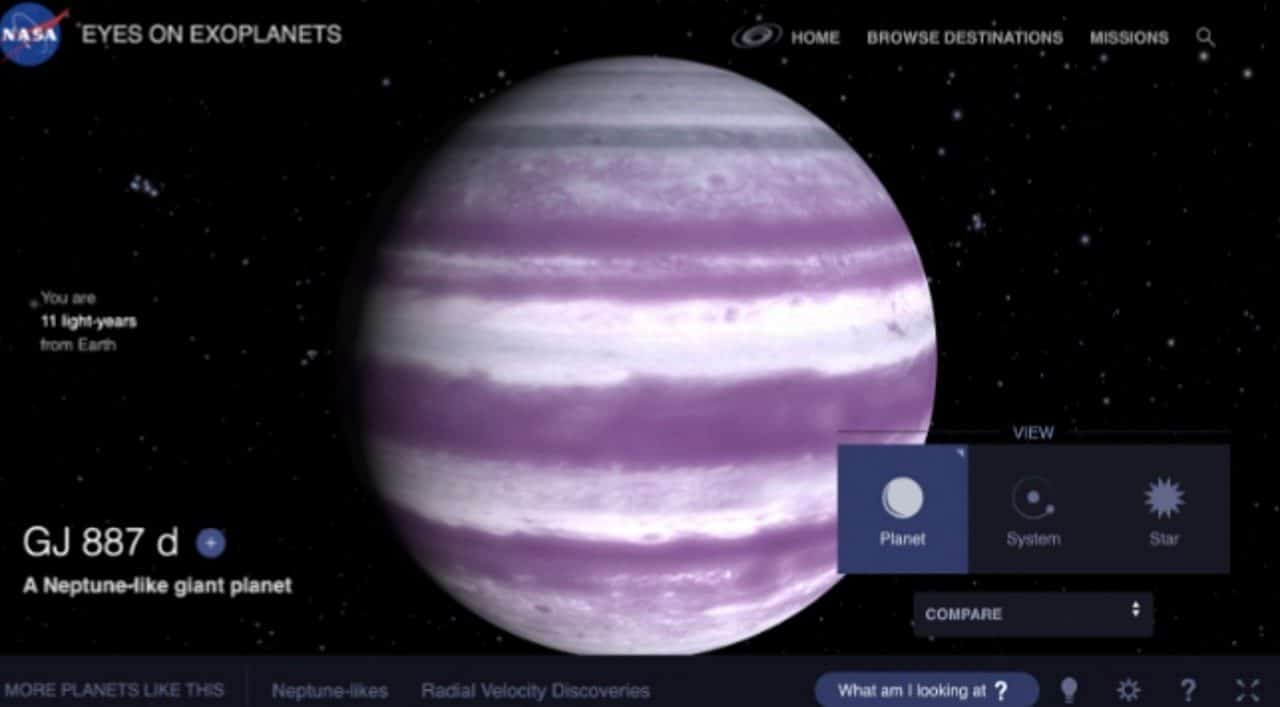
International Cientistas confirmed the existence of a potentially habitable planet called GJ 887d, located just 10 light-years away in the habitable zone of a red dwarf star. The world, which has at least six times the mass of Earth, orbits the star GJ 887 every 50.8 days and receives approximately 80% of the energy that Terra absorbs from Sol. Dados collected by European telescopes positioned at Chile reveal that this is one of the closest planets where liquid water could exist under suitable conditions.
The research, led by astronomer C. Hartogh of Instituto of Astrofísica and Geofísica of Universidade of Göttingen, with participation by Universidade of St Andrews and Instituto Nacional of Astrofísica of Itália, marks a significant advance in the search for potentially habitable worlds. Apesar from cosmic proximity, GJ 887d remains inaccessible to manned travel. The Parker Solar Probe probe, one of the fastest objects created by humanity, would take between 16,000 and 17,000 years to reach the planet traveling at approximately 692,000 kilometers per hour.
A star system full of mysteries
GJ 887, also known as Gliese 887 and Lacaille 9352, is a cool red dwarf that emits only a few percent of the luminosity of Sol. Essa’s peculiar feature significantly shifts the habitable zone closer to the star, allowing planets in relatively close orbits to maintain potentially temperate temperatures. The low stellar brightness represents a crucial advantage for future observations, as it offers less noise and interference compared to systems dominated by more massive and luminous stars.
Além of GJ 887d, the survey confirmed the existence of three other planets in even inner orbits around the star. A fifth, weaker signal suggests the possible presence of another small planet, although the researchers highlight that this latest candidate requires additional observations for definitive confirmation. The complexity of the multiplanetary system indicates that GJ 887 hosts a dynamic and structured environment.
GJ 887d’s orbital distance places the planet about 32 million kilometers from its host star. Para to put it into context, this represents a considerably greater proximity than that of Mercúrio in relation to our Sol. Apesar from this proximity to the red dwarf, the planet receives only 80% of the solar energy that Terra absorbs, placing it within the parameters of the habitable zone where liquid water could, theoretically, be preserved on the surface.
https://twitter.com/INAF_astro/status/2040075226457752030?ref_src=twsrc%5Etfw
Metodologia scientific that revealed the planet
Astronomers used the radial velocity method to detect GJ 887d, a technique that measures the tiny back-and-forth motion of a star caused by the gravitational pull of its orbiting planets. Essa approach does not observe the planet directly, but identifies stellar oscillations that reveal its presence. The data was collected using two high-precision spectrographs operated on the Observatório Europeu of the Sul on the Chile: HARPS and ESPRESSO, instruments recognized worldwide for their exoplanet detection capabilities.
A fundamental challenge faced by the team was distinguishing the genuine signals from the planets from the noise generated by the starspots of GJ 887 itself. To address this issue, scientists implemented an advanced statistical model called a Gaussian process, which works as a sophisticated mathematical filter capable of subtracting stellar interference from the raw data collected. Este process made it possible to confirm that the 50.8-day signal actually corresponded to an orbiting planet and not to natural variations of the star.
The work also measured the rotation of GJ 887 over approximately 39 days and used this cycle as a reference to further separate stellar noise from genuine planetary signals. Essa approach demonstrates how modern ground-based observatories, equipped with nanometric precision instrumentation, can detect distant worlds without the need for direct space travel. The reanalysis of previous observations combined with new data consolidated previously suggested conclusions and expanded knowledge about the system.
The habitable zone and its uncertainties
NASA defines the habitable zone as the distance from a star at which liquid water could exist on the surface of planets orbiting it. Essa definition works as a useful filter in the search for potentially living worlds, but does not automatically guarantee the presence of oceans, a sustainable atmosphere or even conditions favorable to life. It is an initial parameter that opens up possibilities, not absolute certainty.
In the specific case of GJ 887d, the study’s temperature estimates, considering only stellar radiation without the effect of an atmosphere, indicate values below zero degrees Celsius by terrestrial standards. Contudo, a sufficiently dense and properly composed atmosphere could raise these temperatures to levels more compatible with liquid water. The reverse risk also exists: an uncontrolled greenhouse effect would transform the planet into a rocky hell similar to Vênus, where temperatures hover around 465 degrees Celsius.
With a mass approximately six times greater than that of Terra, GJ 887d could be composed of solid rock similar to our planet or have an extremely dense atmosphere rich in gases. Essa compositional uncertainty remains one of the main open questions. Determinar the geological and atmospheric nature of the world requires more sophisticated observational techniques that are still under development.
Why a Quiet Red Dwarf Offers Hope
Red Anãs often produce intense solar flares capable of gradually eroding the atmospheres of nearby planets, making them hostile environments for trapping gases and water. Esse phenomenon represents one of the main concerns when studying worlds orbiting these stars. GJ 887, however, exhibits notably different behavior. A report published in the journal Science in 2020 highlighted the exceptionally low activity of GJ 887 as a positive factor for the atmospheric preservation of its planets.
The relative stability of the star creates more favorable conditions compared to other similar systems. Proxima Centauri b, for example, remains the subject of scientific debate due to intense eruptions from its host star, which could compromise the habitability of any nearby world. GJ 887 offers a distinct scenario where the current stellar calm facilitates not only remote observations but also suggests a less turbulent history that could have preserved atmospheres over billions of years. Embora a calm star today does not prove that it was calm in the distant past, this characteristic increases the probabilities of relative habitability.
Remote Observação as an Exploitation Tool
Mesmo just 11 light-years away, GJ 887d remains completely inaccessible for direct missions with current space technology. Instead of travel, scientists use remote sensing, which consists of extracting information through the analysis of light and radiation emanating from the planet. Essas observations can reveal temperature changes over an orbit, atmospheric properties, presence of clouds and possible greenhouse gases.
- Métodos remote sensing used:
- Espectroscopia for atmospheric composition analysis
- Fotometria to measure orbital temperature variations
- Direct Imagem using advanced interferometry
- Thermal Análise for estimating surface properties
- Busca by spectral biomarkers in future observations
GJ 887d’s relative proximity offers a crucial observational advantage. A nearby bright star gives future space observatories more photons to work with, significantly improving attempts to take direct images or perform precise thermal measurements. If scientists can constrain temperature variations and surface reflectivity, they could determine whether the planet is a rocky world with a potentially temperate climate or a dense mini-Neptune with an impenetrable atmosphere.
The next steps in astronomy
The next big question in the investigation of GJ 887d is clear and fundamental: does the planet have a substantial atmosphere, and if so, is it capable of supporting liquid water on the surface? Como GJ 887d does not transit in front of its star when observed from Terra, many of the conventional atmospheric tests become technically challenging. Isso does not mean impossibility, only that alternative methods must be developed and refined.
Para the immediate future, next-generation space observatories will have unprecedented analysis capabilities. The already operational Telescópio Espacial James Webb and its planned successors will offer ever-increasing resolution and sensitivity for characterizing the atmospheres of distant exoplanets. The discovery of GJ 887d puts this world on the shortlist of the best candidates for intensive observation when new technologies become available.
The importance of GJ 887d lies not in definitively affirming the existence of a living world, but in creating a selective list of the most promising destinations for future scientific investigations. The combination of cosmic proximity, habitable zone location and an unusually quiet red dwarf star makes GJ 887d an exceptional target. Essa combination is rare in the known universe, giving the planet a particular strategic relevance in observation plans for the coming decades.