

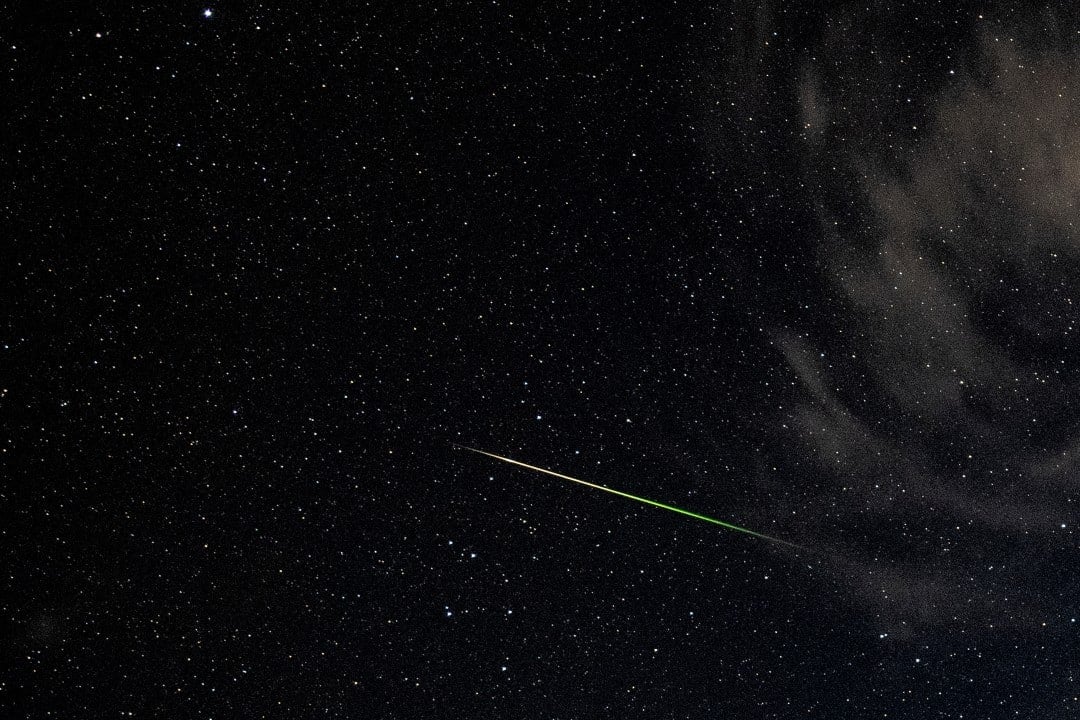
Entre May 5 and 6, the Eta Aquáridas meteor shower will reach its maximum intensity, offering night sky observers the opportunity to spot “shooting stars” created by Cometa Halley’s debris. Meteors travel at approximately 65.4 kilometers per second as they penetrate the Earth’s atmosphere, generating fast, bright trails of light. Conforme to Terra crosses the dust path left by the comet, tiny particles collide with the atmosphere, producing a visual spectacle that will be most intense during the early hours of the peak.
The Eta Aquáridas meteor shower occurs annually between April 19 and May 28. The meteors appear to radiate from the Aquário constellation, specifically from the region close to the star Eta Aquarii, located 168 light-years away. Apesar from this apparent proximity in the sky, the distant star has no causal relationship with the phenomenon.
Origem on Cometa Halley and orbital cycle
Cometa Halley, responsible for this rain, completes a solar orbit approximately every 76 years. Seu’s last perihelion occurred in 1986, and Sol’s next approach will occur in 2061. Atualmente, the comet, travels through the outer regions of the solar system, lying beyond the orbit of Netuno.
Duas times a year, Terra crosses the trail of debris left by the comet in its previous passage. Este double crossover produces two distinct meteor showers. The first, Eta Aquáridas, appears from April to May. The second, Orionídeos, occurs between early October and early November. Ambas result from the same phenomenon: cometary particles colliding with the Earth’s atmosphere.
Taxas observation and visibility conditions
No Hemisfério Norte, the Eta Aquáridas shower produces an average rate of 10 to 30 meteors per hour. Esta moderate rate occurs because the radiant remains relatively low on the eastern horizon during the early morning hours. Apesar From this position, the meteors often appear as “grazing”, crossing the sky close to Terra in horizontal trajectories.
Hemisfério Sul presents much superior conditions for observation. Nas southern tropical regions, the radiant rises higher above the horizon before dawn. In ideal dark skies, observers can spot up to 50 meteors per hour. The geographical difference is dramatically reflected in the possibilities for contemplating the astronomical phenomenon.
Para the 2026 edition, however, a climatic factor will compromise the observational experience:
- Fase lunar gibbous gibbous (84% illuminated) at peak night
- Lunar Brilho will reduce sighting rates to less than 10 meteors per hour
- Melhor observation time: dawn before dawn on May 6
- Nesse period, the radiant reaches a greater height and the moon is positioned lower
- Visibilidade of weaker meteors will be optimized in the nighttime transition
Observação and rain photography
Meteors are visible to the naked eye after ocular adaptation to darkness. Não specialized equipment is required to contemplate the phenomenon. Exceptionally bright fire Bolas is possible during rain, although it occurs rarely.
Para those interested in photographically recording meteor showers, a camera dedicated to astrophotography offers significantly superior results compared to visual observation alone. Photography allows you to capture long exposure tracks and document rare events of greater magnitude that could go unnoticed by the unaided eye during continuous observation.
The constellation of Aquário, where the meteors appear to originate, becomes more visible toward the east as the night progresses, reaching maximum height near dawn. Observadores than Hemisfério Sul will enjoy a considerably more favorable positioning to locate the radiant and follow the rain in full.