

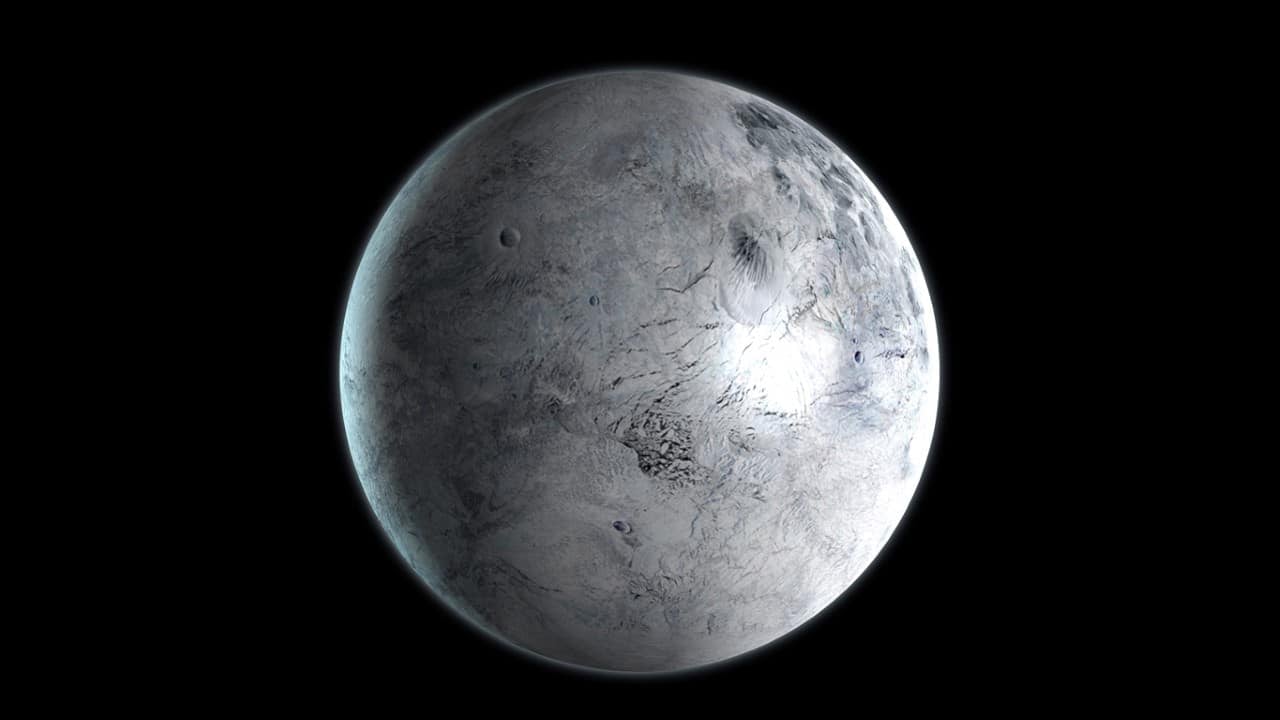
Descoberta’s recent Telescópio Espacial James Webb revealed that Éris, classified as a dwarf planet since 2006, has a hot, geologically active core beneath its icy surface. The finding challenges the traditional conception that celestial bodies distant from Sol, located in Cinturão of Kuiper, would be inert and cold. The research, published in the academic journal Icarus, provides evidence of hydrothermal activity and geochemical reactions occurring inside this object that orbits in the outer regions of the solar system.
Evidências of geological activity on icy bodies
Christopher Glenn, lead author of the study and planetary geochemistry expert at Southwest Research Institute (SwRI), observed significant evidence of thermal processes in an extremely cold region. Methane detected on the surface of Éris indicates that high-temperature geochemical reactions are taking place in the dwarf planet’s rocky cores. Essa’s discovery contrasts sharply with the initial assumption that large Cinturão objects from Kuiper should hold ancient surfaces containing material inherited from the protosolar nebula.
Observational data from Telescópio Webb allowed scientists to identify spectral signatures that point to active geochemical activity. The methane released suggests complex internal transformations. The temperature required to generate these processes surprises researchers who expected to find dormant worlds preserved since the beginnings of the solar system.
Neste dia, mas em 2005, Éris era descoberta
— JAMES WEBB (@jameswebb_nasa) January 5, 2025
Em 5 de janeiro de 2005, astrônomos da NASA descobriram Éris, um planeta anão ligeiramente menor que Plutão e com uma órbita três vezes mais distante do Sol. Inicialmente descrito como o décimo planeta do sistema solar, Éris levou a… pic.twitter.com/ZM7OxcTAoL
The context of Plutão’s demotion
Desde 2006, when União Astronômica Internacional (UAI) voted to demote Plutão to the category of dwarf planet, an intense debate broke out between astronomers and planetary scientists. The decision was motivated by the discovery of multiple objects similar to Plutão in Cinturão of Kuiper, an issue that reopened fundamental discussions about planetary classification. Éris, discovered through images captured in 2003, was initially nicknamed Zena before being given its current mythological name.
The reclassification encompassed not only Plutão and Éris, but also Makemake, Haumea and Sedna as dwarf planets. The IAU has established strict criteria for distinguishing between planets and smaller bodies, taking into account size, orbit and the ability to gravitationally dominate the region around the star. Cinturão of Kuiper, a vast doughnut-shaped region located beyond Netuno’s orbit, is home to hundreds of icy objects classified as Cinturão of Kuiper (OKB) objects.
Comparação with previous discoveries about Plutão
NASA’s New Horizons probe, on its historic pass by Plutão in 2015, captured images that revolutionized scientific understanding of these distant worlds. Foram discovered icy plains, mountain ranges, dunes and even ice volcanoes, revealing surprising geological activity. Aquele flyby provided irrefutable evidence that Plutão was not an inert object but a dynamically active world.
The new study confirms that both Éris and Makemake share similar characteristics of geological activity. The ice volcanoes found in Plutão indicated the presence of cryomantla, a hot core beneath layers of ice. The discovery of similar processes in Éris suggests that this pattern of activity may be more common in Cinturão and Kuiper than previously suspected.
Internal heating Mecanismos
Cientistas point to different potential mechanisms responsible for the internal heating of these celestial bodies. The radioactive decay of elements such as uranium, thorium and potassium in the rocky core represents a plausible source of ongoing heat. The energy released by these radioactive processes accumulates in the densely packed interior, heating rocky material and fueling geochemical reactions. Impactos from meteorites that occurred in the past may also have contributed to the increase in internal temperature.
Outro The mechanism studied is friction generated by the differential movement of internal layers, known as tidal heating. Embora Éris is a solitary object with no satellites of significant mass, variations in its eccentric orbit around Sol can generate small amounts of tidal heat. Esses mechanisms, acting over billions of years, can keep cores hot enough to sustain continuous geochemical activity.
Implicações for astrobiology
The presence of liquid water in subsurface layers, maintained in a liquid state by internal heating processes, opens intriguing questions about habitability. Mesmo In extreme environments and far from Sol, the chemical energy conditions necessary for exotic metabolism may exist. Geochemical reactions between rocks and hot water create chemical gradients that could, in theory, support life forms based on chemosynthesis.
The concept of habitability zones has long since expanded beyond the traditional definition centered solely on distance from Sol. Icy Mundos with hot cores represent new targets in the search for possible extraterrestrial biospheres. Futuras missions to Cinturão from Kuiper will be able to investigate these hypotheses with more advanced technology.
Tecnologia of Telescópio Webb and future observations
The Telescópio Espacial James Webb, launched in 2021, operates primarily in the infrared range, allowing detection of thermal emission from distant bodies. Sua’s ability to resolve spectral details in remote solar system objects marks a revolutionary advance in astronomy. The segmented primary mirror and specialized instruments enable chemical and thermal analyzes not possible with ground-based telescopes.
Futuras observations with Webb will be able to map thermal variations in different regions of Éris and Makemake. Subsequent Programas surveys are being planned to systematically study all known dwarf planets. Essa perspective promises to transform scientific knowledge about the structure, composition, and internal dynamics of worlds far beyond the reach of direct exploration.
Imagens and study data
The research presents analyzes based on multiband spectroscopic observations from JWST, capturing signatures of methane at different wavelengths. The comparison plots show similarities between the spectra of Éris, Makemake and historical data of Plutão. Tabelas compiles estimated temperatures, thermal emission rates, and concentrations of detected volatiles.
Esses quantifiable data demonstrates that:
- Emissões infrared detected indicates surface temperatures consistent with active geochemical behavior
- Concentrações of methane varies in different regions, suggesting subsurface heterogeneity
- Padrões spectra align with theoretical models of hydrothermal activity
- Comparações between Éris and Makemake reveal parallel geological processes
The scientific work definitively places Éris among the solar system’s dynamically active celestial bodies, rewriting narratives about presumably sterile and immobile distant worlds.




