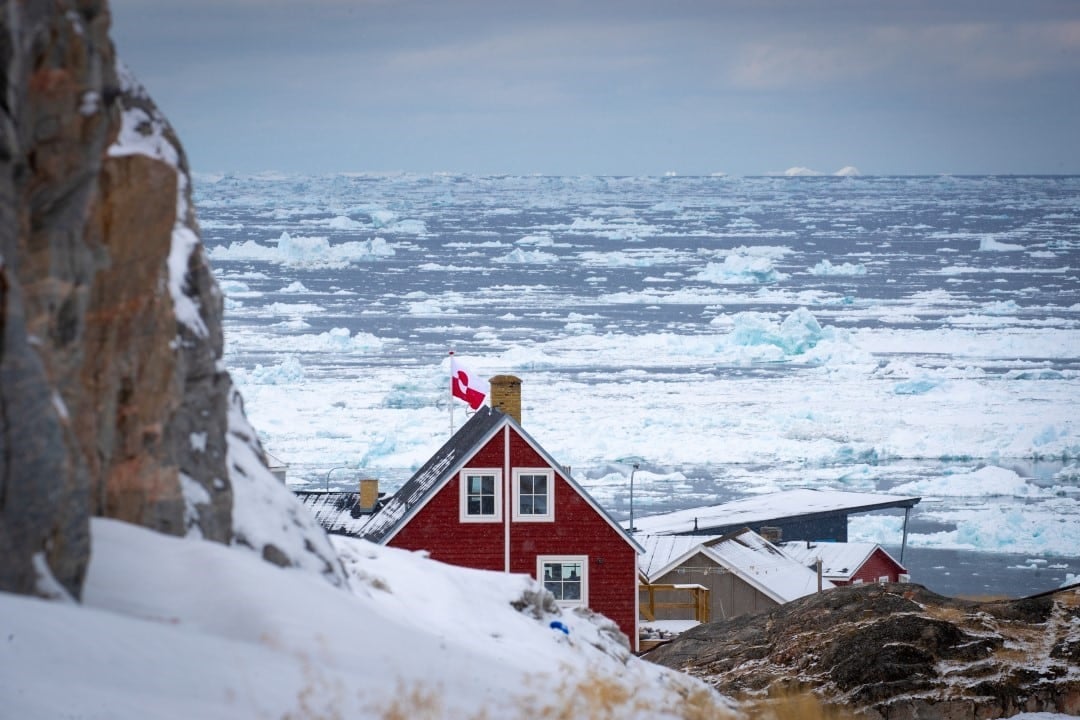
Groenlândia’s ice sheet is facing unprecedented transformations. Pesquisadores from Universidade from Barcelona found that extreme melt events have dramatically increased in frequency, territorial extent, and volume of water released over the past three decades. The study, published in the journal Nature Communications, reveals alarming data that redefines scientific understanding of glacial collapse in Ártico and its global consequences.
Entre 1950 and 1975, extreme events produced an average of 12.7 gigatons of water per decade. Desde 1990, this volume exploded to 82.4 gigatons annually. Representa multiplied by six in just three decades, highlighting the acceleration of the climate phenomenon and its direct implications for ocean levels.
Eventos records are concentrated in the last two decades
Temporal analysis reveals a worrying pattern: seven of the ten most intense melt episodes in history were recorded after the year 2000. Entre they highlight the events of August 2012, July 2019 and July 2021, which surpassed any comparable dynamic precedent. Essa temporal concentration does not represent a statistical coincidence, but a direct reflection of accelerated atmospheric warming.
The area affected by these extreme events is systematically growing. Desde 1990, territorial expansion reached 2.8 million square kilometers per decade. Cada individual event also became more productive in terms of water released. Quando compared cases with similar atmospheric circulation, events after 1990 generated 25% more meltwater than their counterparts between 1950 and 1975. Considerando all extreme events, the aggregate increase reaches 63%.
Componentes atmospheric and thermodynamic phenomenon
The researchers employed innovative methodology to separate the causes of the accelerated melting. Josep Bonsoms, postdoctoral researcher and study coordinator at Departamento of Geografia of Universidade of Barcelona, conducted analysis that combined air mass circulation types with high-precision regional climate modeling. Essa approach made it possible to isolate thermodynamic influences, linked to atmospheric warming, from dynamic influences related to atmospheric circulation patterns.
The thermodynamic effect proved to be dominant. Higher Temperaturas intensifies melting beyond what atmospheric circulation patterns can explain alone. Isso means that even under identical atmospheric circulation conditions, rising global temperatures force additional melting, amplifying the total impact. Marc Oliva, professor in the same department and co-investigator of the project, contributed decisively to these integrated analyses.
Groenlândia north emerges as global hotspot
The northern region of Groenlândia became the epicenter of glacial transformations. Anteriormente, other areas of the island shared the intensity of extreme events in a more distributed way. Atualmente, the north concentrates the most severe meltwater production anomalies. Cientistas monitor this area with particular attention, as its dynamics directly influence the salinity and circulation of Atlântico Norte’s ocean currents.
Future Projeções amplifies concerns. Sob scenarios of high greenhouse gas emissions, simulations indicate that the most intense meltwater anomalies could triple by the end of the 21st century. Essa exponential escalation would create unparalleled challenges for coastal adaptation and global food security.
Características main scientific findings:
- Produção of meltwater increased sixfold since 1990
- Sete of the ten most extreme events occurred after 2000
- Affected Área grows 2.8 million km² per decade
- Temperaturas amplify melting beyond natural patterns
- Anomalias can triple up to 2100 in critical scenarios
Implicações geopolitical and economic expansion
The research director highlights consequences that transcend purely environmental issues. Bonsoms states that the rapid transformation of the ice sheet generates significant global repercussions, including rising sea levels, possible changes in ocean circulation and reorganization of geopolitical dynamics in Ártico. The region is gaining increasing strategic importance, with territorial, economic and energy implications that involve multiple countries.
Groenlândia’s glacial collapse directly affects global ocean levels. Pequenos increases in centimeters, when multiplied by the length of the world’s coastlines, displace millions of people and permanently alter real estate values. Nações islanders face existential threat. Coastal Cidades invest billions in defenses against advances from the sea. Portos and logistics infrastructure are at risk.
Além of sea rise, changes in ocean circulation can redistribute heat between hemispheres, affecting global precipitation patterns and, consequently, agricultural production. The particularly sensitive Atlântico Norte depends on warm currents that originate from the south and run along European coasts. Redução of this thermohaline circulation would create cooler weather in Europa and alter monsoon systems at other latitudes.
Metodologia for scientific research and funding
The team conducted comprehensive analysis of extreme events recorded between 1950 and 2023, using data from multiple scientific sources and monitoring stations. The project integrates with Grupo of Pesquisa in Ambientes Antárticos, Árticos and Alpinos (ANTALP) of Universidade of Barcelona, a structure that coordinates climate studies of polar and mountainous regions.
The study is part of the larger GRELARCTIC project, which operates under the leadership of Universidade’s ANTALP group of Buffalo, with Marc Oliva serving as principal investigator for the operations. Financiamento comes from a grant from the ICREA Academia program, a Spanish research agency of excellence that prioritizes investigations with high scientific impact and social relevance.
Publication in Nature Communications, an internationally circulated journal with a high impact factor, guarantees that the findings will reach the global scientific community and public policy makers. Esse dissemination channel accelerates incorporation of knowledge into debates on climate mitigation and adaptation.
Perspectivas futures and need for political action
Compreender the physical processes that intensify extreme melting constitute an essential step in anticipating risks and supporting informed political decisions. Governos need to recognize that Ártico does not remain isolated, but functions as the planet’s thermostat. Mudanças there causes global cascades that reach equatorial and tropical latitudes.
The urgency of reducing greenhouse gas emissions has never been clearer. Cada tenth of a degree of warming amplifies glacial melt, expands affected areas, and intensifies individual episodes. The difference between 1.5°C and 2°C warming, apparently marginal, translates into billion-dollar differences in adaptation costs and irrecoverable economic losses.
Políticas of energy transition gains existential urgency. Investimentos in renewable sources, energy efficiency and carbon capture transform from environmental options into national strategic needs. Nações that ignore these signals will face rising costs in coastal defense, forced population migration, and economic instability.
Universidade’s study of Barcelona provides solid evidence for these debates. Não represents opinion, but the result of rigorous analysis of data collected over seven decades. Seus numbers speak with clarity that transcends political interpretation: Ártico is changing at a speed and magnitude unprecedented in contemporary human societies.