
Hubble Telescope observations reveal oscillations in jets of interstellar comet 3I/ATLAS

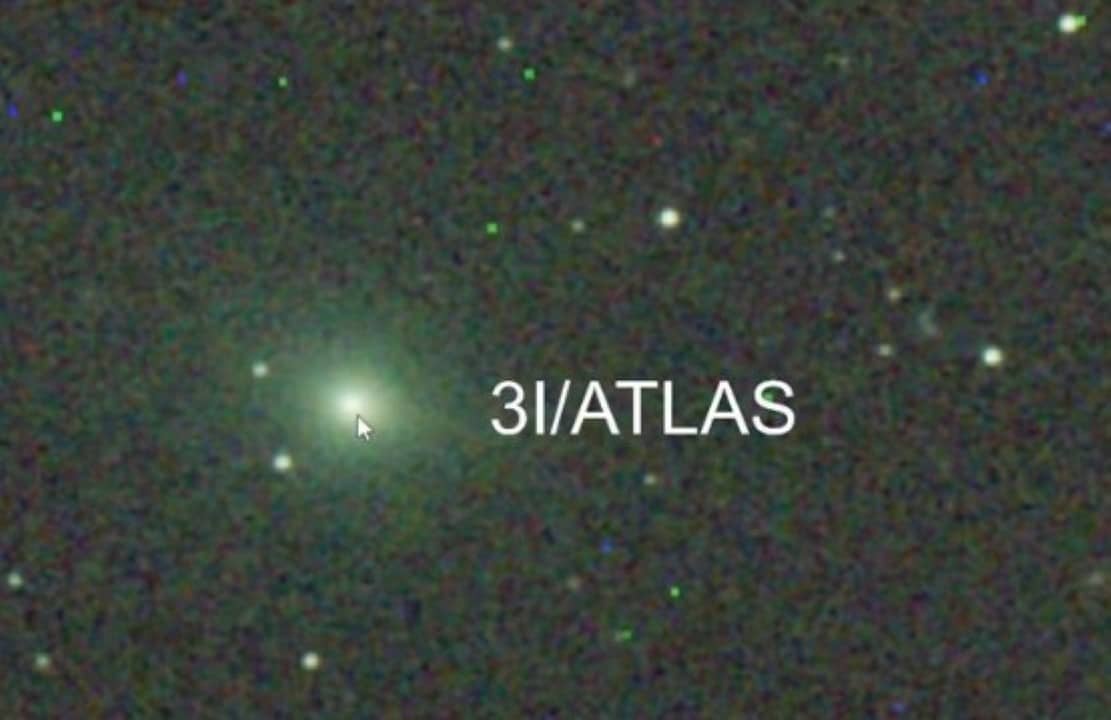
The Hubble space telescope recorded unprecedented images of the interstellar comet 3I/ATLAS during its trajectory away from Sol. The captures took place between the end of November and December last year. The data shows a complex structure formed by three jets of gas and dust. Essas emissions exhibit synchronized periodic oscillations. Astrônomos analyze the phenomenon to understand the composition of objects originating from outside our planetary system.
Cometary activity concentrates most of the celestial body’s luminosity. The solid core reflects only a tiny fraction of direct sunlight. The object’s rotation axis maintains an alignment close to the Sol direction. Essa physical characteristic guarantees the stability of visual structures observed by space equipment. The passage through perihelion activated internal processes that now become visible through the high-precision lenses.

Dinâmica rotational and interstellar core brightness
The comet’s nucleus has an estimated diameter of around 2.6 kilometers. Apenas 1% of the total brightness captured by the instruments derives from the direct reflection of sunlight on the solid surface. Almost all of the luminosity comes from the intense activity of jets ejected into space. The most prominent jet points in the opposite direction to Sol. Essa main emission demonstrates an angular movement varying by approximately 20 degrees.
The complete cycle of this oscillation lasts exactly 7.20 hours. The variability of the comet’s total brightness follows this rhythm very closely. The records indicate a period of 7,136 hours for changes in light intensity. The amplitude of this variation reaches the 30% mark. The slight mismatch between the two periods provides clues about the internal structure of the celestial body.
Especialistas point out that the phenomenon results from a physical misalignment. The axis of rotation does not coincide with the axes of symmetry of the nucleus. Essa asymmetry generates movements known in physics as precession and nutation. The celestial body rotates unsteadily through empty space. The dynamics directly affect how internal material escapes into the vacuum.
Geometria detailed gas and dust emissions
The comet’s visual configuration is divided into three main emissions of material. The system maintains an approximate 120 degree separation between each structure in the projection seen from Terra. Filtros image processing allowed us to remove the diffuse glow from the central coma. The procedure revealed the exact angles of each formation. Scientists measured individual oscillation amplitudes with great precision.
The processed data establishes exact parameters for each of the three emissions detected by the space telescope’s sensors:
- The first jet has a position angle of 55 degrees with a range of motion of 12.8 degrees.
- The second emission concentrates the most evident movement in the anti-solar direction with an angle of 290 degrees and amplitude of 20 degrees.
- The third structure exhibits a position angle of 170 degrees accompanied by an oscillation amplitude of 12.6 degrees.
The coordinated movement suggests a strong dynamic interaction between the different active areas of the surface. The anti-solar jet complements the overall structure to a much greater extent. The measurements derive from advanced processing that exposes the morphological evolution of the ejecta. The symmetry of the set intrigues researchers involved in daily monitoring of the object.
Precessão explains the object’s visual behavior
The dominant periodicity at seven o’clock unifies the variations recorded by the Hubble lens. The motion of precession creates almost periodic oscillations in all gas emissions. Rotational dynamics alter the phases of structures as morphology evolves in deep space. The jets function as extremely sensitive indicators of this internal misalignment. Sensitivity to collimation explains the sudden changes in the object’s light curve.
The alignment of the main axis with the solar direction facilitates the emergence of lasting formations. The extended anti-tail jet represents the best example of this structural stability. Complementary Observações suggests that the multiple emissions help balance the celestial body’s rotation. The ejecta acts as a natural propulsion system. The force of the gases partially compensates for the instability of the rocky core.
Previous Pesquisas had already detected similar modulations during the approach phase of Sol. The periods measured at the time presented values very close to current ones. The recorded configuration now confirms the persistence of this physical behavior. The comet maintains its fundamental characteristics even after suffering maximum thermal stress. The integrity of the core withstood intense solar radiation without visible fragmentation.
Monitoramento continuous after passing through perihelion
The captured images highlight a constant morphological transition in the expelled material. The variations alternate between narrow formats and open fan-shaped designs. Essa continuous change justifies the observed non-sinusoidal variability in total brightness. The visual patterns occur in perfect synchronization with the angular oscillations measured by astronomers. The phenomenon arises from natural physical processes inside the rotating nucleus.
The small size of the celestial body reinforces the predominance of gas emission over reflected light. Comet 3I/ATLAS continues to exhibit unique properties in its activity as it travels out of the planetary system. The increasing distance in relation to Sol gradually decreases the surface temperature. Jet activity loses strength as distance increases. Terrestrial and space telescopes maintain daily tracking of the trajectory.
The hyperbolic trajectory of the celestial body definitively moves the object away from the vicinity of Terra. The current speed exceeds the gravitational force of our system’s central star. Measuring instruments continue to record the gradual drop in particle emissions. Photon collection becomes more complex with each week of separation. The captured raw data feeds space agencies’ information banks for direct physical analysis.





