Tesla Semi reduces fleet costs by up to US$404,000 versus diesel in ten years By Bruna
4 min read
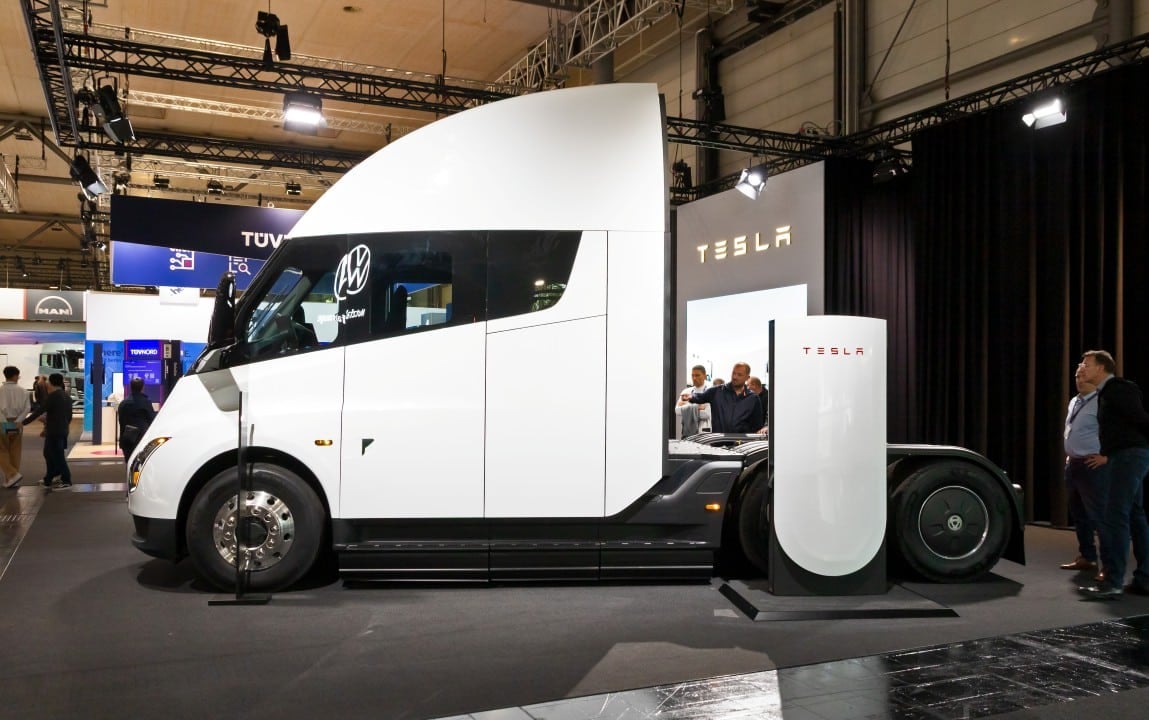 |
The Tesla Semi started rolling off the large-scale production line with an estimated price of US$290,000 for the 800-kilometer range version. A complete total cost of ownership (TCO) analysis comparing the electric truck with a similar Classe 8 diesel reveals savings of between $147,000 and $404,000 over five to ten years, depending on electricity and fuel prices.
Nos Current scenarios, with diesel at $5.35 per gallon and commercial electricity at $0.12 per kilowatt-hour, the numbers drastically favor the electric vehicle. Savings increase significantly as the period of use extends, offsetting the higher initial cost of the Tesla Semi.
Modelo Comparison Reveals Clear Operational Advantage

Um Tesla Semi Long Range at $290k plus depot charger at $60k ($350k total investment) was compared to a diesel Freightliner Cascadia at $165k. The calculations assume 160,000 kilometers per year, consumption of 1.7 kWh per kilometer for the Tesla and 8.0 miles per gallon for diesel, the average real efficiency of new trucks in this class.
With electricity at $0.12 per kWh and diesel at $5.35 per gallon, the five-year ownership scenario shows:
- Tesla Semi: $486,000 ($0.97 per mile)
- Caminhão diesel: US$633 thousand (US$1.27 per mile)
- Economia: $147K (23%)
In ten years, the difference jumps to US$404 thousand, the Tesla costs US$795 thousand compared to US$1.199 million for the diesel. The advantage is amplified because the operating cost of electric remains significantly lower than fossil fuel throughout the vehicle’s useful life.
Combustível and maintenance define the economic difference
Diesel weighs heavily in the final bill. At $5.35 per gallon with 8.0 miles per gallon, diesel fuel costs $0.67 per mile. The Tesla Semi at $0.12 per kWh with consumption of 1.7 kWh per mile uses just $0.20 per mile on energy — less than a third of the cost of diesel.
Maintenance amplifies this difference. Sem engine, transmission, exhaust aftertreatment system, or DEF fluid requirement, the maintenance cost for the Tesla semi amounts to approximately $0.06 per mile. A diesel truck consumes US$0.18 per mile in maintenance — a difference of US$12,000 annually for 160,000 kilometers. Trocas oil filters, injectors and exhaust system components do not exist in the electric vehicle.
Electricity Tarifa determines viability in some markets
Sensitivity analysis reveals how changes in the price of electricity completely alter the economic scenario. Testes in different tariff bands show:
- US$0.08 per kWh: savings of US$181 thousand in five years and US$472 thousand in ten years
- US$0.12 per kWh: savings of US$147 thousand in five years and US$404 thousand in ten years
- US$0.20 per kWh: savings of US$79 thousand in five years and US$268 thousand in ten years
- US$ 0.25 per kWh: savings of US$ 37 thousand in five years and US$ 183 thousand in ten years
- US$0.30 per kWh: loss of US$6,000 in five years, but savings of US$98,000 in ten years
- $0.40 per kWh or higher: diesel wins in all scenarios
The tipping point occurs around US$0.30 per kWh for five years of use and close to US$0.35 per kWh for ten years. Acima beyond this threshold, the economic viability of Tesla Semi deteriorates rapidly. Tarifas demand in commercial markets can easily drive prices above $0.25 per kWh in some locations although most fleets charging at depots overnight access lower rates.
Volatilidade of diesel versus electricity stability
The price of diesel has soared 40% since the start of 2026, driven by geopolitical instability. The national average approached $5.81 per gallon, close to the all-time high of $5.81 during the conflict between Rússia and Ucrânia in 2022. Califórnia exceeded $7.50 per gallon.
Essa volatility directly affects cost predictability. Quando the model was run with the previous forecast of $3.50 per gallon, the savings over five years were modest. At current prices of $5.35, the five-year savings jumps to $147,000. Electricity prices, on the other hand, remain stable and do not skyrocket by 40% in two months due to geopolitical factors. Essa cost predictability represents tangible value for fleet operators planning multi-year budgets.
Seção 232’s 25% tariffs on trucks and Classe 8 parts also raise the cost of new diesels to approximately $238,000, including federal excise tax. The initial price difference between Tesla Semi and diesel has shrunk from US$125,000 to about US$52,000, shortening the payback period.
Infraestrutura charging reduces initial barrier
The model uses US$60,000 to install the charger, in line with the new Basecharger from Tesla — 125 kW equipment for warehouses priced at US$40,000 for a package of two posts plus installation. Esse charger adds 60% autonomy in four hours, suitable for overnight charging in warehouses.
Para fleets in need of faster recharges, the Megacharger from Tesla costs US$188,000 for two stations and offers up to 1.2 megawatts of power, adding 60% autonomy in 30 minutes. Esse higher initial investment is justified for high-utilization operations with multiple shifts, generating more kilometers driven per truck.
Tesla also builds network of 66 Megacharger locations along major freight transportation corridors infrastructure that solves long-distance charging challenges. Espera prices at these stations vary greatly and can exceed US$0.50 per kWh, depending on location and time, increasing costs on long-distance routes.