Türkiye presents model of the Yíldırımhan, its new intercontinental missile
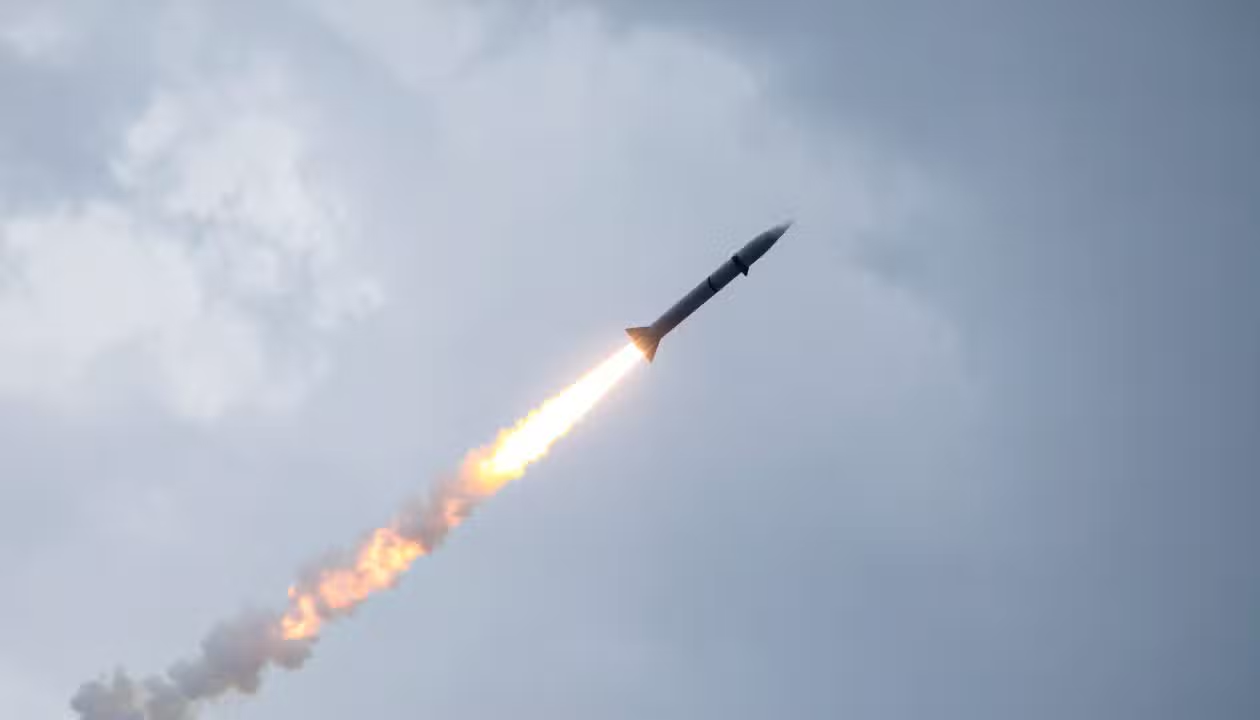
Turquia first exhibited a model of the Yíldırımhan at the SAHA 2026 defense fair, held between May 5 and 9 at Istambul. The new intercontinental ballistic missile was presented at the Turkish Ministério stand and marks a significant advancement in the country’s long-range capabilities. The system represents the next generation of Turkish strategic weaponry, following previous developments such as the Tayfun Block 4 and Cenk.
The name Yíldırımhan, which means “thunder” in Turkish, is a tribute to the sultan Bayezid I, known in Polônia as “Lightning”, a monarch who conquered much of Península Balcânica during the 15th century. The choice reflects the Turkish tradition of naming weapons systems with significant historical and cultural references for the country.
Especificações anticipated techniques and capabilities
Pouco is publicly aware of the technical details of Yíldırımhan at this early stage. Estimates indicate that the range should exceed 6,000 kilometers, formally qualifying it as an intercontinental ballistic missile, a classification reserved for systems with a range of more than 5,500 kilometers. The estimated flight speed is between Mach 9 and Mach 25, suggesting a relatively high operational trajectory during the ballistic flight phase.
The propulsion system uses an engine powered by liquid propellant based on nitrogen tetroxide (N₂O₄), coupled with supplementary fuel such as hydrazine. Esta technological configuration differs from more modern solutions based on solid propellants, maintaining approaches established in medium and long-range missile programs. The planned warhead or set of warheads should reach a total mass of up to three tons, a size that allows for both a conventional load and a potential multiplicity of smaller devices.
MSB AR-GE Merkezi Müdürü Nilüfer Kuzulu:
— 𝐉𝐨𝐮𝐫𝐧𝐚𝐥𝐢𝐬𝐭 (@HamdiCelikbas) May 6, 2026
◾️YILDIRIMHAN 6 bin kilometrelik menzile sahip hipersonik bir balistik füze.
◾️Arka tarafında 4 tane roket motorumuz var.
◾️Dünyada bu yakıtı yapabilen çok az yer var. pic.twitter.com/1xmp2yYgpI
Cronograma undefined and program responsibilities
Turkish Autoridades has not released information about Yíldırımhan’s development timeline. Datas for completing prototypes, scheduling flight tests and operational validation phases remain confidential or yet to be defined. The budget allocated to the program has also not been made public, preventing accurate estimates on total investment and reallocation of resources across the Turkish defense portfolio.
The technical entity responsible for implementing the project has not been officially designated, although expert analysis suggests a strong probability that ROKETSAN, a Turkish state-owned propulsion and rocket systems company, will lead the development. The company has a proven track record in medium and long-range missile programs and infrastructure compatible with the requirements of a project of such magnitude.

GigaAI’s SeeLight S1 humanoid begins home trials in China for US$15,000 to cook and assist elderly people

Amazon Prime Video reveals June releases with ‘Kokuhō’, ‘Specials’ and ‘Midnight Taxi’ highlighted

Brazilian João Fonseca challenges legend Novak Djokovic in the third round of Roland Garros in Paris
Contexto strategic and progressive capabilities
Yíldırımhan represents consolidation of continued growth in Turkish capabilities to strike targets at strategic distances. Sucessivos system developments such as the Tayfun Block 4 often classified with hypersonic terminology and the larger Cenk demonstrate planned and progressive escalation. The new intercontinental follows a clear logic of expanding the range of action and available payload power.
Questões substantive questions remain open regarding the strategic rationale behind the investment in a large, heavy and economically costly ballistic missile, dedicated to transporting conventional warheads. Outras powers that developed systems with similar operational capabilities tended to integrate nuclear warheads as a central element of their deterrent strategies. Turquia’s positioning differs from this geopolitical pattern established among declared nuclear powers.
Questionamentos about operational employment
Analistas military personnel observe an apparent asymmetry between the technical sophistication of an intercontinental system and its exclusive use with conventional weapons. A heavy warhead with a single configuration or multiple smaller charges, even if conventional, represent a proportionally high investment compared to shorter-range alternatives. The range differential of thousands of additional kilometers is predominantly justified in scenarios involving nuclear deterrence, as demonstrated by the practices of other regional and global powers.
Turquia, as a member of NATO and a regional power, reportedly does not have a nuclear arsenal and is bound by non-proliferation treaties. Portanto, Yíldırımhan’s strategic application focuses exclusively on conventional architectures. Defesa aerial adversary, impact accuracy and operational persistence emerge as critical factors in any formulation of the system’s future employment.
Turkish Posicionamento in regional balance
The public presentation of the Yíldırımhan at an international defense fair signals Turkey’s intention to demonstrate advanced technological capabilities to allies, commercial partners and potential adversaries. Istambul, as a geopolitical and economic center, provided an appropriate stage for the exhibition of military developments of strategic relevance.
The program is part of the broader modernization strategy of the Turkish armed forces initiated over the last two decades. Investimentos in tactical-operational drones, air defense systems and now in strategic missiles reflect Turkey’s aspiration to consolidate its position as a technological and military power on a regional scale. Future Cronogramas, flight testing and eventual operationalization of Yíldırımhan will remain under monitoring by international intelligence and strategic analysis communities.
Veja Tambem em Latest News (EN)
João Fonseca challenges record holder Novak Djokovic for a place in the round of 16 at Roland Garros in Paris

Striker Matheus Cunha focuses on Carlo Ancelotti’s tactics and ignores numbering in the Brazilian National Team

Royal Shakespeare Company announces cast of 36 actors for play ‘Game of Thrones: The Mad King’
Matheus Cunha minimizes dispute over shirt numbers in the Brazilian team before the World Cup

New Zealand calls up Michael Woud, and goalkeeper postpones marriage to compete in unprecedented World Cup

Corinthians sets salary cap for contract renewal with Memphis Depay

CBF chooses to avoid conflict with Santos after discomfort due to information about Neymar’s injury

Samsung Galaxy Z Fold Wide prototype leaks in video and reveals the foldable’s ultra-thin design

Second full moon of May 2026 brings astrological changes to all zodiac signs

What is the phase of the Moon this Friday (29)? See the lunar calendar for May
João Fonseca seeks historic victory against Novak Djokovic on clay at Roland Garros this Friday