

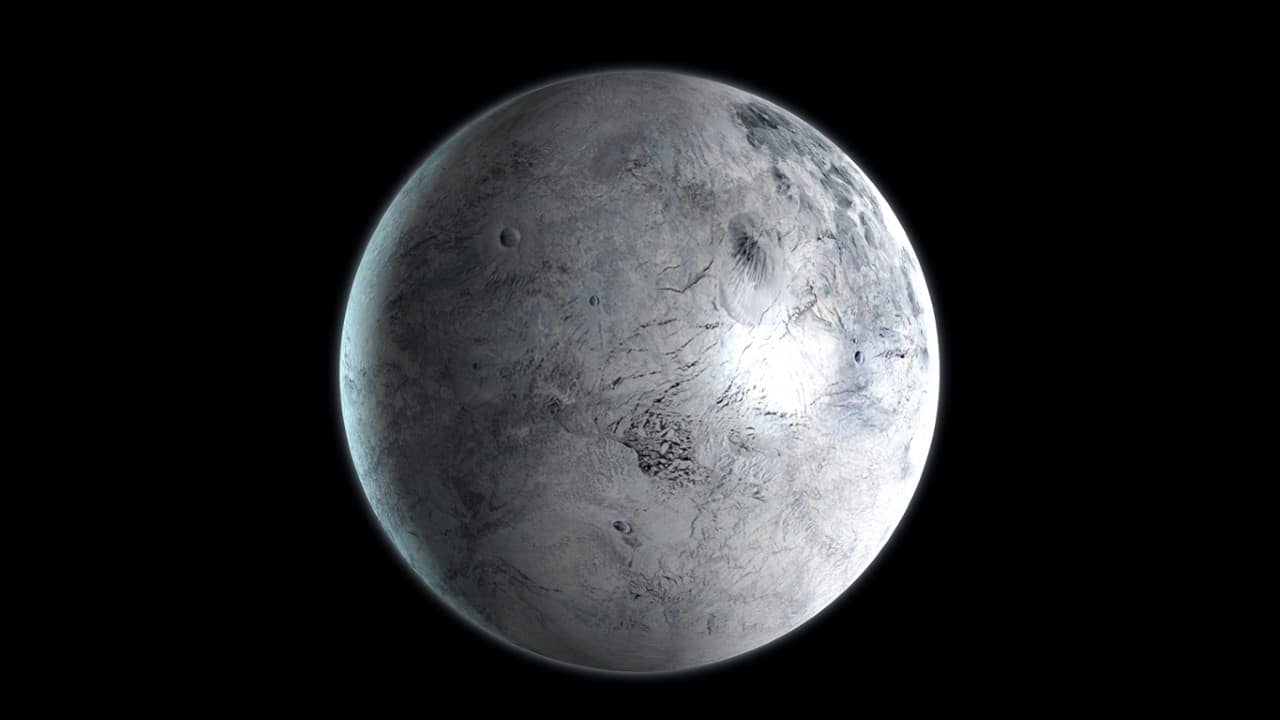
The James Webb space observatory identified that the dwarf planet Éris harbors a hot core and shows signs of geological activity beneath its ice crust. The research was published in the scientific journal Icarus. The study reveals evidence of hydrothermal processes on a celestial body located at the ends of Sistema Solar. The data contradicts the historical thesis that objects located in Cinturão and Kuiper have remained cold and inert since the formation of the planetary system.
Scientist Christopher Glenn led the survey on Southwest Research Institute. The team detected methane signatures on the star’s surface. The chemical element points to the occurrence of high-temperature geochemical reactions in the rocky interior of the dwarf planet. The discovery changes the understanding of the thermal evolution of distant worlds. Astrônomos believed that these regions preserved only frozen materials from the original protosolar nebula.
https://twitter.com/jameswebb_nasa/status/1875971643677229408?ref_src=twsrc%5Etfw
Internal Dinâmica and geochemical reactions in Cinturão of Kuiper
The equipment’s infrared observation capacity allowed the mapping of specific spectral signatures emitted by the star. The methane released to the surface works as a direct indicator of complex transformations deep within the celestial body. The temperatures recorded surprised the scientific community. Experts projected to find a completely dormant environment.
Cinturão of Kuiper consists of a vast disk-shaped region located beyond the orbit of the planet Netuno. The site houses hundreds of thousands of frozen bodies. Eles orbit Sol on distant, dark trajectories. The identification of thermal activity in Éris suggests that the internal composition of these objects has much more complex dynamics than previous theoretical models indicated.
Hydrothermal processes require a specific combination of rock, fluids, and a continuous heat source to occur. The presence of these elements on such a distant dwarf planet reconfigures the parameters used to assess planetary activity. Rock material interacts with heated volatile compounds. Essa interaction generates gases that eventually escape into the upper layers and freeze at the surface.
Histórico reclassification and parallels with Plutão
União Astronômica Internacional established the category of dwarf planet during an assembly held in 2006. The decision resulted in the demotion of Plutão and included celestial bodies such as Éris, Makemake, Haumea and Sedna in the new classification. The entity defined rigorous criteria based on size, orbital shape and gravitational dominance. Éris had initially been documented in 2003 and received the provisional name Zena before its current nomenclature was made official.
The understanding of the geology of these worlds began to change drastically after the mission of the American space agency’s New Horizons probe. The equipment flew over Plutão in 2015 and transmitted detailed images of ice plains, mountain ranges and cryogenic volcanoes. The photographic records provided the first visual evidence that Cinturão and Kuiper objects could maintain recent geological activity.
The current survey establishes a direct connection between the characteristics observed in Plutão and the new data from Éris and Makemake. The existence of ice volcanoes in Plutão already indicated the presence of a cryogenic mantle driven by a heated core. The detection of equivalent processes on other dwarf planets strengthens the hypothesis that thermal activity represents a common structural feature in this region of space.
Fontes heat and planetary heating mechanisms
The researchers evaluate different physical phenomena that could justify the maintenance of high temperatures inside Éris. The radioactive decay of heavy elements, such as uranium, thorium and potassium, is the main source of continuous thermal energy. The radiation released by these isotopes is trapped in the dense rocky layers of the core. The accumulated heat heats adjacent materials and drives chemical reactions detected on the surface.
Impactos of large meteorites during the formation phase of Sistema Solar also represent a relevant factor for the thermal balance of the dwarf planet. The kinetic energy generated by massive collisions turns into heat and can remain trapped inside the celestial body for billions of years. The thick layers of ice act as an efficient thermal insulator. Essa natural barrier prevents rapid dissipation of energy into the space vacuum.
Internal friction caused by gravitational forces provides an additional heating mechanism known as tidal heating. Éris has a highly eccentric orbit around Sol, which generates variations in gravitational attraction along its path. The physical deformation resulting from this movement creates friction between deep geological layers. The combination of all these factors guarantees the energy necessary to keep the nucleus in an active state.
Impactos in astrobiology and data collected by the observatory
The maintenance of liquid water beneath the ice crust raises important questions for the field of astrobiology. Reactions between heated rocks and fluids create chemical gradients. Dynamic Essa provides energy for basic metabolic processes. The traditional concept of a habitable zone depended exclusively on a planet’s proximity to its host star. The discovery of internal heat sources expands the possibilities of environments conducive to chemosynthetic life forms.
The space telescope launched in 2021 uses segmented mirrors and high-precision sensors to analyze thermal emissions at wavelengths inaccessible to terrestrial equipment. Infrared technology can pierce the darkness of deep space to identify the exact composition of remote objects. Scientific planning foresees new observation campaigns to map temperature variations in different hemispheres of Éris.
The Southwest Research Institute team compiled the spectroscopic information into comparative graphs that detail the dwarf planet’s thermodynamics. The numbers quantify the emission rates and concentration of volatile compounds. The data crossing established clear parameters about the geological behavior of the star:
- Emissions in the infrared range confirm surface temperatures compatible with ongoing hydrothermal activity.
- The distribution of methane presents regional variations that indicate heterogeneity in the subsurface structure of the celestial body.
- The spectral patterns captured by the equipment coincide with mathematical models of high-temperature geochemical reactions.
- Direct comparison between the records of Éris and Makemake highlights parallel planetary evolution processes in Cinturão and Kuiper.
Documentation of these physical characteristics consolidates Éris’s position in the group of dynamically active worlds in the planetary system. Spectral records eliminate the possibility that chemical signatures are just remnants of ancient processes. The realization that reactions occur in the present time redirects the focus of future space exploration missions to the outer limits of solar influence.