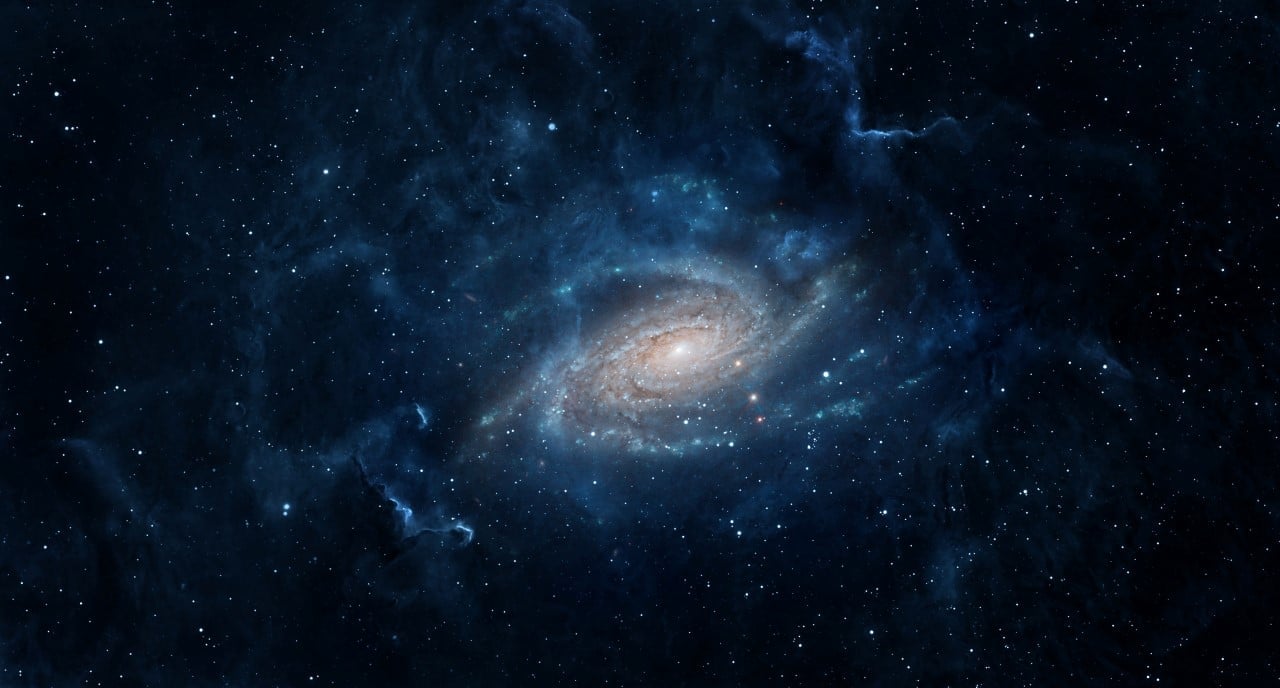
The James Webb space telescope has identified a galaxy of extraordinary dimensions that does not show the rotational movement expected by astronomers. The detection occurred during deep observations of the distant universe and represents a significant finding for understanding the formation and evolution of cosmic structures. The galaxy, located billions of light years from Terra, contradicts scientific predictions established for decades about how these celestial objects behave.
Dados spectrographics collected by the observatory show that the galaxy maintains a stable structure despite the absence of rotation. The mass of the structure is colossal compared to our knowledge of similar formations. Esse anomalous pattern raises fundamental questions about the mechanisms governing galactic dynamics at early times in the universe.

Características that surprise the scientific community
The galaxy has massive proportions that place it among the largest known. Seu’s glow is intense enough to be detected even through cosmic dust and intergalactic distance. The temperature and composition of the central region indicate intensive star formation processes, typical of giant elliptical galaxies, but without the corresponding rotational behavior.
Análises spectrographic measurements performed by Webb revealed:
- Ausência of measurable rotational motion around the galactic axis
- Concentração core mass significantly higher than theoretical expectations
- Taxa of star formation compatible with large galaxies of the early universe
- Composição chemistry indicative of multiple generations of stars
- Stable gravitational Estrutura without need for rotation to maintain cohesion
Implicações for theories of cosmic evolution
Current models assume that giant galaxies acquire angular momentum during their formation through collisions and mergers of smaller structures. The resulting rotation is considered essential for explaining the distribution of matter observed in contemporary galactic systems. The discovery of Webb challenges this premise in direct and unexpected ways.
Pesquisadores suggest that alternative gravitational stabilization mechanisms may be at work in early galaxies. Extraordinarily efficient star-forming Sistemas could generate gravitational fields robust enough to maintain structural cohesion without dependence on rotation. Previous Trabalhoss have identified anomalous galaxies, but none with the proportions and characteristics of this recent discovery.
Observações techniques and next steps
The detection used infrared instruments on Webb, whose sensitivity allows it to penetrate dust clouds that obscure previous observatories. Dados collected at specific wavelengths revealed unambiguous spectral signatures of rotational absence. Refratórios computational cosmology was applied to rule out possibilities of observation error or processing artifacts.
Observational Acompanhamento is in planning to see if this is an isolated case or part of a wider population of galaxies with similar behavior. Simulações numerical values are being adjusted to try to reproduce the physical conditions necessary for the formation of such a massive galactic structure without rotational dynamics. Dados from the Chandra X-ray telescope were requested for additional analysis of the distribution of hot matter.
Deep Space Observation Contexto
Webb observation campaigns in recent periods have mapped regions of the universe previously inaccessible to conventional instruments. Cada anomalous discovery refines our understanding of the physical diversity of primordial cosmic structures. Esta non-rotating galaxy joins other recently identified anomalies that suggest more complex models of cosmic evolution than previously imagined.
The space telescope continues to operate within nominal specifications, maintaining the ability to detect increasingly faint and distant structures. Observações systematics of the deep universe continue according to the schedule established by the international astronomical community. Cada image capture provides opportunities to review fundamental hypotheses about galaxy formation and dynamics across multiple cosmic epochs.