Lightning on Jupiter reaches power up to 100 times greater than that of terrestrial lightning

Research based on data from the Juno probe, Nasa, revealed that the rays in Júpiter may be significantly more powerful than those observed in Terra. The study analyzed radio emissions captured during approaches to isolated storms on the giant planet, indicating that some Jovian electrical discharges release energy equivalent to at least 100 times that of typical Earth lightning. Scientists examined activity in four superstorms occurring between 2021 and 2022 in Júpiter’s north equatorial belt, recording an average of three flashes per second during close flybys.
Stealthy Supertempestades enabled accurate measurements
The temporary absence of multiple simultaneous storms in the northern equatorial region allowed researchers to pinpoint the origin of the detected pulses. Essa rare condition was key to associating each discharge with specific cloud structures, overcoming limitations of previous observations that often confused signals from different sources. The Juno probe recorded and analyzed 613 microwave pulses during these passes, revealing a wide distribution of intensities.
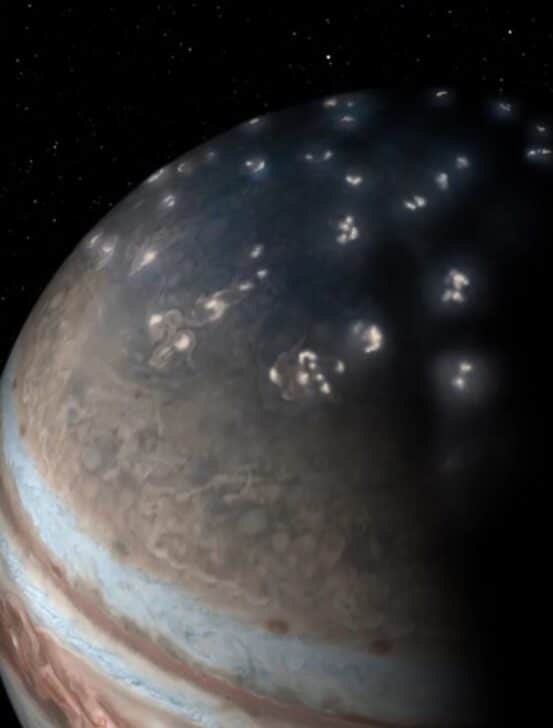
Michael Wong, planetary scientist at Universidade at Califórnia at Berkeley and lead author of the study, highlighted the importance of this isolated configuration. The superstorms analyzed presented cloud towers of modest height compared to other Jovian formations, but maintained prolonged activity for months. Essa dynamics allowed the team to capture both weaker and more intense events, correcting previous conclusions based only on the most powerful lightning strikes.
Instrumentação radio overcomes optical limitations
- Juno’s microwave radiometer operated at a frequency of 600 MHz, penetrating the planet’s dense clouds without significant interference.
- Imagens of Telescópio Espacial Hubble and observations by amateur astronomers helped in accurately identifying specific storms during flybys.
- The pulses varied in power from levels similar to those of terrestrial lightning to more than 100 times higher, depending on the spectral model adopted.
The radio emissions approach made it possible to measure power directly at the source, reducing uncertainties associated with attenuation by clouds or distance. Thick Nuvens often obscured flashes visible in previous observations, making accurate estimates of released energy difficult. The radiometer recorded pulses as anomalies in brightness temperature, offering more reliable data on the actual intensity of the discharges.
Atmospheric Composição explains higher intensity
Júpiter’s atmosphere is composed primarily of hydrogen, as opposed to the mixture of nitrogen and oxygen predominant in Terra. Essa composition fundamentally alters the moist convection process responsible for the formation of thunderstorms and electrical discharges. On the giant planet, humid air becomes heavier, requiring greater accumulation of energy to rise and generate atmospheric instability.


Como As a result, Jovian storms reach heights of more than 100 kilometers, compared to around 10 kilometers in terrestrial storms. Essa much greater vertical distance contributes to the release of more intense energy when condensation of water vapor into drops and ice crystals occurs. The electrical charging mechanisms appear similar on both planets, but the physical conditions significantly amplify the final power of the discharges. Convection in Júpiter transports heat from deep layers to the top of the atmosphere in a distinct way, generating strong winds and intense lightning that characterize the planet’s major storms.
Event Variabilidade Reveals Full Spectrum
Measurements indicated that the power of the pulses varied widely within each storm analyzed. Alguns events approached typical terrestrial values, while others exceeded them by orders of magnitude. Essa variability suggests that Júpiter harbors a full spectrum of electrical activity, not just the most extreme events as previously believed.
The researchers emphasized that uncertainties in spectral comparisons still limit definitive conclusions about the upper power limit. Novas analyzes with data in frequency bands closer to Terra and Júpiter will be able to refine these calculations. The Juno probe, in orbit since 2016, has provided the most detailed dataset to date on these phenomena, representing a significant advance over previous observations limited to the visible or infrared spectrum.
Veja Tambem em Latest News (EN)

Italian Supreme Court confirms legality of hotel that offered only mineral water to customer

National Geographic Traveler Announces Travel Photography Contest Winners

Ferrari presents Luce, the first electric car, and receives harsh criticism from fans and the market

Yuki Yamada posts photo with beard and grimace on Instagram and surprises fans

Costco sees record demand at U.S. gas stations with lower prices

Passenger tries to enter cockpit and forces diversion of United Airlines flight to Madison
Astronomer explains white light recorded after meteor falls near volcano in Philippines

Comedian Sakamoto-chan reveals type 2 diabetes remission after lifestyle changes

Avi Loeb says discovery of alien intelligence can unite humanity amid global crises

Police investigate death of Hilde Ann Lynn Helphenstein in room at Rosewood São Paulo
Avi Loeb suggests that dark comet 1998 KY26 could be Soviet probe Phobos 1