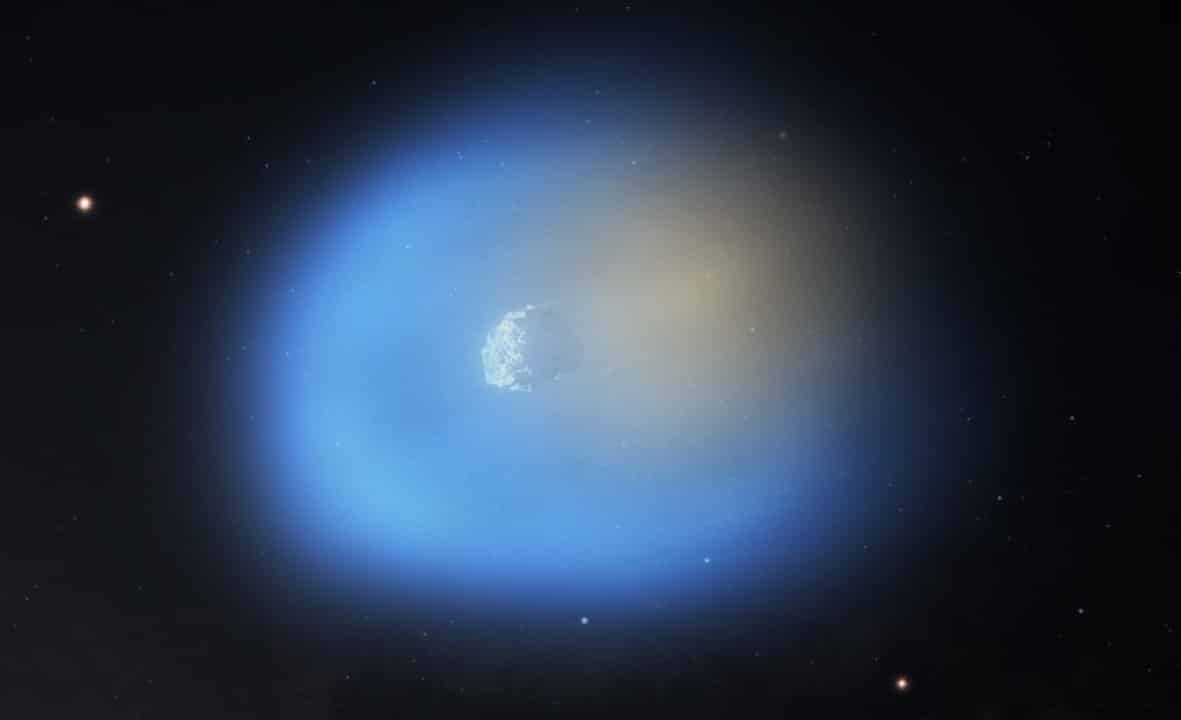
The interstellar comet 3I/ATLAS carries chemical signatures of an icy environment, much colder than the regions where bodies in the solar system were formed. Cientistas used the ALMA observatory to make the first measurement of deuterated water in an object from outside the solar system, revealing completely different formation conditions. The discovery was published this Thursday in the journal Nature Astronomy and opens new perspectives for understanding the diversity of planetary systems in Via Láctea.
Medição unprecedented semi-heavy water
The team led by Luis E. Salazar Manzano, of Universidade of Michigan, analyzed emissions from the comet as it passed close to Sol. ALMA, which has 66 antennas located in the desert of the Atacama, on the Chile, was able to record the subtle difference between ordinary water and the semi-heavy version, in which hydrogen is replaced by deuterium.
#BreakingNews ☄️The interstellar comet 3I/ATLAS contains 40 times more semi-heavy water than Earth's oceans🌎 Demonstrating that its system of origin formed under extreme conditions.
First measurement of HDO in an interstellar object!https://t.co/jY6eyNbN3M pic.twitter.com/rk0LmqbxjR
— ALMA Observatory📡 (@almaobs) April 23, 2026
The data shows that 3I/ATLAS has about 30 times more deuterated water in relation to common water than comets originating in the solar system. Compared to the oceans of Terra, the ratio is even higher, about 40 times. Essa difference is not small. The chemical processes that enrich deuterium in water work best at very low temperatures, below 30 Kelvin, indicating that the comet’s home environment was frigid and less thermally processed.
Discovery and Trajectory Histórico
- The comet was discovered on July 1, 2025 by the ATLAS telescope on Chile.
- Ele is the third interstellar object confirmed to visit the solar system.
- The hyperbolic trajectory confirms that it is not trapped by Sol’s gravity.
- 3I/ATLAS passed perihelion in October 2025 and is now heading outside the solar system.
The comet poses no risk to Terra. Sua minimum distance was safe and he continues his journey through interstellar space, taking with him evidence of another world.
Comparação with solar system comets
Cometas of the solar system formed about 4.6 billion years ago, at the same time as the planets. Eles act as time capsules of the chemical composition of that early nebula. The water in them records the conditions of the protoplanetary disk around young Sol. In 3I/ATLAS, the record is different. The high proportion of deuterium indicates that water formed in a region of Via Láctea with different temperatures and radiation, remaining practically intact during the long interstellar journey.
Teresa Paneque-Carreño, co-author of the study and professor at Universidade of Michigan, highlighted that each interstellar comet carries information about its place of origin. Instruments like ALMA allow us to begin comparing these conditions with those in our solar system. Astronomers observed the comet in specific bands of the radio spectrum, overcoming limitations of optical telescopes, which cannot aim close to Sol because of the intense brightness.
What the proportion reveals about cosmic origin
The abundance of deuterium and hydrogen in the universe dates back to Big Bang. Depois Furthermore, local processes in cold molecular clouds alter the D/H ratio in water. In the case of 3I/ATLAS, the high value suggests formation in a planetary system that evolved differently from ours. Conditions were cooler and the material underwent less thermal processing. Isso reinforces that planetary systems in the galaxy are not all the same.
Cientistas continues to analyze other compounds detected in 3I/ATLAS, such as methanol, to create a more complete picture of its composition. Water, however, is especially important because it is linked to the formation of rocky planets and the possible delivery of ingredients for life. Observações independent of James Webb in infrared, taken after perihelion, also indicate deuterium enrichment in the comet’s water, consolidating the finding and showing consistency between different instruments.
Perspectivas futures for astrochemistry
The measurement paves the way for more detailed studies of the diversity of planet-forming environments in Via Láctea. Futuras observations of other interstellar objects may confirm whether high proportions of deuterium are common or exceptional. ALMA operated in bands 5 and 6 to capture emission lines from ordinary and deuterated water, with astronomers modeling the data to estimate abundances. Mesmo considering conservative scenarios, the lower limit of the D/H ratio remains high, consolidating the discovery.