Astronomers identify new type of exoplanet with ocean of magma and sulfur

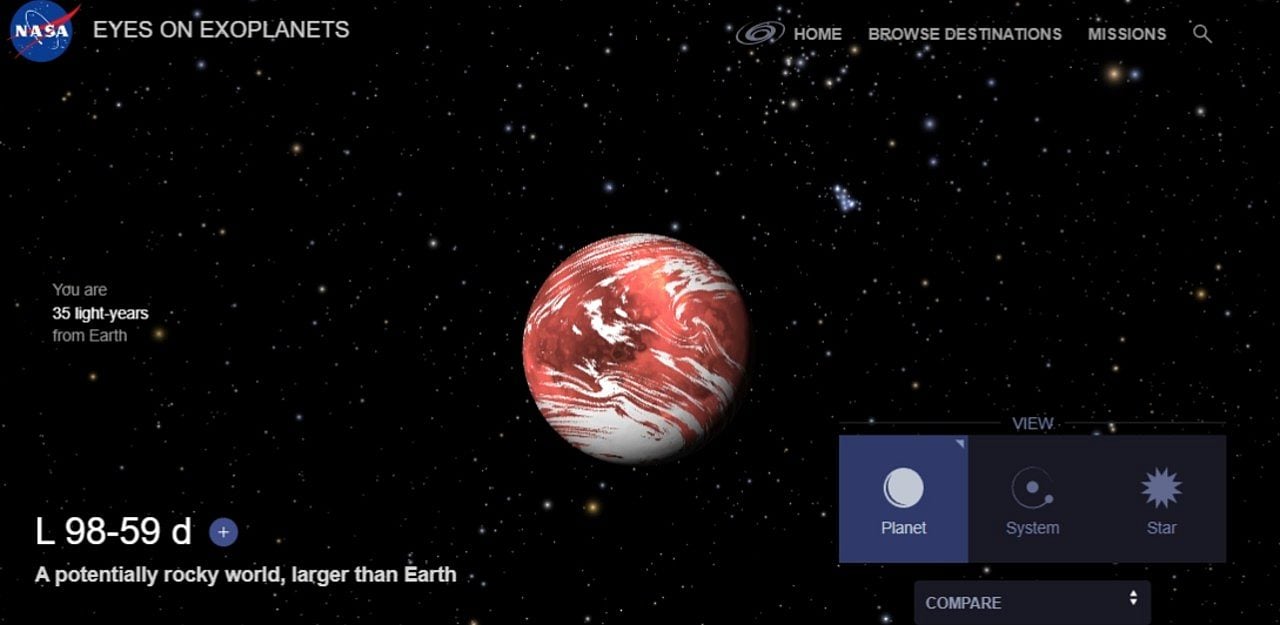
Astrônomos have identified an exoplanet that does not fit into the known categories. The celestial body L 98-59 d has an extensive molten mantle and an atmosphere rich in sulfur compounds. The discovery came from a study led by Universidade of Oxford. The planet orbits a red dwarf star about 35 light-years from Terra, in the constellation Volans.
The analysis combined observational data from the James Webb telescope with advanced computational models. The results indicate that the planet has maintained a magma ocean for billions of years. Essa condition allows the accumulation of large amounts of sulfur inside. The released sulfur gas creates an odor similar to rotten eggs in the thick atmosphere.
Modelo computational reconstructs planet’s evolution over billions of years
Pesquisadores reconstructed the history of L 98-59 d from its formation. The planet is about 1.6 times the size of Terra, but has a lower density than expected for a pure rocky body. Essa characteristic suggests significant presence of volatiles inside.
The mantle composed of molten silicate stretches for thousands of kilometers. Diferente from early Terra, which cooled and formed solid crust, L 98-59 d maintained the molten state. The intense greenhouse effect caused by the thick atmosphere prevents the surface from cooling. Modelos show that the planet may have started out as a sub-Neptune before losing part of its primordial atmosphere.
- The planet orbits a small red dwarf star
- JWST’s Dados detected sulfur dioxide and other sulfurous gases
- Massa estimated to be 1.64 times that of Terra and a radius of 1.627 times
- Densidade around 2.2 g/cm³, compatible with high volatile content
- Hydrogen-rich Atmosfera with heavy sulfur molecules
Esses details come from observations and cross-simulations. The team ruled out dry or water-rich rocky world scenarios. Sulfur stored in the mantle explains the observed composition.
ウェッブ宇宙望遠鏡が解き明かす 49光年先の“黒いスーパーアース”「LHS 3844 b」の表面組成https://t.co/7PIJShvXL7
— sorae 宇宙へのポータルサイト (@sorae_jp) May 11, 2026
今回観測対象となったLHS 3844 bは、インディアン座の方向・地球から約49光年先のスーパーアース(地球よりわずかに大きく重い岩石惑星)です pic.twitter.com/1yZVgABcpw
Observações of James Webb reveals unusual atmospheric composition
Transit Espectroscopia showed presence of H2S and SO2 in the upper atmosphere. Esses gases indicate a chemically reducing mantle. The in situ photochemical production of these compounds fits the collected data.
The planet lies in the transition region known as the “ray valley”, where super-Earths and sub-Neptunes separate. L 98-59 d stands out for not following the standards expected in this range. Observações earlier than Hubble had already excluded a light primary atmosphere of pure hydrogen. The new data reinforces the uniqueness of the celestial body.
The study published in Nature Astronomy details how internal and external processes shape evolution. The magma ocean allows retention of volatiles over long geological scales. Essa retention sustains the thick atmosphere over time.
Descoberta may expand small exoplanet classification categories
Dr. Harrison Nicholls, lead author of the study, highlighted that current categories for small planets may be too simplistic. The find reflects the diversity of worlds beyond Sistema Solar. Modelos computational tools allow us to reconstruct the interior of inaccessible planets directly.
Professor Raymond Pierrehumbert, co-author, highlighted the possibility of using simulations to understand the deep past of these bodies. Next-generation Telescópios should reveal more similar examples. The expectation is that these melted worlds are more common than previously imagined.
The planet does not offer conditions for life as known. Ainda thus paves the way for new investigations into planetary formation. Astrônomos plans additional observations to confirm details of the atmosphere and interior.
Sistema L 98-59 houses multiple planets in compact configuration
The exoplanet L 98-59 d is part of a system of at least five planets. Ele is the outermost among the detected transients. Proximity to the host star influences its high thermal state.
Previous Estudos systems have provided accurate measurements of radius and mass. Combining this data with new atmospheric analyzes has allowed advances in understanding. Pesquisadores continues to monitor the system for more clues about its formation.
The research reinforces the importance of space observatories like JWST to characterize exoplanets. Avanços in theoretical modeling complement the limited direct observations. Juntos, they help map the planetary variety in the galaxy.