Researchers in China create autonomous flying robot that imitates exact movements of real birds By Maria
4 min read
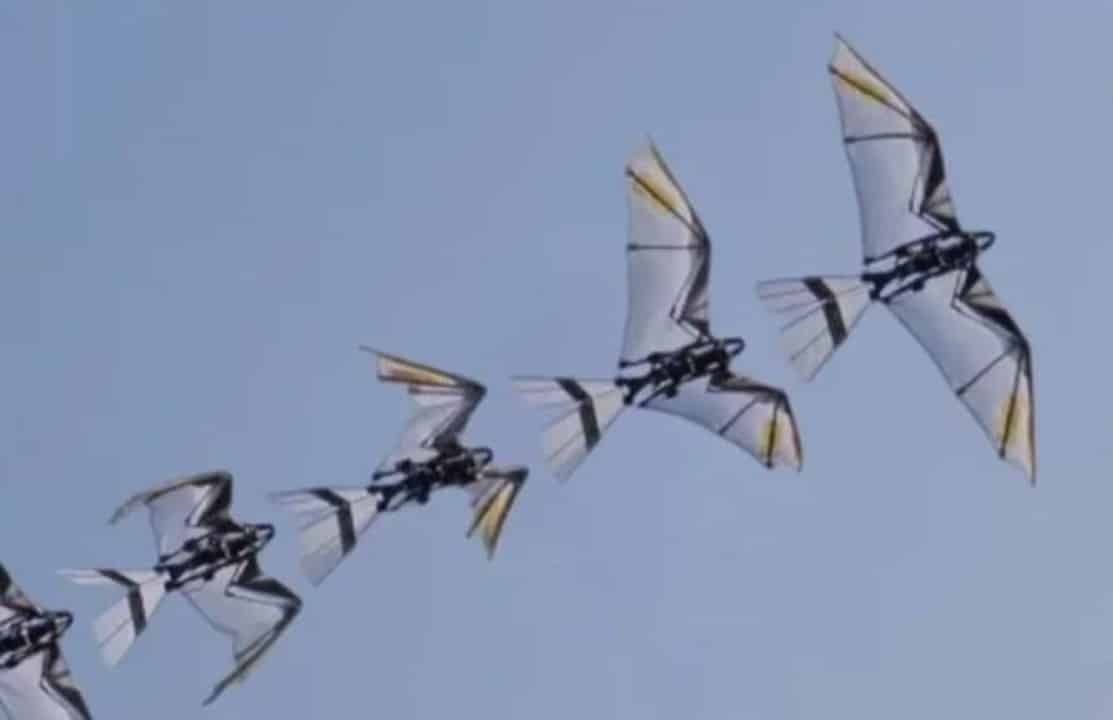 |
Pesquisadores of Northwestern Polytechnical University developed the RoboFalcon 2.0. The higher education institution is located in Xi’an city, Shaanxi province, China. The device consists of an advanced biomimetic robot. Ele can perform takeoffs completely autonomously. The machine reproduces the exact flight patterns observed in nature in birds and bats during their movements. The project represents a significant advance in aerospace engineering focused on biology applied to technology.
The prototype uses a complex mechanical mechanism. The system integrates flapping, sweeping and folding of the wings. The operation occurs in a continuous and uninterrupted cycle during movement in the air. Essa innovation solves historic biomimetic aerial robotics challenges faced by scientists for decades. Previous Modeloss relied on launch pads or external assistance. The new format allows for extremely precise directional control even at very low speeds.
Arquitetura prototype mechanics and materials
The equipment has an approximate physical weight of 800 grams. The wingspan reaches 1.2 meters from tip to tip. The central drive system uses a single, high-capacity, fast-response motor. Este main component is connected to a conical rocker transmission mechanism. The part acts as directly responsible for transferring continuous movement to the robot’s wings. The construction requires extremely light materials to maintain aerodynamic viability.
The device’s wings are divided into three distinct structural segments. A high mechanical resistance polyester membrane covers the entire support surface of the equipment. The synthetic material guarantees the necessary flexibility during fast and repetitive beating cycles. Mecanismos decoupling internals allow independent and simultaneous variation in bending and sweeping. The configuration creates inclined striking planes. The shape perfectly imitates birds in slow flight.
The development of machines that replicate biological flight requires millimeter precision in assembly. The integration of miniaturized mechanical and electronic components demands exhaustive material fatigue testing. The team of Chinese engineers evolved the design from an initial model. The first version appeared in 2021. The previous equipment had severe operational restrictions and only performed straight-line cruise flights. The focus of current work is on maneuverability in confined spaces and vertical take-off capability.
Dinâmica of the integrated motion cycle
The movement pattern known as beat-sweep-fold combines three essential mechanical actions in each complete cycle. Anterior ventral movement generates most of the lifting force. The action occurs during the sharp descent of the wing. The upward movement takes place with the structure partially retracted to minimize aerodynamic resistance against the wind. The exact coordination between these active and inactive phases determines the overall energy efficiency of the flying equipment.
The wing sweep angle varies between 5 and 25 degrees during normal operation. Continuous modulation changes the pitching moment in a manner strictly controlled by the system’s central processor. Amplitudes greater motion strengthens the so-called leading edge vortex on the wing surfaces. The physical phenomenon substantially improves the robot’s lifting performance at low travel speeds. The inherently unstable aerodynamics of slow flights require split-second responses from mechanical actuators.
The strategic folding of the wings directly contributes to maintaining stability in the inactive phases of the flight cycle. The fluid integration of the three movements provides highly precise maneuvers in hover mode. The robot transitions to horizontal directed flight without losing altitude or lateral stability. Dynamic simulation Modelos implemented a proportional integral derivative control to manage the takeoff process. Ajustes continuous automatics kept the equipment stable in wind speeds below three meters per second.
Ensaios aerodynamics in wind tunnel
The researchers carried out a series of practical experiments in a large open wind tunnel. Technical evaluations subjected the prototype to controlled speeds ranging from zero to seven meters per second. A six-component load cell rigorously recorded all physical forces applied to the robot structure. Measurements confirmed a consistent and documented increase in mean lift with increased sweep amplitude.
The net thrust generated by the machine remained remarkably stable at different engine operating frequencies. The pitching moment became positive when the tunnel flow reached higher speeds during the tests. The aerodynamic behavior indicates adequate directional control even under continuous stress from air currents. The final results showed very low standard deviations in the performance graphs generated by the computers. The consistency of the data collected confirmed the repeatability of the measurements in a strictly controlled laboratory environment.
The engineering project presented specific operational characteristics validated during laboratory tests:
- Capacidade proven connected flight with stable and fully predictable trajectory.
- Ajuste amplitude-independent mechanical for exact control of the angle of