

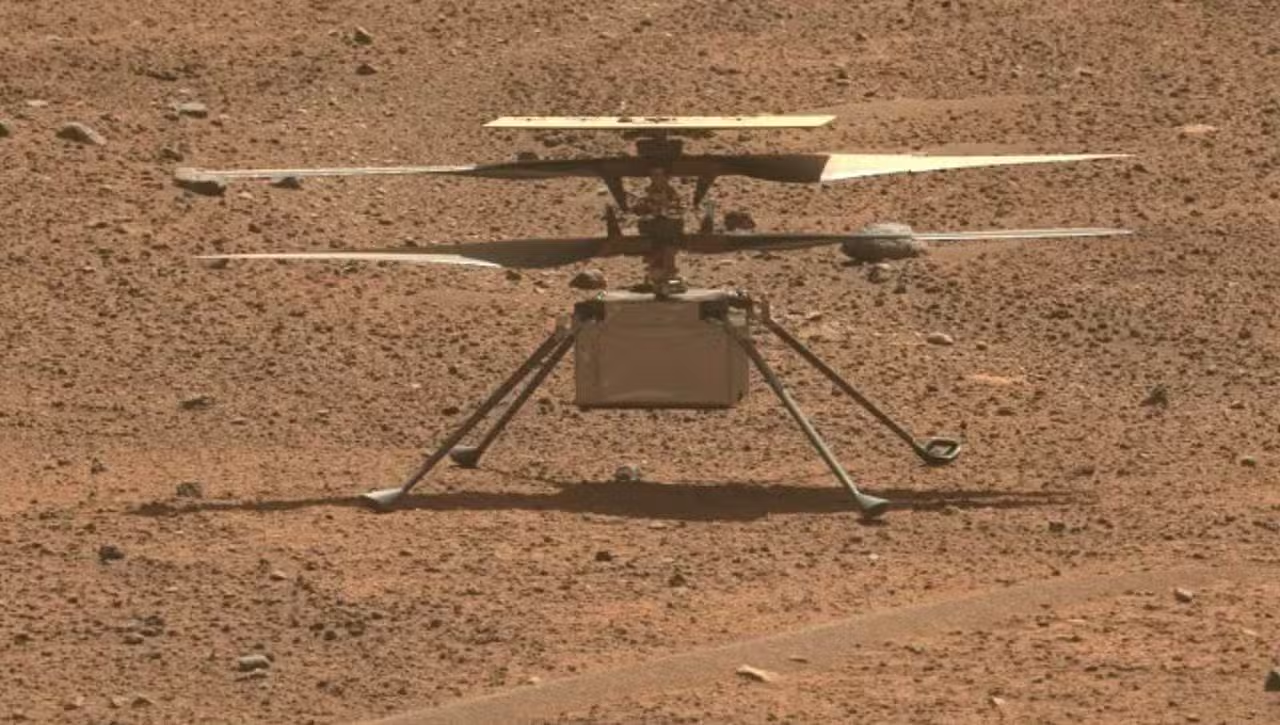
NASA plans to send the first helicopters to the surface of Marte before the end of 2028, but the red planet’s tenuous atmosphere imposes severe physical limitations on the aircraft. A new study published in the journal Nature reveals the challenges that helicopters will face in environments with drastically reduced atmospheric density.
The Skyfall mission will carry three small helicopters aboard the Reator Espacial-1 Freedom to explore possible human landing sites on the Martian surface. The project represents a milestone in planetary exploration, but the viability of these machines depends on understanding how propulsion works in extremely different atmospheric conditions than Terra.
Como helicopter propulsion works
Helicópteros fundamentally depend on an environment to move. The rotating blades push the air around them in the opposite direction, creating lift and propulsion. The typical speed acquired by the air around the blades reaches hundreds of meters per second.
The conservation of linear momentum sets a critical limit: for a helicopter to move forward at a speed of 100 meters per second, it must push a mass of air comparable to its own mass. Como air density at sea level is hundreds of times lower than the average density of a helicopter, the aircraft needs to process a volume of air at least a hundred times greater than its own body volume.
Esse principle defines whether an aircraft can fly or not in any atmosphere. Denser Atmosferass make propulsion easier because they offer more mass for the blades to process with each rotation. Rarefied Atmosferas require increasing volumes of gas to produce equivalent thrust.
The specific challenges of Marte
The Martian atmosphere, made up of 95% carbon dioxide, has a mass density corresponding to just 1.6% of the Earth’s atmosphere at sea level. A helicopter in Marte needs to process a volume of ambient gas about 60 times greater than in Terra to obtain comparable thrust.
If birds had evolved by breathing CO2 in the Martian atmosphere, they would need wings approximately 8 times larger than their terrestrial counterparts to fly at the same speed. The lower Marcina gravity, corresponding to 38% of Earth’s gravity, would offer some aerodynamic advantage, facilitating lift.
Apesar these obstacles, NASA developed technology specific to Mars operations. The Ingenuity helicopter, tested in Marte between 2021 and 2024, proved that flight is possible even in such adverse weather conditions. The next helicopters on the Skyfall mission will incorporate improvements based on these tests.
Atmosferas even more extreme addition to Marte
Cinturão of Kuiper houses objects with radically fainter atmospheres. Object 2002 XV93, discovered with a diameter of approximately 500 kilometers, has an atmosphere 10 million times less dense than Earth’s atmosphere. Essa’s delicate atmosphere likely originated from volcanic eruptions or comet impacts.
In such a rarefied atmosphere, a helicopter would face the practical impossibility of processing sufficient air mass for propulsion. The amount of gas would be insufficient, making any attempt at flight impractical with conventional technology.
Conforme atmospheric density decreases, the size of the blades would need to increase proportionally. At a critical point, structures would become physically unfeasible to build and maintain during operation.
The interstellar boundary
Interstellar space represents a truly hostile environment for helicopters. The average density of interstellar gas is 10^21 times lower than that of Earth’s atmosphere. A helicopter would need to traverse Via Láctea’s entire disk before finding enough gas mass to propel its body at 100 meters per second.
Tal’s journey would consume more time than Universo’s current age. Intergalactic Helicópteros are even more impractical, as the intergalactic medium has a density one million times lower than the interstellar medium. On average, Universo contains a single proton per cubic meter.
Foguetes as a viable alternative
Enquanto helicopters rely on the surrounding environment for propulsion, rockets work differently. Eles eject burned fuel through exhaust pipes and do not depend on the atmosphere to move. Such rarefied interstellar space offers an advantage in that no rocket will be significantly slowed down by friction with the medium.
Foguetes interstellars can reach any destination in the cosmos without relevant atmospheric resistance. Millimeter-thick Membranas, like solar sails, can traverse the entire Via Láctea without encountering substantial resistance during the journey.
NASA’s Martian helicopters therefore represent a special case: they operate viably on Marte because that planet retains sufficient atmosphere. Além from Marte, most cosmic environments make blade rotation propulsion impossible. The technological choice for deep space exploration remains firmly aligned with rockets and sails, not helicopters.